
eDiscoveryDaily

Court Denies Defendant’s Motion to Overrule Plaintiff’s Objections to Discovery Requests

Defendant Sanctioned for Spoliation of Physical Evidence, But Not ESI: eDiscovery Case Law

In Reed v. Kindercare Learning Centers et. al., No. 15-5634 (W.D. Wash., Nov. 17, 2016), Washington District Judge Benjamin H. Settle (yes, that’s his real name!) granted the plaintiff’s motion for discovery sanctions with respect to spoliation of physical evidence in the form of the facility where the plaintiff worked, but denied the plaintiff’s motion with regard to spoliation of ESI.

Case Background

In this disability discrimination case, the plaintiff had previously filed a Motion to Compel production of documents, which had been granted by the court (with certain limitations). After the defendants did not comply with the order, the plaintiff filed a motion for sanctions as well as a motion to compel entry upon land to inspect the facility where the plaintiff worked.  The plaintiff argued that, after she served the defendants with a notice of entry upon land to inspect the center where the plaintiff had worked, the defendants closed the center without notice and informed the plaintiff that the center had closed and that an inspection would not be possible, eventually informing the plaintiff that the fixtures/furniture were removed from the center and an inspection would not be possible, offering another center with a similar layout as an alternative.

The plaintiff also argued that Defendants “(a) failed to secure relevant email accounts prior to destruction; (b) searched for email and other records for the first time in response to this motion; and (c) possess dozens of relevant documents that were never produced or listed on a privilege log.”

The defendants filed a response to the motion for sanctions and also filed a motion for clarification or reconsideration of the granted motion to compel.

Judge’s Ruling

With regard to the request for the Court to clarify or reconsider its order based on the scope of the production and the deadline for production, Judge Settle, in denying the request, stated that “Defendants do not show a manifest error of law and, at most, submit new evidence that could have been brought to the Court’s attention earlier. Defendants previously argued, without support, that the requested production would not be proportional to the needs of the case. The Court dismissed this argument because it declined to evaluate proportionality in the absence of actual evidence. Thus, the fact that production may be disproportionate to the needs of the case is not an issue the Court will reconsider.”

With regard to the request for sanctions regarding spoliation of physical evidence (i.e., the center where the plaintiff had worked), Judge Settle stated “These facts show that Defendants have acted in at least a grossly negligent, irresponsible and cavalier manner with regard to the Notice of Entry upon the Lakewood center. Accordingly, the Court finds that an adverse instruction may be appropriate. The language of any instruction will be determined after Reed collects evidence from KinderCare’s other centers because, at this time, the Court is unable to properly weigh the prejudice Reed has suffered.”  Judge Settle also granted the plaintiff’s motion to inspect two other defendant locations, rejecting the defendant’s objection that the motion was untimely.

With regard to the request for sanctions for spoliation of ESI, Judge Settle stated that “[w]hile Defendants could have implemented better retention policies and more actively searched for electronically stored information, Reed has failed to show that Defendants have spoiled any evidence. In fact, Defendants have recently discovered and produced a relevant employee file.”

So, what do you think?  Was the Court’s argument for denying the ESI spoliation claim sufficient?  Please share any comments you might have or if you’d like to know more about a particular topic.

Disclaimer: The views represented herein are exclusively the views of the author, and do not necessarily represent the views held by CloudNine. eDiscovery Daily is made available by CloudNine solely for educational purposes to provide general information about general eDiscovery principles and not to provide specific legal advice applicable to any particular circumstance. eDiscovery Daily should not be used as a substitute for competent legal advice from a lawyer you have retained and who has agreed to represent you.


The Importance of Early Data Assessment: eDiscovery Best Practices

Why do we have a picture of Santa Claus for an eDiscovery blog post about early data assessment?  Read on.

In the Fall 2016 eDiscovery Business Confidence Survey conducted last month, over a third of all respondents cited Increasing Volumes of Data as expected to be most impactful to the business of eDiscovery over the next six months.  With more and more data to manage, understanding what you have in that data as early as possible has become more important than ever as you attempt to plan the budget for your upcoming discovery efforts.

Knowing how much data you have in gigabytes (GB) or terabytes (TB) that may be subject to litigation isn’t enough to accurately estimate the number of files you have.  As we’ve discussed before, the number of files in each gigabyte can vary widely.

Why is that important?  The more files you have, the more files you potentially have to review.  With review costs estimated to be between 70-80 percent of all eDiscovery costs, a lot more files to review can drive up eDiscovery costs significantly.  Wouldn’t it be better to know early in the case how many files you have?

That’s where early data assessment comes in.  The ability to assess your data early enables you to better estimate your eDiscovery costs, so that you can decide whether to settle or litigate and also so that you can plan resources if you do decide to litigate.

In addition to determining the number of files that you have, it’s also beneficial to determine the expanded size of your collection after processing (so that you can estimate costs for storing or hosting that collection) to determine how many different types of files you have and how many files and data volume is comprised by each file type.  Also, whether any of the files are exception files, such as corrupt or password protected files.  Those files can take a lot of time to address, adding costs to the eDiscovery process.

Want more?  It’s also important to determine how many emails and attachments you have, how many domains those emails represent and also how many email conversations are encompassed with those emails.  And, the timelines for your email collection, so you can identify potential gaps in your collection.

Early data assessment can provide all of that information to you at the outset of litigation.

Here’s the best news: it doesn’t have to cost anything to perform that early data assessment.  CloudNine is offering free early data assessment reporting to provide your organization with valuable information to help shape its litigation strategy.  Consider it an early holiday present this season!  You’re welcome, and happy holidays!

I told you to read on, right?  :o)

So, what do you think?  Do you perform assessment of your data early in the litigation life cycle?  Please share any comments you might have or if you’d like to know more about a particular topic.

Disclaimer: The views represented herein are exclusively the views of the author, and do not necessarily represent the views held by CloudNine. eDiscovery Daily is made available by CloudNine solely for educational purposes to provide general information about general eDiscovery principles and not to provide specific legal advice applicable to any particular circumstance. eDiscovery Daily should not be used as a substitute for competent legal advice from a lawyer you have retained and who has agreed to represent you.
Court Denies Defendant’s Motion to Overrule Plaintiff’s Objections to Discovery Requests

Court Orders Defendant to Produce Additional ESI Responsive to 78 “Unopposed” Search Terms: eDiscovery Case Law

In Venturdyne, Ltd. d/b/a Scientific Dust Collectors v. Carbonyx, Inc., d/b/a Carbonyx Carbon Technologies, et. al., No. 14-00351 (N.D. Ind., Nov. 15, 2016), Indiana District Judge John E. Martin ordered the defendant to produce additional ESI to the plaintiff to be retrieved via 78 “unopposed” search terms that neither party objected to during negotiation over the plaintiff’s original list of 126 search terms.

Case Background

In this breach of contract case, the parties agreed to use keywords to search the defendant’s electronically stored information (ESI) and the defendant turned over sample emails related to the case to help determine what keywords would be appropriate.  On February 25, 2016, the plaintiff’s counsel sent the defendant’s counsel a list of 126 keywords to use for retrieving ESI.  On March 10, the defendant’s counsel sent an email to the plaintiff striking 20 search terms from the list and, on April 28, the plaintiff’s counsel responded by voluntarily removing 28 additional terms, leaving 78 terms and also objecting to 7 of the 20 terms deleted by the defendant.  In all, neither party objected to 78 of the original 126 search terms during this negotiation.

The plaintiff’s counsel sent the defendant’s counsel follow-up emails on May 6, May 24, June 3, June 13, and June 30 and the defendant’s counsel did not respond to any of those emails, causing the plaintiff to file a Motion to Compel on July 12.

Judge’s Ruling

While noting that “Carbonyx contends that it has produced ‘more than 12,000 pages of documents, consisting of emails and their attachments, as well as paper documents’”, Judge Martin also noted that “these documents were generated using the search terms ‘Scientific Dust Collectors’ – the name Venturdyne does business under – and ‘Scientific.’” (those terms happen to be redundant, by the way, as the second term would would include the results of the first term – just sayin’)  But, he also noted that “Carbonyx’s assertion that the documents it has already produced…are completely responsive is not convincing.”

As a result, Judge Martin stated:

“Accordingly, Carbonyx must produce documents flagged by the 78 unopposed search terms contained in DE 48-7. Those terms appear ‘reasonably calculated to lead to discovery of admissible evidence’ in that the terms were based on sample emails related to this case and the parties already eliminated many generic words like ‘money.’”

Judge Martin also noted that “the court must, after giving an opportunity to be heard, require the party . . . whose conduct necessitated the motion, the party or attorney advising that conduct, or both to pay the movant’s reasonable expenses incurred in making the motion, including attorney’s fees.”  So, he ordered the plaintiff to file an itemization of its costs and fees, including attorney’s fees, incurred in making the Motion to Compel by November 21, with the defendant to file a response by December 5 and the plaintiff to file a reply to that by December 12.

So, what do you think?  Would the ruling have turned out differently if the defendant had continued to work with the plaintiff?  Please share any comments you might have or if you’d like to know more about a particular topic.

Disclaimer: The views represented herein are exclusively the views of the author, and do not necessarily represent the views held by CloudNine. eDiscovery Daily is made available by CloudNine solely for educational purposes to provide general information about general eDiscovery principles and not to provide specific legal advice applicable to any particular circumstance. eDiscovery Daily should not be used as a substitute for competent legal advice from a lawyer you have retained and who has agreed to represent you.
Supreme Court Gives Samsung an Early Christmas Present – For Now: eDiscovery Case Law

We almost made it the entire year without an update on the ubiquitous Apple v. Samsung case.  Thanks to the U.S. Supreme Court, this long lasting case isn’t done yet.

As reported earlier this week by Greg Stohr of Bloomberg Law (Supreme Court Orders New Look at Apple’s Award From Samsung), the Supreme Court, in a unanimous opinion (8-0) told a federal appeals court to take another look at a $399 million award won by Apple from Samsung for copying the design of the iPhone.

Writing for the court, Justice Sonia Sotomayor said Apple might not be entitled to Samsung’s entire profit on 11 infringing smartphones. She told a federal appeals court to consider whether Apple should be able to recoup profits attributable only to particular components, a question which SCOTUS did not address.  Sotomayor said the lower court’s approach “cannot be squared with the text” of the federal patent statute. Design patents, which cover the ornamental look of an object rather than any functional aspect, are increasingly used by tech companies and makers of consumer products to differentiate their products from competitors. Believe it or not, SCOTUS hadn’t considered design patents since disputes involving spoon handles in the 1870s and carpets in the 1890s.  Technology has advanced a bit since then.

Google, Facebook Inc., EBay Inc. and Hewlett Packard Enterprise Co. said in filings that a victory for Apple would allow owners of design patents to extract unfair rewards on products that can have hundreds or even thousands of features.

We’ve covered Apple v. Samsung several times over the years, from our first post covering an adverse inference sanction that Samsung received in 2011 for failing to turn off “auto-delete” of emails after the case began to “patentgate” and the resulting $2 million sanction for an inadvertent disclosure made by Samsung’s outside counsel firm to our most recent post last year where we reported yet another stay that Samsung received in having to pay damages.  This case has it all: two tech titans going at it for 5+ years (so far) and eDiscovery failures as well.  Gotta love it.

In a year where it had to scrap production of its Note 7 device because of exploding batteries (a new report just released by a manufacturing tech company claims the design of the battery was too “aggressive”), Samsung does at least get some good news before the end of the year.  At least for now.

So, what do you think?  Will this case ever end?  Please share any comments you might have or if you’d like to know more about a particular topic.

Disclaimer: The views represented herein are exclusively the views of the author, and do not necessarily represent the views held by CloudNine. eDiscovery Daily is made available by CloudNine solely for educational purposes to provide general information about general eDiscovery principles and not to provide specific legal advice applicable to any particular circumstance. eDiscovery Daily should not be used as a substitute for competent legal advice from a lawyer you have retained and who has agreed to represent you.
Court Denies Defendant’s Motion to Overrule Plaintiff’s Objections to Discovery Requests

Finding Categorical Privilege Log to Be Inadequate, Court Orders Plaintiff to Provide a Metadata Log: eDiscovery Case Law

In Companion Property and Casualty Insurance Company v. U.S. Bank N.A., No. 15-01300 (D. S.C., Nov. 3, 2016), South Carolina District Judge J. Michelle Childs determined that the plaintiff’s categorical Privilege Log was inadequate and ordered the plaintiff to provide to the defendant a metadata log for all documents withheld or redacted, affidavit(s) from the person(s) with knowledge regarding the privileged third party and common interest parties and a list of anticipated litigation(s) for the documents withheld on the basis of work product protection.

Case Background

In this case where the plaintiff alleged breach of contract and breach of fiduciary duty over the substantial decrease in value of trusts associated with use of the plaintiff’s insurance program, the defendant initially moved for an order compelling the plaintiff to produce a more-detailed “document-specific privilege log of redacted and withheld documents” which pre-date February 14, 2014 and also requested that “with respect to any work product claims,” the plaintiff should provide information regarding “what litigation it anticipated, when the litigation was anticipated, the facts that caused . . . [Plaintiff] to anticipate the litigation, and how that anticipation drove the creation of the withheld document.”

In responding, the plaintiff argued it submitted a categorical privilege log, which the parties “expressly” agreed was acceptable and that the parties had agreed that privilege logs did not need to identify redacted documents in which the asserted privilege was evident on the face of the document.  The defendant then changed the requested relief in its Motion to Compel to request a metadata log of each withheld document, including dates of communications, date created, document custodian, to/from/cc information, and subject lines for emails and certain specific communications from a key third party.  The plaintiff agreed to produce the metadata log, but was adamant that all communications with a key third party were protected by the attorney-client privilege.  The defendant accepted that proposal in part, but asked the court to require production of the agreed-upon information earlier than the plaintiff proposed, review certain communications from the key third party to determine if privilege had been properly withheld and require the plaintiff to attach to the list of anticipated litigations “an affidavit stating the point in time it anticipated such litigation, the facts that caused it to anticipate such litigation and describe the categories and types of documents that were created in anticipation of such litigation”.

Judge’s Ruling

Judge Childs noted that “To comply with the requirements set forth in Rule 26(b)(5)(A), a party seeking protection from producing documents must produce a privilege log that ‘identifies each document withheld, information regarding the nature of the privilege/protection claimed, the name of the person making/receiving the communication, the date and place of the communication, and the document’s general subject matter.’”  With that in mind, Judge Childs ruled:

“Upon review of the Categorical Privilege Log in the context of Defendant’s complaints, the court finds that Plaintiff’s log does not allow Defendant or the court to test the applicability of the attorney-client privilege and/or work product protection as to each document sought to be withheld. Accordingly, the court concludes that Plaintiff’s Categorical Privilege Log is inadequate.”

As a result, Judge Childs ordered the plaintiff to provide to the defendant on or before November 18, a metadata log for all documents withheld or redacted dated before February 14, 2014, affidavit(s) from the person(s) with knowledge regarding the privileged third party and common interest parties and a list of anticipated litigation(s) for the documents withheld on the basis of work product protection dated before February 14, 2014.

So, what do you think?  Are categorical privilege logs generally sufficient enough to communicate to parties what it being withheld and why?  Please share any comments you might have or if you’d like to know more about a particular topic.

Disclaimer: The views represented herein are exclusively the views of the author, and do not necessarily represent the views held by CloudNine. eDiscovery Daily is made available by CloudNine solely for educational purposes to provide general information about general eDiscovery principles and not to provide specific legal advice applicable to any particular circumstance. eDiscovery Daily should not be used as a substitute for competent legal advice from a lawyer you have retained and who has agreed to represent you.
It May Be FALL, But eDiscovery Business Confidence Is On The RISE: eDiscovery Trends

The results are in from the ACEDS and Complex Discovery Fall 2016 eDiscovery Business Confidence Survey, which was conducted last month and (as was the case for the Winter, Spring and Summer surveys) the results are published on Rob Robinson’s terrific Complex Discovery site.  How confident are individuals working in the eDiscovery ecosystem in the business of eDiscovery?  Let’s see.

As always, Rob provides a complete breakdown of the latest survey results, which you can check out here.  So, to avoid redundancy, I will focus on trends over the past four surveys (for the most part) to see how the responses have varied from quarter to quarter.

Again this quarter, I’ll be participating in a panel discussion webinar moderated by Mary Mack of ACEDS with George Socha of BDO Consulting, Eric Mandel of Indicium Law, Zach Warren of Legaltech News, David Horrigan of kCura and Jennifer Johnson of Commonwealth Legal also participating as panelists where we will discuss these trends and others.  Click here to register for that webinar.

Over a Hundred Respondents Again: This time, there were 113 total respondents to the survey, which is over 100 respondents for the second straight quarter.  Continued sponsorship from ACEDS and promotion from EDRM, strong>LTPI, Masters Conference, kCura, Women in eDiscovery and new Canadian sponsor Commonwealth Legal (not to mention us here at CloudNine) has helped continue to keep the number of respondents high.

Canadians Are People Too: Speaking of Canada, one change from past surveys was to break out the Canadian responses from the US responses in the results, where nearly twenty percent (19.5%) of the respondents were from our neighbors to the north.  Oh, Canada!  Rob broke out the Canadian responses here.

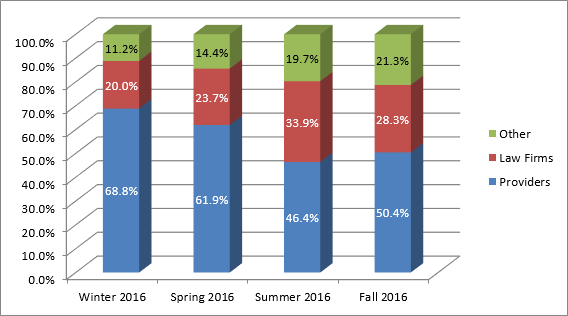
Respondents Still Diverse, But Slightly Less So: Of the types of respondents, 57 out of 113 were either Software and/or Services Provider (33.6%) or Consultancy (16.8%) for a total of 50.4% of respondents as some sort of outsourced provider (just over half of total respondents).  Law firm respondents were still in a strong second place with 28.3%.  Corporation respondents was the only other category over 10% this time.  Here’s a graphical representation of the trend:

fall2016-1

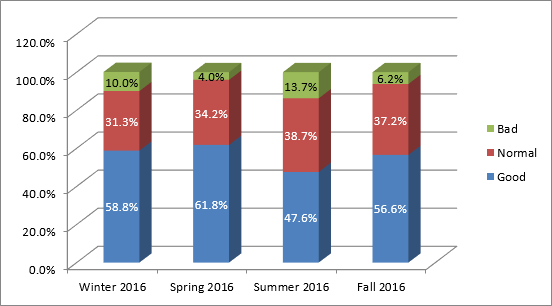
Over Half of Respondents Consider Business to Be Good: Over 56% (56.6%, to be exact) of respondents rated the current general business conditions for eDiscovery in their segment to be good, with 6.2% rating business conditions as bad.  Last time, those numbers were 47.6% and 13.7% respectively.  Does this reflect a seasonal dip during the summer – the only quarter where less than half of the respondents were bullish on business?  We’ll see.  Here is the trend for the four quarterly surveys this year:

fall2016-2

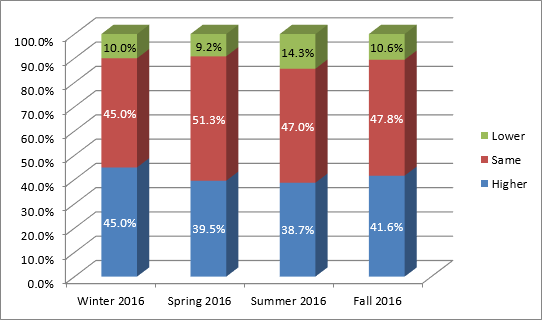
Almost Everyone Still Expects eDiscovery Business Conditions to be as Good or Better Six Months From Now: Almost all respondents (94.7%) expect business conditions will be in their segment to be the same or better six months from now (slightly down from last quarter’s 97.0%).  Revenue (also at combined 94.7% for the same or better) and profit (combined 89.4%) were improved over last quarter.  Here is the profits trend for the four quarterly surveys this year:

fall2016-3

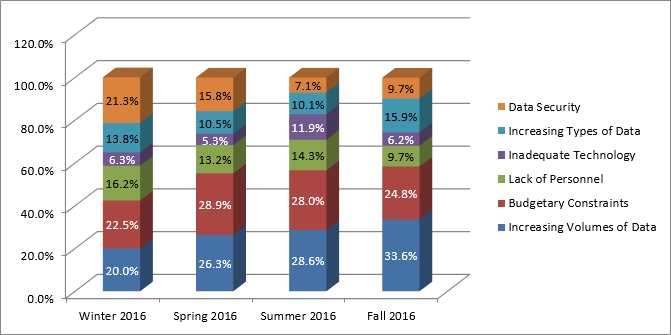
Increasing Volumes of Data is Clearly Considered to be the Most Impactful to eDiscovery Business: Increasing Volumes of Data (33.6%) was clearly considered to be the most impactful to the business of eDiscovery over the next six months, followed by Budgetary Constraints (a distant second at 24.8%).  Increasing Types of Data (15.9%) rose to third, Lack of Personnel and Data Security (both at 9.7%) tied for fourth and Inadequate Technology (6.2%) dropped back to dead last (where it has been in all but the last survey).  The graph below illustrates the distribution across the four quarterly surveys this year.

fall2016-4

The clearly notable trend here is the continued rise in the importance of Increasing Volumes of Data.  With data doubling in organizations every 1.2 years, it’s clear that the issue of data discovery is becoming more important than ever.

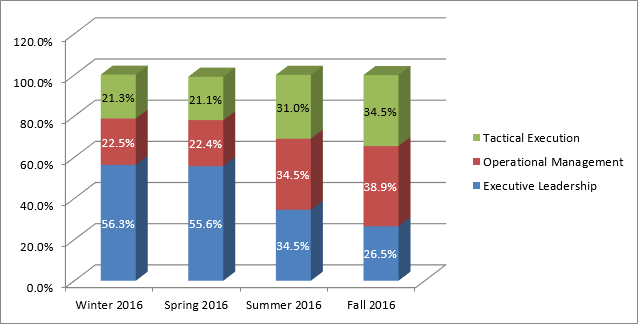
Continued Increase in “Rank and File” Responses: Last time, we noted a virtual even split among type of respondents (based on role), with Executive Leadership, Operational Management and Tactical Execution almost an even split.  The latter two categories continues to rise, at 73.5% of total respondents (with Executive Management down to 26.5%, less than half of the first two surveys).  Here’s that breakdown, quarter by quarter:

fall2016-5

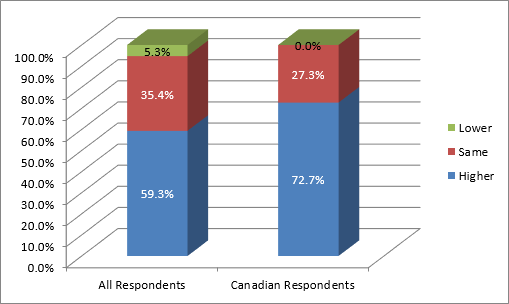
Canada Even More Bullish: Across the board, the respondents from Canada were even more confident in the state of eDiscovery business than the group overall.  As an example, here are the expectations for revenue for the next six months for all respondents and for Canadian respondents:

fall2016-6

Rob has published the results on his site here, which shows responses to additional questions not referenced here.  Check it out.

So, what do you think?  What’s your state of confidence in the business of eDiscovery?  Please share any comments you might have or if you’d like to know more about a particular topic.

Disclaimer: The views represented herein are exclusively the views of the author, and do not necessarily represent the views held by CloudNine. eDiscovery Daily is made available by CloudNine solely for educational purposes to provide general information about general eDiscovery principles and not to provide specific legal advice applicable to any particular circumstance. eDiscovery Daily should not be used as a substitute for competent legal advice from a lawyer you have retained and who has agreed to represent you.
Evolution of eDiscovery Automation – Looking Back and Looking Forward: eDiscovery Trends

How has eDiscovery automation technology evolved over the years?  Where is it headed?  What is the current state of acceptance for Technology Assisted Review (TAR) within courts and within the bar?  How do the different TAR approaches work?  Has the promise of TAR been fulfilled?

Those are just a few of the questions presented and discussed last Thursday in our E-Discovery Day webcast 10 Years Forward and Back – Automation in eDiscovery which was presented by ACEDS and sponsored by CloudNine.  If you missed the webcast, you’re in luck – the webcast was recorded!

Moderated by Mary Mack, Executive Director of ACEDS, the webcast highlighted the progress of eDiscovery automation technology over time and took a look at the present state of the technology and where it could be headed.  Speakers included:

  • George Socha, Co-Founder of EDRM and Managing Director at BDO, who turned on the “wayback” machine to look at the evolution of eDiscovery technology for well more than ten years back (more like 30 when the term “eDiscovery” didn’t even exist yet) and took a look forward toward what to expect for the future;
  • David Horrigan, E-Discovery Counsel and Legal Content Director at kCura, who discussed the evolution and current state of acceptance of TAR by courts and within the bar;
  • Bill Dimm, Founder and CEO of Hot Neuron, who discussed what we’ve learned about improving TAR technologies and how to effectively measure results, as well as how each of the most common TAR approaches work;
  • Bill Speros, Principal of Speros & Associates, who discussed the current state of the practice of TAR and whether TAR (and machine learning technology in general) is currently living up to its promise or it has reached the peak of inflated expectations.

I spoke as well about factors that are driving practitioners and providers alike toward discovery automation technology, the evolution of that technology to where we are today and whether any of the current automation technologies has the potential of becoming a disruptive innovation that revolutionizes how discovery is conducted.  The panel also addressed several questions from the audience over the course of the 90 minute session.

The webcast was well attended with several of the attendees rating the webcast as “Excellent” and a number of them commenting that the webinar was very informative and provided excellent information about the use of TAR and the history of eDiscovery technology.

Now is your chance to find out if you agree.  Below is the video recording of the webinar.

You can also check it out here and also download a PDF copy of the slides (though I should note that many of the slides have animations, so the best way to get the full effect is to watch the video).  Feel free to drop me a line and let me know what you think.

So, what do you think?  Did you attend an E-Discovery Day event?  Please share any comments you might have or if you’d like to know more about a particular topic.

Disclaimer: The views represented herein are exclusively the views of the author, and do not necessarily represent the views held by CloudNine. eDiscovery Daily is made available by CloudNine solely for educational purposes to provide general information about general eDiscovery principles and not to provide specific legal advice applicable to any particular circumstance. eDiscovery Daily should not be used as a substitute for competent legal advice from a lawyer you have retained and who has agreed to represent you.
Court Denies Defendant’s Motion to Overrule Plaintiff’s Objections to Discovery Requests

Defendant Ordered to Produce Source Code Responsive to Agreed Upon Search Protocol: eDiscovery Case Law

In ACI Worldwide Corp. v. MasterCard Technologies, LLC et. al., No. 14-31 (D. Nebraska, Oct. 27, 2016), Nebraska Magistrate Judge F.A. Gossett granted the plaintiff’s Motion to Compel Production of the defendant’s Full Source Code in part, “to the extent there are any files that MasterCard has not produced responsive to the parties’ previously established joint Search Protocol.”

Case Background

In this action where the plaintiff alleged the defendants violated a licensing agreement and disclosed confidential information regarding the plaintiff’s software, the disclosure of the defendant’s source code had been the subject of ongoing discovery disputes for more than a year.  In an order dated July 13, 2015 (and covered by us here), the court found the plaintiff had shown the relevance and a particular need for electronically stored information (“ESI”) constituting or containing the plaintiff’s proprietary information, but, because the court did not have the expertise necessary to determine the best way to retrieve the requested information, the parties were directed to devise a joint search protocol or methodology to retrieve the information requested by the plaintiff; otherwise, the court would appoint a special master.

The parties then generally agreed to a search protocol, but were unable to reach a full agreement on the search terms to be used.  In August 2015, the court ordered the defendant to run the plaintiff’s “Counterproposal Search Protocol” and produce the search results no later than September 16, 2015; after the defendant’s objections were overruled, the parties subsequently conferred and agreed that the defendant would run the Search Protocol and produce the requested materials by October 9, 2015. The defendant continued to hesitate to produce actual source code without an additional protective order, and after another motion to compel by the plaintiff, the court again ordered the defendant to run the Search Protocol and produce the requested information, which included source code. In February 2016, the court denied the defendant’s motion for partial reconsideration, but stated it would entertain inclusions of additional provisions to the protective order in place, if the parties agreed. In March, the court adopted the parties’ joint protective order for source code.

Ultimately, the plaintiff filed the current motion to compel disclosure of the entire source code, claiming that the defendant had not produced all items identified by the Search Protocol, stating production of the entire source code was warranted due to “MasterCard’s history of refusing to produce clearly relevant source code” and alleging that the source code produced to date supported its allegations of misappropriation. The defendant counters that the remedy is the production of missing files pursuant to the Search Protocol, and not the production of the entire source code.

Judge’s Ruling

Noting its previous emphasis that “The Federal Rules of Civil Procedure . . . emphasize that electronic discovery should be a party-driven process”, Judge Gossett ruled that:

“ACI’s request now for the entire source code to the MDS is not proportional to the needs of the case, would include information irrelevant to ACI’s claims, and would defeat the purpose of the protracted efforts by the parties to reach a compromise regarding production of MDS source code…To the extent MasterCard’s production has been deficient, the remedy is not to compel the production of its entire source code for the MDS. Rather, the court will compel MasterCard to produce only the source code retrieved using the parties’ joint search protocol that MasterCard has not yet produced.”

So, what do you think?  Given the defendant’s numerous delays in producing source code, should the court have granted the plaintiff’s motion in total?  Please share any comments you might have or if you’d like to know more about a particular topic.

Disclaimer: The views represented herein are exclusively the views of the author, and do not necessarily represent the views held by CloudNine. eDiscovery Daily is made available by CloudNine solely for educational purposes to provide general information about general eDiscovery principles and not to provide specific legal advice applicable to any particular circumstance. eDiscovery Daily should not be used as a substitute for competent legal advice from a lawyer you have retained and who has agreed to represent you.

Today is E-Discovery Day 2016!: eDiscovery Trends

Today is December 1.  As we mentioned last week, that means today is E-Discovery Day!

As the site for E-Discovery Day states, “[o]n December 1, 2016, thousands of Legal and IT professionals will gather both online and off to discuss e-discovery. They will be met with a full day worth of informative webcasts, in-person networking events and more—all hosted by E-Discovery Day sponsors.”

Last year, according to their site, there were 1,351 webcast participants, 26 eDiscovery experts who presented and 83% of last year’s participants said they would participate again this year.

In last week’s post, we covered the webcasts that will occur over the course of the day.  Webcast sessions start at 11:15am ET this morning and run through 7:00pm ET this evening, giving you a full day of sessions to choose from!

I’m excited to be presenting again with my colleagues Mary Mack, George Socha, David Horrigan, Bill Dimm and Bill Speros at the 10 Years Forward and Back – Automation in eDiscovery webcast session – it was very well received at The Masters Conference in DC in October.  So, if you missed it then, you can catch it today at 1pm ET!  Click on the link here to register.

You can also click on the link here to check out our previous post regarding the all of the webcasts and register for any of them via the links provided.

In addition, there will be in-person networking events in Dallas, Detroit, Houston, Jacksonville, Los Angeles, Orange County and New York.  Click on the appropriate link to register for the in-person event near you!

So, what do you think?  Do you plan to attend an E-Discovery Day event?  Please share any comments you might have or if you’d like to know more about a particular topic.

Disclaimer: The views represented herein are exclusively the views of the author, and do not necessarily represent the views held by CloudNine. eDiscovery Daily is made available by CloudNine solely for educational purposes to provide general information about general eDiscovery principles and not to provide specific legal advice applicable to any particular circumstance. eDiscovery Daily should not be used as a substitute for competent legal advice from a lawyer you have retained and who has agreed to represent you.

By 2020, 92 Percent of Everything We Do Will Be in The Cloud: eDiscovery Trends

In this case, I guess you could say that foresight is 2020… :o)

Before I begin, though, I should note that: Today is the last day to participate in the quarterly eDiscovery Business Confidence Survey being conducted by Complex Discovery and ACEDS!  It’s a simple nine question survey that literally takes about a minute to complete.  The more respondents there are, the more useful the results will be!  Click here to take the survey yourself.  Don’t forget!

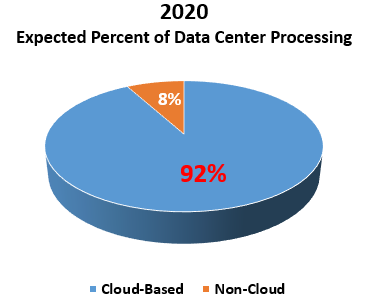
According to an article on Forbes.com, by 2020, 92 percent of computing workloads will be processed by cloud data centers; versus only eight percent being processed by traditional data centers.

The article (With Internet Of Things And Big Data, 92% Of Everything We Do Will Be In The Cloud, written by Joe McKendrick and released earlier this month) references estimates released by Cisco that show that cloud traffic is likely to rise 3.7-fold by 2020, increasing 3.9 zettabytes (ZB) per year in 2015 (the latest full year data for which data is available) to 14.1 ZB per year by 2020.  (FYI, a zettabyte is one billion terabytes!)

Not surprisingly, Big Data and associated Internet of Things are a big part of this growth, according to the study’s authors.  By 2020, database, analytics and IoT workloads will account for 22% of total business workloads, compared to 20% in 2015. The total volume of data generated by IoT will reach 600 ZB per year by 2020, 275 times higher than projected traffic going from data centers to end users/devices (2.2 ZB); 39 times higher than total projected data center traffic (15.3 ZB).

The survey also finds that public cloud is growing faster than private cloud. By 2020, 68 percent (298 million) of the cloud workloads will be in public cloud data centers, up from 49 percent (66.3 million) in 2015.  However, the authors attribute much of that growth to hybrid cloud strategies, such as cloud bursting, which is “an example of hybrid cloud where daily computing requirements are handled by a private cloud, but for sudden spurts of demand the additional traffic demand — bursting — is handled by a public cloud.”  The authors also see a rise in Software as a Service (SaaS) for online applications, where by 2020, 74 percent of the total cloud workloads will be SaaS workloads, up from 65 percent currently.

Needless to say, with more data than ever in the cloud by 2020, eDiscovery will be conducted on more and more cloud-based data.  Fasten your seat belts and put your tray tables up!

So, what do you think?  Do you find yourself using the cloud more in your organization?  Please share any comments you might have or if you’d like to know more about a particular topic.

Disclaimer: The views represented herein are exclusively the views of the author, and do not necessarily represent the views held by CloudNine. eDiscovery Daily is made available by CloudNine solely for educational purposes to provide general information about general eDiscovery principles and not to provide specific legal advice applicable to any particular circumstance. eDiscovery Daily should not be used as a substitute for competent legal advice from a lawyer you have retained and who has agreed to represent you.