
eDiscovery

A smarter approach to privilege review

A Smarter Approach to Privilege Review: Balancing Risk, Cost, and Data Control

Privilege review is one of the most important parts of eDiscovery, but it’s also one of the easiest places for costly mistakes to happen.

An email that includes an attorney isn’t automatically privileged. A Microsoft Teams conversation might contain both business discussions and legal advice. And when thousands of documents are being reviewed under a tight deadline, maintaining consistency across reviewers can become a challenge.

For legal teams, the goal isn’t just identifying privileged information. It’s protecting client communications, making defensible decisions, and keeping the review process efficient without adding unnecessary costs.

In this guide, we’ll explore practical ways to strengthen privilege review, manage modern data types, and use technology to support better decisions, regardless of where your review takes place.

What Is Privilege Review in eDiscovery?

Privilege review is the process of identifying material protected by attorney-client privilege, the work product doctrine, or another applicable protection before documents are produced. It can involve everything from a formal legal memo to a short message buried in a longer Teams discussion.

An attorney’s name on a message does not settle the question. Reviewers still need to understand who was communicating, why, and what the conversation actually says. Just as important, the team needs a consistent way to record those decisions.

A defensible process is not built on the assumption that no one will ever make a mistake. It is built on clear instructions, reasonable checks, and a record of how the team handled the work.

Why Is Privilege Review Difficult in Cloud-Based eDiscovery?

Modern communications rarely fit neatly into one document

Consider a Teams conversation that begins with a business update, moves into legal advice, and ends with a routine operational follow-up. The whole thread may come back in one search, but different parts can raise different privilege questions. Slack, text messages, and other collaboration tools create the same problem.

Reviewing the conversation in context matters more than relying on a sender field or a keyword alone. Your instructions should explain how to handle mixed business and legal discussions.

More reviewers can mean more inconsistent calls

eDiscovery review platforms (both SaaS and On-Premise versions) make it possible for colleagues in different offices to work in the same matter. That helps when deadlines are tight, but it also means people may interpret the same instruction differently. A regular calibration meeting and a clear route for questions can prevent small differences from becoming production issues.

Sensitive data can influence where review happens

Some matters involve client restrictions, regulatory obligations, or data residency requirements. Those constraints may determine whether the team uses a cloud platform, keeps data inside its own environment, or divides matters across both. Make that decision early, before moving sensitive material into a location that may not meet the matter’s requirements.

How to Build a Defensible Privilege Review Workflow

The most useful work often happens before the first reviewer opens a document. A little planning can save your team from revisiting thousands of documents later.

Step 1: Give reviewers rules they can actually use

Start with a written protocol that defines the types of privilege at issue, how to code potentially protected material, and when to escalate a delicate decision. Address dual-purpose communications, attachments, and any common-interest or joint-defense arrangements relevant to the case.

Include an attorney reference list with names, known aliases, email addresses or domains, and law firm identifiers. It will not make every decision automatic, but it will give reviewers a better place to start.

Step 2: Match the decision to the right reviewer

A tiered process gives each person a clear role. First-level reviewers flag likely privileged material. Senior reviewers resolve routine questions and check consistency. Supervising attorneys make the most sensitive decisions and oversee the log. This keeps the work moving without asking junior reviewers to make the hardest calls alone.

Step 3: Use technology to narrow the work, not replace judgment

Search terms, attorney-domain filters, email threading, metadata, and near-duplicate detection can help surface likely privileged material and reduce repeated reading. CloudNine Review brings case data into a searchable workspace, so the team can organize its review instead of juggling disconnected files.

These platforms help you decide where to look. They do not determine whether a piece of communication is legally privileged. That still takes an attorney who understands the facts and the applicable rules.

Step 4: Coordinate privilege and relevance review when practical

If your workflow and staffing allow it, consider assessing relevance, privilege, and confidentiality during the same pass. That can reduce the number of times a document has to be opened. The tradeoff is that reviewers need precise coding guidance and a clear way to send uncertain choices to counsel.

Step 5: Check the work while review is underway

Do not leave quality control until the production date is in sight. Sample completed decisions, compare how reviewers handle similar documents, and document corrections. Keep an audit trail of changes and escalations. Those habits help you find problems while there is still time to address them.

How to Create a Defensible Privilege Log

The privilege log explains what is being withheld and why. A useful log gives opposing counsel enough information to evaluate the claim without revealing the protected substance. The right format depends on the court, the case, and any agreement between the parties.

Choose a format that fits the matter

Traditional document-by-document logs typically identify the author, recipients, date, and basis for withholding. Metadata-based logs use extracted fields and may need additional description. Categorical logs group similar documents, which can reduce repetitive entries when permitted by the governing requirements.

There is no single format that works for every matter. Discuss log expectations early, including treatment of attachments, required fields, and whether categories are acceptable. The Rule 26(f) conference or a comparable early case-planning discussion is a good place to start.

Address inadvertent production before it happens

Consider seeking a Federal Rule of Evidence 502(d) order at the outset. Such an order can protect against privilege waiver from disclosure covered by its terms. It does not take the place of careful review, but it can provide an important safeguard if something is produced by mistake.

Choosing Between On-Premise and Cloud Deployment for Privilege Review

There is no universal answer to where privilege review should run. The better question is what your matter requires and how your team needs to work.

When on-premise review makes sense

Keeping data on your own infrastructure may be the right fit when a client or regulator requires tighter control over storage and access. It can also appeal to teams that want to manage hosting inside their existing environment. CloudNine Review On-Premise is available for teams that need that level of control, without separate cloud hosting fees.

When cloud review makes sense

Cloud review can make it easier for a case team to access the same case data fast through automated processing and hosting since case teams can get started without managing review servers. CloudNine Review (SaaS and On-Premise versions) supports searching, reviewing, and producing material in one place and processes more than 4,800 file types, including phone extraction reports and Slack exports.

When a combination makes sense

Different cases can call for different approaches. A highly sensitive matter may stay on-premise, while another benefits from cloud advantages. Having both options lets you make that decision based on the case rather than force every dataset into the same setup.

Whichever path you choose, confirm your organization’s access controls, retention requirements, and review procedures before the matter begins.

How AI and Generative AI Are Changing Privilege Review

AI-assisted tools can help reviewers spot likely attorney communications, group related material, suggest tags, and summarize documents for closer inspection. Used carefully, those capabilities can focus attention on the items that need it most and help speed up the review process.

But a suggested tag is not a final privilege call. Mixed-purpose advice, common-interest questions, and possible waivers still require legal judgment. If your team uses AI-assisted review, document the approach, test the output, and include it in your normal quality-control process.

CloudNine’s partnership with eDiscovery AI adds options for tasks such as auto-tagging and summarization within CloudNine Review. Your team should still validate the results against its own privilege protocol.

Privilege Review for Modern Data Types

When data comes from phones or collaboration tools, decide early how conversations will be displayed. A flat export can make it harder to tell who said what, when advice was given, and which part of the conversation needs closer inspection.

Where your review tools allow it, keep the thread, participants, timing, and surrounding messages visible when making a call. Review and redact at the appropriate message or conversation level rather than relying only on a flat document export. Preserving context helps attorneys explain why one part of a conversation is withheld and another is not.

Reducing Privilege Review Costs Without Sacrificing Defensibility

Privilege review takes time, and that time affects the client’s bill. The answer is to reduce avoidable work while maintaining the checks that protect the production.

Cut down the review population early

Use early case assessment to narrow dates, custodians, and search terms, then remove duplicates and identify related email threads where appropriate. Every document that can be reasonably excluded from review is one less document someone has to open, code, and potentially revisit.

Make costs explainable before the invoice arrives

Ask how data volume, hosting, users, and additional services affect the estimate. On-premise and SaaS options may have different cost structures, so choose the approach that fits the matter and make sure you can walk your client through the numbers. No one enjoys a surprise bill, so knowing what drives the cost is much more useful than finding out after the deadline.

Bring in help when the workload grows

Some matters outgrow the team available to handle them. CloudNine’s U.S.-based Client Services team can help with bringing data in, developing search terms, and managing project work alongside your case team. That extra support can be especially useful when a new data source arrives late in the schedule.

FAQs About Privilege Review in Cloud eDiscovery

How does a 502(d) order help protect privilege?

A court-entered Rule 502(d) order can prevent disclosure from resulting in privilege waiver to the extent specified by the order. Ask counsel to address it early rather than relying on a clawback discussion after production.

Can AI make the final privilege decision?

AI can help identify and organize material for review, but final privilege decisions belong with qualified legal reviewers who can assess the facts and applicable law.

Is cloud or on-premise better for sensitive matters?

It depends on the client’s requirements, data controls, and team workflow. Some matters call for on-premise review with consumption cost considerations or high volumes; others work well in the cloud where quick uploads and access to smaller matters can be more efficient. You may need both options across your caseload.

What makes a privilege log defensible?

Consistency, accurate information, and enough detail to explain the protection claimed. Agree on the log format early and check entries against your review decisions before production.

Key Takeaways: Privilege Review in Cloud eDiscovery

  • Set privilege rules and an escalation process before review begins, so everyone knows how to handle difficult calls.
  • Treat chat, text, and collaboration data as conversations, not just isolated keyword hits.
  • Build attorney oversight, quality control, and privilege-log planning into the workflow from day one.
  • Choose cloud, on-premise, or a mix based on each matter’s security needs, team, and budget.

A Practical Next Step

Privilege review will always require careful judgment, but the process itself doesn’t have to be unnecessarily complicated.

Clear protocols, consistent oversight, and technology that supports the way your team works can help make privilege review more manageable, even as data volumes and communication methods continue to evolve.

At CloudNine, we’ve spent more than 20 years working alongside legal professionals to help simplify the complexities of eDiscovery. We understand that every matter comes with its own challenges, and finding the right approach starts with understanding your team’s needs.

If you’re looking for ways to make privilege review more efficient while maintaining control over your data and decisions, we’d welcome the opportunity to show you how CloudNine can help.


What Data Control Means in eDiscovery

What Data Control Means in On-Premise eDiscovery

For in-house legal teams, control over data has become just as important as the ability to search, review, and produce it.

Cloud-based eDiscovery platforms provide flexibility and automation, but they also require organizations to place sensitive legal data in an environment managed, at least in part, by a third party. For matters involving investigations, intellectual property, employee communications, government records, regulated information, or other sensitive electronically stored information (ESI), that is more than a technology decision. It is a question of risk. A hybrid deployment is becoming more of the standard rather than one or the other.

For this article, on-premise eDiscovery and data control means having authority over where legal data resides, who can access it, how it moves through the eDiscovery process, and which security and retention policies apply.

What Does Data Control Mean in eDiscovery?

Data control involves much more than keeping files behind a firewall. It includes control over:

  • Where ESI is hosted, processed, and reviewed
  • Who has administrative and matter-level access
  • How authentication and permissions are managed
  • How data enters and leaves the system
  • How long data remains in the environment
  • Which security, backup, and retention policies apply
  • How the organization documents compliance with internal and external requirements

When legal teams rely entirely on externally hosted environments, they may have less direct visibility into the underlying infrastructure and how their data is stored, secured, processed, and accessed. An on-premise eDiscovery platform changes that equation by allowing the organization to operate the technology within infrastructure it controls.

That infrastructure may be in the organization’s data center, a private cloud, or another approved environment. The important distinction is that the organization maintains greater authority over the environment supporting its eDiscovery workflows.

Five Benefits of On-Premise eDiscovery Data Control

1. Greater Control Over Data Security

An eDiscovery matter may contain privileged communications, personally identifiable information, financial records, employee data, trade secrets, intellectual property, and confidential business information.

Keeping that data in a controlled environment can reduce the number of external systems involved in its lifecycle. It also allows internal security teams to align the eDiscovery platform with established controls for authentication, network access, monitoring, backups, and data protection.

Instead of determining whether a third-party environment fits the organization’s security requirements, the organization can build its eDiscovery environment around those requirements. This can be especially important for sensitive investigations and regulated information.

2. More Direct Control Over Access

Legal teams work with attorneys, paralegals, litigation support professionals, IT personnel, outside counsel, investigators, consultants, and other stakeholders. Each may need a different level of access.

An on-premise environment allows an organization to apply its own policies for:

  • User authentication and role-based permissions
  • Administrative and network access
  • Matter-level access
  • User provisioning and deprovisioning
  • Data transfers and internal monitoring

This helps legal departments align eDiscovery access with the organization’s broader information-security policies instead of managing it as a separate technology silo.

3. Stronger Alignment With Compliance Requirements

Government agencies, financial institutions, healthcare organizations, corporations, and other regulated entities may have specific requirements for how sensitive information is stored, transferred, processed, and accessed.

For these organizations, the question is not simply whether an eDiscovery platform includes security features. It is whether the organization can maintain and document appropriate controls throughout the data lifecycle.

On-premise eDiscovery can help when data must remain within a particular geographic region, network, infrastructure, or security boundary. It can also make it easier for legal, IT, security, and compliance teams to apply consistent policies to sensitive information.

4. Control Across the eDiscovery Workflow

Data control should extend beyond document review. An eDiscovery matter may include collection, processing, analysis, review, redaction, production, and preservation. When those activities occur across multiple environments, organizations may have less visibility into how data moves between stages.

An on-premise eDiscovery environment can bring more of the workflow under a common infrastructure and governance model. The objective is not simply to keep data on a local server. It is to maintain control over the data throughout the eDiscovery lifecycle.

5. Greater Cost Predictability

Hosted eDiscovery costs may be tied to data volume, processing, storage, hosting, users, or other usage factors. As a matter grows or remains open longer than expected, those costs can become difficult to predict.

With an on-premise model, the organization controls the supporting infrastructure and may be able to establish a more predictable long-term technology cost structure. It still needs to account for software, infrastructure, security, maintenance, and internal resources, but it may reduce recurring third-party hosting costs. (For a closer look at the numbers, see What Drives On-Premise eDiscovery Review Costs.)

This can be particularly valuable for organizations that regularly manage large litigation portfolios, investigations, regulatory matters, or ongoing information-governance needs.

Cloud vs. On-Premise eDiscovery: Which Is Better?

Neither deployment model is universally better.

Cloud-based eDiscovery remains an excellent option for organizations that value rapid deployment, accessibility, and reduced infrastructure management. On-premise eDiscovery may be a stronger fit when an organization needs greater control over security, access, data location, compliance, or long-term costs. Many organizations need both.

The right question is whether the deployment model provides the appropriate balance of:

  • Security and control
  • Accessibility and scalability
  • Regulatory and compliance requirements
  • Internal infrastructure and IT resources
  • Matter volume and duration
  • Short- and long-term costs

Different matters may require different levels of control. A hybrid strategy can allow an organization to match the environment to the sensitivity, scale, and requirements of each workload.

On-Premise Does Not Have to Mean Outdated

One common misconception is that on-premise technology requires legal teams to sacrifice modern functionality.

Today’s on-premise eDiscovery platforms can support modern data sources, advanced processing, powerful search and analytics, streamlined review workflows, and other capabilities expected from contemporary legal technology. The difference is where the technology operates and who controls the environment.

Modern functionality and data control are not mutually exclusive. For some organizations, combining the two is precisely the goal.

CloudNine Review On-Premise

CloudNine provides technology for both cloud and on-premise eDiscovery workflows, allowing organizations to select the environment that fits their security, compliance, operational, and financial requirements.

CloudNine Review On-Premise provides a modern review environment that can be deployed within an organization’s own infrastructure or preferred private environment. This brings eDiscovery closer to the data, security policies, and systems the organization already controls.

For in-house legal teams, that can mean greater confidence that sensitive legal information is being managed according to organizational requirements rather than placed into a one-size-fits-all technology model.

Frequently Asked Questions About On-Premise eDiscovery

What is on-premise eDiscovery?

On-premise eDiscovery uses software deployed within infrastructure controlled by the organization, such as its data center or private cloud, to process, search, review, and manage electronically stored information.

Does on-premise eDiscovery provide more data control?

It can. On-premise deployment gives an organization more direct authority over data location, infrastructure, administrative access, security controls, retention, backups, and data movement. The level of control still depends on how the environment is configured and governed.

Is on-premise eDiscovery more secure than cloud eDiscovery?

Not automatically. Security depends on the technology, configuration, policies, monitoring, and people managing the environment. On-premise deployment can be advantageous when an organization has strong internal security resources or needs to apply specific controls.

Who should consider on-premise eDiscovery?

Organizations handling sensitive, regulated, government, investigative, or high-volume legal data may benefit from evaluating on-premise eDiscovery. It may also suit organizations seeking greater cost predictability or tighter integration with internal security and compliance programs.

Can an organization use both cloud and on-premise eDiscovery?

Yes. A hybrid approach allows legal teams to choose the deployment model that best fits each matter’s sensitivity, accessibility, scalability, and cost requirements.

Data Control Is a Legal Technology Decision

The future of eDiscovery is not necessarily cloud-only or on-premise-only. It is about choice.

As data becomes more sensitive, distributed, and central to litigation, investigations, compliance, and corporate decision-making, organizations need technology that provides the appropriate level of control.

For some matters, SaaS will be the right answer. For others, particularly those involving sensitive information, government data, regulatory obligations, or strict internal security policies, on-premise eDiscovery may provide the stronger foundation.

Data control is ultimately about control over risk. When security, compliance, cost, and governance matter, on-premise eDiscovery deserves a place in the conversation.

What drives on prem ediscovery costs?

What Drives On-Premise eDiscovery Review Costs

The production deadline is set. Then another round of custodian data is added to the case, more people need to review it, and the case stays open longer than expected. You still need to find what matters and get the production out. You also need to explain what the additional work will cost.

Choosing between cloud and on-premise review starts there. The useful question is not which option has the lowest advertised price. It is what each option will cost for your matters, your team, and the time your data needs to remain available.

What drives the cost of cloud review?

SaaS eDiscovery review costs can change as a matter grows. Depending on the agreement, you may pay hosting fees in several ways: by data volume per month, processing, user access, or added capabilities.

The Winter 2026 eDiscovery Pricing Survey analysis, published by ComplexDiscovery in partnership with EDRM, offers useful benchmarks. For basic hosting without analytics, 54.7% of respondents reported prices below $10 per GB per month. For hosting with analytics, 32.1% reported prices between $15 and $25 per GB per month. These are survey responses, not a quote for your matter.

A monthly rate may be easy to budget for at the start. The total changes when more data arrives, several matters run at once, or a case remains hosted after active review slows down. Ask what happens to the bill in each of those situations before you choose a platform.

What drives the cost of on-premise review?

With on-premise review, your organization runs the platform in its own environment and controls how case data is hosted. Law firms and legal service providers can charge clients for hosting and build a potential source of revenue. Your software and infrastructure costs remain in your hands, giving you more control over how you price review services and manage your margins. To understand the full financial picture, budget for the infrastructure and ongoing support your expected caseload will require.

That gives you a different way to plan costs, especially if your team handles a steady volume of matters, keeps data for a long time or has low economic cases with high data volumes. It also means checking whether your infrastructure has room for a large new collection or several reviews at once where budgets are tight on those cases.

Get the full on-premise estimate in writing. Ask what the license covers annually, how access is priced, who maintains the environment, and what it will cost to add capacity. Those answers matter more than a comparison of hosting fees alone.

Where can an eDiscovery case budget change unexpectedly?

Processing. In the Winter 2026 survey, 73.6% of respondents reported ingestion-stage processing prices below $75 per GB. Prices measured at completion, after data has been prepared for review, covered a wider range. Ask vendors which volume they use to calculate a processing charge and when they measure it.

Reviewer access. The survey found that 41.5% of respondents reported fees between $50 and $100 per user per month for access to hosted data; 34.0% reported alternative pricing models. Those results show why access terms deserve attention, but they do not describe CloudNine Review On-Premise licensing. For each platform you consider, ask how the price changes if more attorneys or paralegals need to join a matter.

What hosting includes. Basic hosting and hosting with analytics had different price ranges in the survey. Check which search, review, and support capabilities are included in each proposal. A lower per-GB figure does not tell you the full cost of getting a dataset ready for production.

When could on-premise review cost less?

Compare the options over the same period and for the same expected work. Estimate your cloud hosting charges across active and retained matters. Then add up the full on-premise cost: software, infrastructure, maintenance, staffing, and expected services.

If projected cloud hosting charges alone exceed that full on-premise total, on-premise costs less under those assumptions, even before you count other cloud charges. If they do not, you need to compare the remaining costs on both sides before drawing a conclusion.

Run the numbers for a normal workload and for a demanding one. Add the custodian who arrives late, the larger dataset, and the case that stays open. That is how you find out whether the budget will still make sense when the matter changes.

What if your organization needs to keep data in its own environment?

Cost may be only one part of the decision. Your client, agency, or internal policy may require greater control over where case data resides and who can access it. On-premise deployment gives your organization an option to manage the review environment within its own infrastructure.

For public sector buyers, there are on-premise eDiscovery platform options available through Carahsoft and its reseller partners. CloudNine also identifies NASPO ValuePoint and OMNIA Partners contract routes; your procurement team can confirm which route applies to your agency.

How do you choose a review model your team can work with?

Start with the case, not the deployment label. Your paralegals and attorneys need to bring data together, search it, review it, and produce it by the deadline. They may need help when the work becomes complicated, and they definitely need a cost they can explain to the client.

For any of these considerations, CloudNine has created educational content that can help on your journey and our teams can consult with you on what can work best for your situation even if it is continuously changing. If you would like to see the technology behind the discussion, request a demo and bring your matter count, data volumes, current hosting spend, access requirements, and expected retention periods. We can compare the options against the work you actually have to do. If you don’t have any of that information, that is fine too!

The Economic Advantage of On-Premise eDiscovery: Driving Cost Control, Predictability, and Profitability with CloudNine Review

Kari Byers – VP of Sales and Customer Success

In today’s eDiscovery landscape, organizations face mounting pressure to manage expanding data volumes because of the need to mitigate the growing hosting costs. While cloud-based solutions offer convenience and flexibility, they also introduce ongoing consumption-based hosting costs across active and inactive matters alike. As a result, on-premise eDiscovery platforms are experiencing a strategic resurgence among organizations focused on financial efficiency, operational control, and long-term economic value.

CloudNine Review On-Premise exemplifies how different organizations can leverage on-premise technology to achieve distinct business objectives, whether that means containing legal costs for corporations and government agencies or building profitable service offerings for law firms and litigation support providers.

Cost Containment: Taking Back Control of Spend

One of the most compelling advantages of an on-premise deployment is cost containment regardless of objectives like cost containment or maintaining a profit center. SaaS platforms typically rely on consumption-based pricing models (charging per gigabyte, per user, per month, or all of the above) which can escalate rapidly as data volumes increase. Although SaaS platforms like CloudNine Review offer convenience, no infrastructure costs and easy deployment, it should not be the ONLY option.

With an on-premise model:

  • Infrastructure becomes a fixed, upfront investment
  • Data processing and storage costs are no longer variable
  • Recurring hosting and overage fees are eliminated

For corporations and government agencies, this model enables tighter control over legal and investigative budgets. Internal teams can manage large and recurring data volumes without worrying about fluctuating monthly hosting costs or unexpected spikes tied to case activity.

For law firms and litigation service providers, these same economics improve margin performance. By eliminating third-party hosting markups, firms can control their cost basis and retain more revenue from every hosted matter.

The more frequently the platform is used, the lower the effective cost per case; creating compounding economic advantages over time.

Certainty and Predictability: No Surprises

Economic efficiency is not simply about reducing costs, it is also about eliminating uncertainty.

On-premise eDiscovery delivers:

  • Predictable operating expenses
  • Control over hardware lifecycle and depreciation
  • Independence from fluctuating vendor and SaaS pricing models

For corporate legal departments and government agencies, this predictability simplifies annual budgeting and financial forecasting. Legal operations teams can model spend more accurately across investigations, litigation, and regulatory matters without exposure to unpredictable SaaS consumption fees.

For law firms and service providers, predictable infrastructure costs create pricing stability and allow for more strategic fee arrangements with clients, whether through fixed-fee discovery packages, bundled review services, or managed hosting offerings.

From Cost Center to Profit Center

While corporations and government agencies typically deploy on-premise platforms to reduce and control spend, law firms and litigation service providers often leverage the same infrastructure to build revenue-generating profit centers.

Rather than paying ongoing fees to third-party hosting providers, firms can:

  • Offer hosted review services directly to clients
  • Set their own pricing structures
  • Control margins and profitability
  • Retain revenue that would otherwise be shared with SaaS vendors

This enables firms and providers to:

  • Increase profitability per matter
  • Differentiate through in-house eDiscovery capabilities
  • Build stronger client relationships through expanded service offerings

In this context, CloudNine Review On-Premise becomes more than a technology platform; it becomes a strategic business asset that firms and providers have been accustomed to since the beginning of eDiscovery data management.

Data Sovereignty, Security, and Reuse

Beyond direct cost considerations, on-premise deployments deliver additional economic and operational benefits tied to data ownership and control.

Organizations benefit from:

  • Data reuse: Previously processed and reviewed data can be leveraged across matters without incurring re-hosting or reprocessing costs
  • Security alignment: Internal IT and compliance standards can be maintained without paying for premium SaaS security tiers
  • Reduced data movement: Eliminating large-scale uploads and downloads reduces bandwidth, transfer delays, and administrative overhead

For corporations and government agencies, these benefits support internal governance, compliance, and records-management strategies while further reducing long-term spend.

For law firms and service providers, retained access to client data across matters can improve efficiency and increase the value of managed discovery services.

Performance and Workflow Efficiency

When deployed within an organization’s own infrastructure, on-premise solutions can be optimized for performance and tailored workflows.

Benefits include:

  • Faster processing and review performance
  • Reduced downtime or latency concerns
  • Custom integrations with internal systems and workflows

For corporate and government users, these efficiencies reduce time-to-insight, improve internal responsiveness, and accelerate investigations.

For law firms and service providers, operational efficiencies directly impact profitability by reducing labor costs, accelerating matter turnaround, and enabling teams to handle more concurrent work.

The Best of Both Worlds: CloudNine Review SaaS + On-Premise

While the economic advantages of on-premise are significant, CloudNine Review SaaS remains an important component of a modern, hybrid eDiscovery strategy.

SaaS offers:

  • Rapid scalability for overflow or unexpected matters
  • Minimal IT overhead for quick deployment
  • Pay-as-you-go or project-based pricing suitable for client pass-through

When deployed strategically, organizations can:

  • Use on-premise for baseline, high-volume, ongoing, or dormant matters to maximize economic efficiency
  • Leverage SaaS for surge capacity, temporary, or unique matters

This hybrid approach allows:

  • Corporations and government agencies to optimize budget discipline while allowing flexibility with the same user experience
  • Law firms and service providers to maximize margin on core hosted matters while maintaining elastic capacity for peak demand

Conclusion

As data volumes continue to grow and legal cost pressures intensify, on-premise eDiscovery is no longer simply a legacy deployment model; it is a strategic economic decision.

CloudNine Review On-Premise empowers organizations to:

  • Contain and predict legal spend
  • Build profitable discovery service offerings
  • Maintain full control over data and infrastructure
  • Choose between SaaS and On-Premise with a consistent user experience

Whether the goal is cost containment for corporations and government agencies or profit-center creation for law firms and litigation service providers, CloudNine Review On-Premise provides the flexibility to support both strategies.

With joint deployment options, organizations can build a balanced, economically optimized eDiscovery ecosystem designed for today’s demands and tomorrow’s growth.

If you are interested in learning more or seeing a demonstration of CloudNine Review? Schedule a Demo or Consultation

The 2026 C2C Cellebrite User Summit Key Takeaways

Kari Byers – VP of Sales and Customer Success

The Cellebrite User Summit C2C 2026, hosted in Washington, D.C. at the Marriott Marquis Washington, DC from April 13–16, delivered an action-packed experience, with core sessions taking place on the 14th and 15th. From the moment the event began, it was clear this would be more than just another conference. The initially empty stage itself set the tone: massive in scale, paired with futuristic, high-energy music that underscored the seriousness and innovation driving today’s digital investigations community.

A Powerful Opening

The summit kicked off with an inspiring keynote from Tom Hogan, who highlighted Cellebrite’s growth and impact within the law enforcement community, and they sure seemed to have been busy the past year! Heather Barnhart followed, introducing keynote speaker Terry Crews.

Crews delivered a message that resonated deeply across the audience, emphasizing the importance of balancing principle, knowledge, and reason. His point was clear: leaning too heavily on one without the others can lead to flawed thinking, whether it’s rigid beliefs without logic or conclusions formed without sufficient knowledge. For an audience largely made up of law enforcement and investigative professionals, the message struck home. These three elements are essential when working to solve and prevent crime.

One of the first breakout sessions I attended with my colleague Rick Clark featured Zuzanna Halemejko, who presented a compelling case study involving the review of over 80,000 images extracted from a mobile device.

Using AI-driven workflows, her team was able to quickly identify relevant images while confidently eliminating non-pertinent ones. This session reinforced a critical takeaway: the value of data collection is only fully realized when paired with intelligent downstream processes. AI is no longer a “nice to have”, it is becoming essential in isolating meaningful evidence from overwhelming data volumes.

Preserving Prompts in the Age of Generative AI

Another standout session came from a familiar eDiscovery veteran, Julie Lewis of Digital Mountain Inc., who explored the emerging importance of preserving prompts in digital investigations.

As generative AI platforms like ChatGPT, Gemini, Claude, Llama 4, and Microsoft Copilot become embedded in daily workflows, the prompts themselves are increasingly relevant pieces of evidence. Lewis walked through where this data resides, how it can be preserved, and its growing role in both investigations and litigation. It’s a rapidly evolving area that will undoubtedly shape future discovery strategies.

OSINT and Courtroom Readiness

In a session led by Ritu Gill and Robert Merriott, the focus turned to Open-Source Intelligence (OSINT) and its role in modern investigations.

Their message was clear: OSINT is powerful, but only when handled correctly. Proper collection, preservation, and presentation are essential to ensure admissibility in court. Through real-world case examples, they demonstrated how investigators can effectively gather online intelligence while preparing for the scrutiny of legal proceedings. The blend of investigative practice and courtroom insight made this session especially valuable.

The Reality of Digital Forensics in Criminal Cases

Several sessions throughout the summit addressed deeply sensitive cases involving child exploitation, homicide, and other serious crimes. While the details remain confidential out of respect for victims, the overarching takeaway was unmistakable: digital forensics continues to play a decisive role in solving even the most complex cases.

One particularly powerful session included a firsthand account from a survivor of child exploitation, illustrating how a cold case was revived through newly uncovered digital evidence. Another highlighted the Omaha Police Department and their remarkable achievement of solving 100% of homicide cases in recent years, which is an accomplishment that has had a measurable deterrent effect on crime.

The message across all of these sessions was both sobering and clear: digital footprints are incredibly difficult to erase, and forensic technology continues to evolve in ways that ensure accountability.

A Deeper Look: Modern Data Challenges in Forensics and eDiscovery

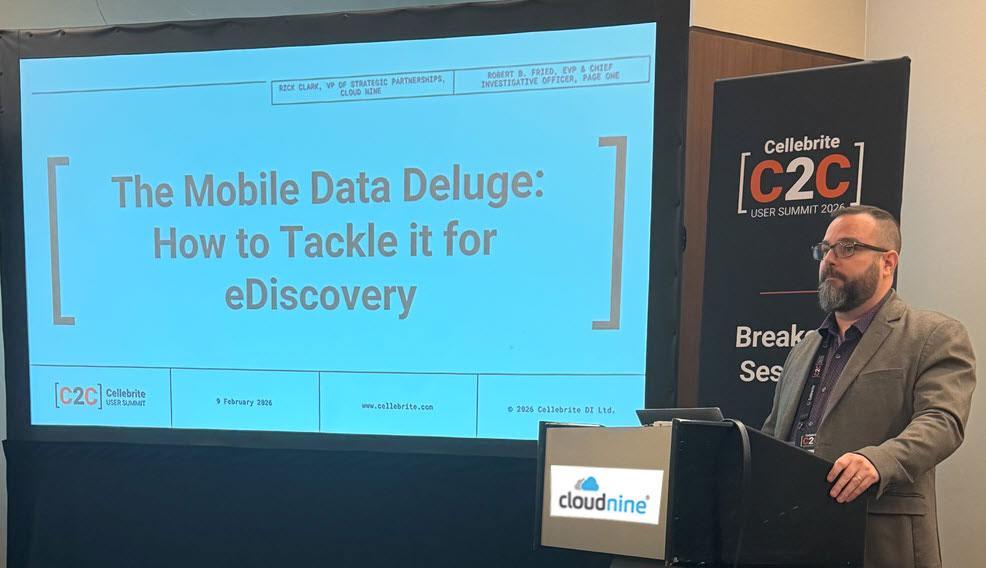
One of the only eDiscovery specific sessions of the summit, and one I was especially proud to attend, featured my colleague Rick Clark, VP of Strategic Partnerships and Marketing at CloudNine, alongside Rob Fried, Executive Vice President of Forensics and Chief Investigative Officer at Page One Inc.

Their session tackled one of the most pressing realities facing our industry today: the fundamental shift in the data landscape.

Rob Fried opened with a forensic perspective, grounding the discussion in what investigators are seeing firsthand: an explosion of mobile device data, cloud artifacts, and application-based evidence. Building on this, Rick Clark brought the eDiscovery lens, connecting how that data ultimately flows into review, analysis, and production workflows.

Together, they outlined what many of us are experiencing daily: traditional email is no longer the primary driver of cases. Instead, matters are fueled by mobile data, messaging platforms like WhatsApp, Signal, and Telegram, social media, and cloud-based collaboration tools.

At the center of this shift are the “three Vs” of modern data:

Volume

Data sizes are surging into gigabytes and terabytes, often across multiple custodians and devices. With the vast majority of cases now involving mobile data, the scale alone is transforming how teams approach processing and review.

Variety

Data sources are more diverse than ever. Each platform introduces unique formats, structures, and collection requirements, making defensibility and completeness more complex.

Veracity

Data is evolving at an unpredictable pace. New applications, changing formats, and rapidly increasing volumes demand constant adaptation from both technology providers and practitioners.

Rick emphasized that these challenges don’t exist in isolation, they compound across the entire eDiscovery lifecycle.

From a collection standpoint, teams must make critical decisions about acquisition methods, whether logical, file system, or full extraction, while also navigating remote custodians and distributed data sources.

review and analysis, the challenge becomes making sense of fragmented, cross-channel communications. Without the right tools to reconstruct conversations and provide context, key insights can easily be missed.

And in production, maintaining the integrity of modern communications like threads, timestamps and relationships requires rethinking traditional, document-centric approaches.

What stood out most in this session was the emphasis on flexibility. Rick highlighted the importance of having deployment options that align with the needs of each case, whether on-premises solutions for sensitive and cost-conscious matters or cloud-based platforms for scalability and accessibility.

This wasn’t just a theoretical discussion, it was a practical framework for how organizations need to evolve. The takeaway was clear: success in today’s environment requires not only advanced technology, but also thoughtful, adaptable strategies that can keep pace with the ever-changing nature of data.

Beyond the Sessions: Networking and Community

Beyond the educational content, the team at Cellebrite delivered an exceptional event experience. One highlight was an evening at the Smithsonian National Portrait Gallery, where we enjoyed incredible food, drinks, live music, and exclusive access to the museum.

Another standout was the Digital Justice Awards (JUSTYS), now in its second year. The ceremony honored 20 individuals across 12 categories, celebrating those who protect communities, businesses, and nations. The theme during this ceremony as well as the entire conference was to honor the heroes who protect nations, communities and businesses (Cellebrite’s Mission). The event, streamed on Law & Crime Network’s YouTube channel, reinforced the summit’s overarching theme: recognizing the real-world heroes behind digital investigations.

The 2026 Cellebrite User Summit was more than just informative; it was energizing and eye opening. From cutting-edge technology discussions to deep human stories of justice and resilience, the event captured the full spectrum of what this industry represents.

For me, attending alongside my colleague Rick Clark, made it fun and a way to discuss all of the topics presented. It’s clear that as data continues to grow in complexity, the collaboration between forensics and eDiscovery professionals will only become more critical.

And if this summit is any indication, the community is more than ready for the challenge.

CloudNine’s Next Evolution: Advancing eDiscovery with Automation, Modern Data, and On-Premise Innovation – Part 4 of 4

This is a Part 4 of a special 4 part series presented by CloudNine.

Over time, the scope of eDiscovery and investigative work has expanded well beyond its original boundaries. What used to center on email and documents now includes dynamic data from cloud systems, smartphones, messaging apps, and collaboration platforms. This shift has placed new demands on legal professionals and organizations to efficiently manage and review data at scale, often within tight deadlines and regulatory frameworks.

Amid this transformation, CloudNine remains focused on delivering forward-thinking innovation. With recent updates here is a four-part series that will discuss:

  • Automated Redaction
  • Microsoft 365 Data Collection
  • Expanded Modern Data Processing through CloudNine LAW
  • CloudNine Review On-Premise Platform with Modern Data

CloudNine delivers a cohesive vision: a fully modernized, automated, and scalable eDiscovery workflow for all data types.

Part 4 – Preparing for the Future: CloudNine Review On-Premise

Review and Beyond: Delivering Control, Context, and a Unified eDiscovery Future

The evolution of eDiscovery is no longer just about collecting and processing data, it’s about creating a seamless, end-to-end workflow that gives organizations complete control over how that data is reviewed, analyzed, and produced. The upcoming CloudNine Review On-Premise platform represents a significant step in that direction, offering organizations greater flexibility in how and where their data is managed with all of the previous articles in this series being rolled into an on-premise modernized eDiscovery review platform!

With full on-premise review capabilities, organizations can keep sensitive data within their own controlled environments while still benefiting from the advanced functionality CloudNine is known for. This deployment model is especially valuable for government agencies and regulated industries, where data security, sovereignty, and compliance are non-negotiable. At the same time, seamless integration with CloudNine LAW ensures that data flows efficiently from processing into review, regardless of whether it originates from traditional sources or modern communication platforms.

The result is a true end-to-end eDiscovery workflow with collection, processing, review, and production all operating within a secure and unified ecosystem. Microsoft 365 data can be collected directly through CloudNine’s connectors, while partnerships with providers such as Cellebrite, Pinpoint Labs, and ModeOne extend collection capabilities to mobile, forensic, and other specialized data sources. These inputs can then be coordinated and managed through CloudNine’s services team, ensuring consistency from the earliest stages of a matter.

Modern Data Review: Context is Everything

One of the most significant advancements in CloudNine Review, whether SaaS or on-premise, is the ability to review data natively, in context.

Key Capabilities

  • Conversation-based review: Instantly see communications between custodians
  • Cross-channel visibility: Follow conversations across email, Teams, and text
  • Granular tagging: Tag individual items or entire conversations
  • Automated redactions on export: No need to manually draw redaction boxes

As data types have evolved, so too has the way reviewers need to interact with that data. One of the most important advancements in CloudNine Review, whether deployed in the cloud or on-premise, is its ability to present information in context. Modern communications are not isolated documents; they are dynamic, multi-threaded conversations that span platforms and participants. Reviewing them effectively requires more than a linear, document-by-document approach.

A Unified Vision for eDiscovery Innovation

CloudNine addresses this need with a context-driven review experience. Conversation-based review allows users to instantly see communications between custodians, making it easier to understand the flow and intent behind interactions. Cross-channel visibility further enhances this capability by enabling reviewers to follow conversations as they move between email, Microsoft Teams, and text messages. This holistic view ensures that critical details are not missed simply because they exist in different systems.

In addition, granular tagging provides flexibility in how information is categorized and organized. Reviewers can apply tags at the individual item level or across entire conversations, aligning workflows with the realities of modern data. Automated redactions on export further streamline the process, eliminating the need for manual markup while maintaining accuracy and consistency in produced documents.

Taken together, these capabilities fundamentally transform the review process. Instead of analyzing isolated files, legal teams can conduct more efficient, context-rich investigations that better reflect how communication actually occurs.

Across all these updates, a clear theme emerges: CloudNine is building a fully integrated, automated ecosystem for modern eDiscovery and over 5,000 traditional data types.

Stepping back, a broader vision becomes clear. Across its platform, CloudNine is building a fully integrated and automated ecosystem designed to handle both modern data sources and thousands of traditional file types. This unified approach delivers meaningful strategic advantages. Automation reduces the manual effort that has historically slowed eDiscovery workflows and introduced risk. Support for modern data ensures that organizations are prepared for the realities of today’s communication landscape and whatever comes next. Unified workflows eliminate the inefficiencies of switching between tools, while on-premise capabilities provide the control and security many organizations require.

For legal teams, government agencies, and corporate investigators, the impact is tangible. They can manage growing data volumes with greater confidence, respond more quickly to investigations and FOIA requests, and maintain defensibility through consistent, auditable processes. Perhaps most importantly, they can scale their operations without adding unnecessary complexity.

Conclusion: Turning Complexity into Capability

The growth of modern data shows no signs of slowing, but with the right approach, it does not have to be overwhelming. CloudNine’s latest innovations from automated redaction and Microsoft 365 connectors to expanded LAW processing and the forthcoming on-premise review platform reflect a focused effort to address the real-world challenges facing today’s legal and investigative professionals.

What emerges is more than incremental progress. It is a shift in how organizations approach eDiscovery: moving from manual processes to automation, from fragmented tools to unified workflows, and from reactive responses to proactive, strategic data management. In this new model, complexity is no longer a barrier, it becomes a capability that organizations can confidently control and leverage.

Stay tuned for our continued incorporation of AI in CloudNine Review!

Series Links:

Part 1: Automated Redaction

Part 2: Microsoft 365 Data Collection

Part 3: Expanded Modern Data Processing through CloudNine LAW

Part 4: CloudNine Review On-Premise Platform with Modern Data

CloudNine’s Next Evolution: Advancing eDiscovery with Automation, Modern Data, and On-Premise Innovation – Part 3 of 4

This is a Part 3 of a special 4 part series presented by CloudNine.

eDiscovery has entered a new era. The days of primarily reviewing email and static files have given way to an environment filled with cloud-based data, mobile communications, chat threads, and collaborative workspaces. With this evolution comes increased complexity, as organizations must quickly sift through growing volumes of diverse data while maintaining compliance and accuracy.

To meet these challenges head-on, CloudNine is driving forward with a commitment to innovation. With recent updates here is a four-part series that will discuss:

  • Automated Redaction
  • Microsoft 365 Data Collection
  • Expanded Modern Data Processing through CloudNine LAW
  • CloudNine Review On-Premise Platform with Modern Data

CloudNine delivers a cohesive vision: a fully modernized, automated, and scalable eDiscovery workflow for all data types.

Part 3 – Expanding the Power of CloudNine LAW: Modern Data Processing Reimagined

The Explosion of Modern Data

The nature of evidence in today’s investigations and litigation has fundamentally changed. While email once dominated the eDiscovery landscape, modern cases now routinely involve a far broader and more complex set of data sources. SMS and mobile messages, chat applications, social media content, and full forensic mobile extractions have become central to telling the complete story.

This shift has introduced new challenges for legal and investigative teams. Historically, handling these diverse data types required multiple specialized tools, each designed for a specific format or source. As a result, workflows became fragmented, data had to be moved and transformed between systems, and valuable context was often lost along the way. What should be a cohesive process instead became a patchwork of disconnected steps.

Today’s cases increasingly involve:

  • SMS and mobile messages
  • Chat applications
  • Social media
  • Forensic mobile extractions

CloudNine LAW is now designed to address this growing complexity by unifying how modern and traditional data is processed and prepared for review. A key advancement is its ability to directly import Cellebrite UFDR (Universal Forensic Data Report) files. This capability brings mobile forensic data that was once siloed in specialized forensic tools into the broader eDiscovery workflow without the need for time-consuming conversions or intermediary steps.

This development is particularly significant because UFDR files contain some of the richest and most nuanced data in modern investigations. They include not only text messages and communications from applications like WhatsApp, but also call logs, voicemails, app data, and detailed metadata that provides critical context for each interaction. Traditionally, extracting value from this data meant converting it into document-based formats, often stripping away relationships between messages, participants, and timelines.

A Unified Platform for All Data

CloudNine LAW bridges traditional and modern data:

  • Emails, PDFs, and Office files
  • Mobile and chat data
  • Cloud-based exports
  • Automated import of UFDR

By enabling direct ingestion of UFDR files, CloudNine LAW preserves this context and allows teams to work with the data in a more natural and complete way. Communications remain connected, metadata stays intact, and the integrity of the original evidence is maintained. This approach eliminates the inefficiencies of manual conversions and reduces the risk of losing key details that could impact case outcomes.

Beyond mobile data, CloudNine LAW serves as a unified processing platform for all types of evidence. Traditional data sources such as emails, PDFs, and Office documents can be handled alongside modern communication data and cloud-based exports. This consolidation significantly reduces tool sprawl, allowing organizations to standardize their workflows and apply consistent processing practices across every data type involved in a matter.

Early Data Culling for Efficiency

LAW enables powerful early-stage data reduction:

  • Deduplication across all data types
  • Advanced filtering
  • Targeted culling before review

The result:

  • Less data sent downstream
  • Faster and more cost-effective review cycles

Efficiency gains extend even further through early-stage data culling. CloudNine LAW enables organizations to reduce data volumes before they ever reach the review phase. Through deduplication across all data types, advanced filtering, and targeted culling, teams can eliminate irrelevant or redundant information early in the process. The result is a smaller, more focused dataset that accelerates review timelines and reduces overall costs.

For government agencies and organizations operating in highly regulated industries, deployment flexibility is another critical consideration. CloudNine LAW’s on-premise capabilities ensure that sensitive data remains within controlled environments. This supports strict security requirements, maintains full organizational control over data, and helps ensure compliance with internal policies and regulatory obligations.

As the volume and variety of modern data continue to expand, the ability to process and manage that data within a single, cohesive platform is no longer a luxury, it’s a necessity. By integrating mobile forensic evidence with traditional eDiscovery workflows, CloudNine LAW empowers organizations to move beyond fragmented processes and toward a more efficient, defensible, and future-ready approach to data management and review.

Series Links:

Part 1: Automated Redaction

Part 2: Microsoft 365 Data Collection

Part 3: Expanded Modern Data Processing through CloudNine LAW

Part 4: CloudNine Review On-Premise Platform with Modern Data

CloudNine’s Next Evolution: Advancing eDiscovery with Automation, Modern Data, and On-Premise Innovation – Part 2 of 4

This is a Part 2 of a special 4 part series presented by CloudNine.

The world of eDiscovery and investigations looks very different than it did just a few years ago. Email and traditional documents are no longer the primary focus and instead, today’s matters span cloud environments, mobile devices, messaging platforms, and real-time collaboration tools. This explosion of data types has introduced new challenges for legal teams, government agencies, and corporations working under demanding timelines and regulatory pressures.

In response to these shifting demands, CloudNine is continuing to advance innovation in meaningful ways. With recent updates here is a four-part series that will discuss:

  • Automated Redaction
  • Microsoft 365 Data Collection
  • Expanded Modern Data Processing through CloudNine LAW
  • CloudNine Review On-Premise Platform with Modern Data

CloudNine delivers a cohesive vision: a fully modernized, automated, and scalable eDiscovery workflow for all data types.

Part 2 – Automation: Driving Efficiency in Microsoft 365 Data Collection

The Challenge of Modern Microsoft 365 Data

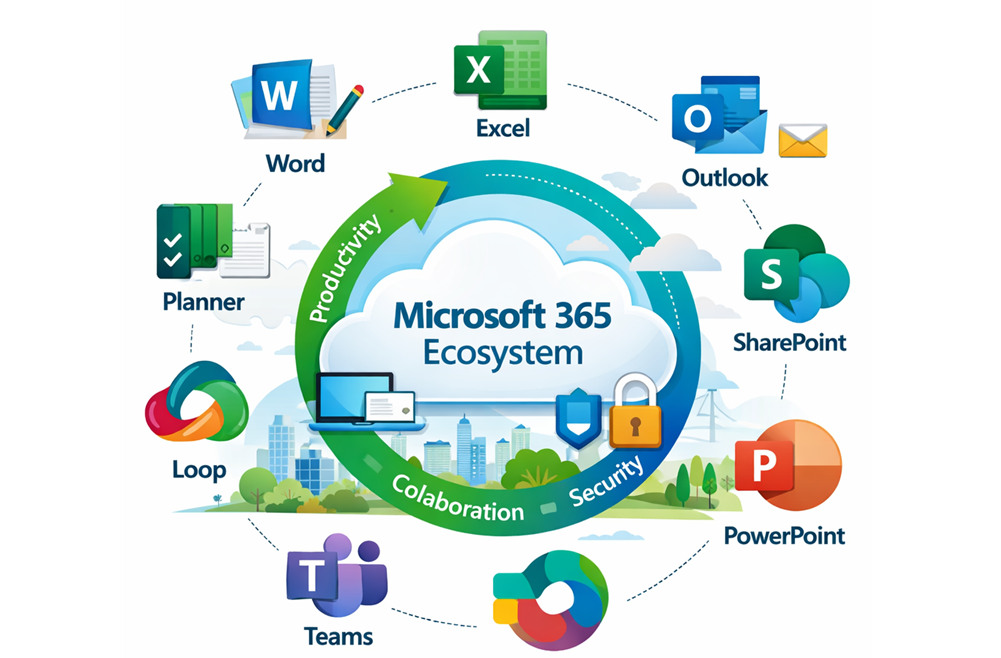
Microsoft 365 has firmly established itself as the backbone of modern enterprise communication and collaboration. From email in Exchange Online to file storage in OneDrive and SharePoint, and increasingly dynamic conversations in Teams, organizations are generating and storing vast amounts of data across a highly distributed ecosystem. Newer applications like Loop and Planner only add to this complexity. While this evolution has improved productivity, it has also created significant challenges for eDiscovery professionals tasked with identifying, collecting, and preserving relevant information.

Unlike traditional data sources, Microsoft 365 content is not centralized or easily exportable. Data is often fragmented across services, governed by layered permissions, and stored in formats that require context to fully understand. For legal and investigative teams, this means that what should be a straightforward collection process can quickly become time-consuming, resource-intensive, and dependent on IT or external vendors.

Organizations must collect data from:

  • Exchange Online (email)
  • OneDrive and SharePoint
  • Teams chats and channels
  • Emerging tools like Loop and Planner

This data is often fragmented, permission-restricted, and difficult to export efficiently.

CloudNine’s Approach: Direct, Unified Collection

CloudNine addresses these challenges by rethinking how Microsoft 365 data collection should work. Rather than relying on manual exports or disconnected tools, CloudNine leverages secure, API-driven integrations to enable direct access to Microsoft 365 data. This approach creates a unified collection experience across Exchange, OneDrive, SharePoint, Teams, and other emerging applications. By centralizing control within a single interface, legal teams can take ownership of the collection process without the traditional bottlenecks.

CloudNine simplifies Microsoft 365 collection through:

  • Secure API-driven integrations
  • Elimination of manual exports
  • A unified interface across all data sources

Legal teams can now manage collections without heavy reliance on IT or third-party vendors.

Automation that Reduces Complexity

Automation plays a central role in this transformation. With CloudNine, collections can be initiated and managed based on custodians, allowing teams to target specific individuals and apply filters that narrow the scope of data from the outset. Once configured, collection jobs can be automatically created and executed, running in the background with minimal user intervention. This reduces the need for constant oversight while ensuring consistency and repeatability.

CloudNine introduces automation at every step:

  • Custodian-based targeting and filtering
  • Automated job creation and execution
  • Background processing with minimal user intervention

CloudNine removes these inefficiencies with a direct pipeline from collection into CloudNine Review.

Automation does not come at the expense of data integrity or context. Complex data types, such as Teams conversations with embedded files or linked content, are collected in a way that preserves their relationships. This ensures that reviewers see communications as they originally occurred, rather than as disconnected fragments.

Another critical advantage of CloudNine’s approach is the elimination of costly and inefficient intermediary steps. Traditional workflows often involve multiple exports, staging environments, and reprocessing using separate tools. Each step introduces additional time, expense, and risk. By creating a direct pipeline from Microsoft 365 into CloudNine Review, these inefficiencies are removed entirely.

Seamless Transition into Review

This seamless transition from collection to review has a meaningful impact on case timelines. Legal teams can move more quickly into Early Case Assessment (ECA), gaining insights sooner and making informed decisions earlier in the process. At the same time, metadata integrity is preserved, and the risk of data loss or corruption is significantly reduced.

Defensibility and Compliance

From a defensibility standpoint, automation also strengthens compliance. Standardized workflows ensure that every collection follows the same repeatable process. Detailed logging and audit trails provide transparency into each action taken, supporting legal defensibility and alignment with EDRM best practices.

Ultimately, what has traditionally been one of the most challenging phases of eDiscovery is transformed into a streamlined, efficient, and reliable process. By combining direct integration with intelligent automation, CloudNine enables organizations to approach Microsoft 365 data collection not as a logistical hurdle, but as a strategic advantage.

The Result: A Transformed Collection Phase

What was once a bottleneck is now:

  • Faster
  • More defensible
  • Cost-effective

CloudNine’s Microsoft 365 connectors give case teams a strategic advantage rather than a logistical challenge.

Series Links:

Part 1: Automated Redaction

Part 2: Microsoft 365 Data Collection

Part 3: Expanded Modern Data Processing through CloudNine LAW

Part 4: CloudNine Review On-Premise Platform with Modern Data

CloudNine’s Next Evolution: Advancing eDiscovery with Automation, Modern Data, and On-Premise Innovation – Part 1 of 4

This is a Part 1 of a special 4 part series presented by CloudNine.

The landscape of eDiscovery and investigations has changed dramatically. What was once a world dominated by email and static documents has evolved into a complex ecosystem of cloud platforms, mobile data, chat applications, and collaborative tools. Legal teams, government agencies, and corporations are now tasked with managing and reviewing vast, diverse datasets and often under tight deadlines and strict compliance requirements.

Against this backdrop, CloudNine continues to push the boundaries of innovation. With recent updates here is a four-part series that will discuss:

  • Automated Redaction
  • Microsoft 365 Data Collection
  • Expanded Modern Data Processing through CloudNine LAW
  • CloudNine Review On-Premise Platform with Modern Data

CloudNine delivers a cohesive vision: a fully modernized, automated, and scalable eDiscovery workflow for all data types.

Part 1 – Smarter PII and FOIA Request Management: Automated Redaction in CloudNine Review

The Growing Complexity of data in discovery and FOIA Requests

Whether it is general litigation or Freedom of Information Act (FOIA), requests are increasing in both volume and complexity. Law firms and government agencies must now process not only emails and PDFs, but also Teams chats, mobile messages, and cloud-based documents. The challenge is clear: how do you maintain transparency while protecting sensitive information?

Manual redaction is no longer sufficient.

The Risks of Manual Redaction

Traditional redaction workflows are:

  • Time-intensive and resource-heavy
  • Prone to human error (missed PII or over-redaction)
  • Difficult to scale under tight deadlines

For legal and FOIA teams, the stakes are high and errors can lead to compliance risks, reputational damage, or legal consequences.

Introducing Automated Redaction in CloudNine Review

CloudNine’s automated redaction capabilities directly address these challenges by embedding intelligence into the review workflow.

How It Works

  • Pattern recognition: Automatically detects Social Security numbers, emails, phone numbers, financial data etc.
  • Keyword and rule-based logic: Customizable detection aligned to agency policies
  • AI-assisted identification: Enhances detection of sensitive or context-based information
  • Consistent application: Redactions are applied uniformly across all documents

Workflow Integration for legal and FOIA Teams

CloudNine seamlessly integrates redaction into the broader review lifecycle:

  1. Ingest and process large datasets
  2. Run automated scans for sensitive data
  3. Validate results with human reviewers
  4. Apply batch redactions with full audit tracking
  5. Export production-ready, redacted documents

Key Benefits

  1. Speed and Efficiency
    Dramatically reduces time spent identifying sensitive data, accelerating FOIA response timelines.
  2. Accuracy and Consistency
    Minimizes human error while standardizing redaction practices.
  3. Cost Savings
    Reduces reliance on manual review, optimizing limited resources.
  4. Defensibility and Compliance
    Provides audit trails and consistent adherence to FOIA exemptions.
  5. Scalability
    Handles growing volumes of modern data without increasing headcount.

Real-World Impact

Imagine a legal team managing a large case with PXI or a government agency responding to a large FOIA request involving thousands of emails and chat messages.

  • Before: Weeks of manual review, bottlenecks, and risk of missed PII
  • After: Automated detection + targeted human validation
  • Result: Faster turnaround, improved compliance, and fewer errors

The Future of eDiscovery and FOIA Processing

Automation and embedded AI are no longer optional, they are essential. Platforms like CloudNine Review are transforming FOIA from a reactive obligation into a streamlined, defensible process.

Series Links:

Part 1: Automated Redaction

Part 2: Microsoft 365 Data Collection

Part 3: Expanded Modern Data Processing through CloudNine LAW

Part 4: CloudNine Review On-Premise Platform with Modern Data

The “Cloud Reset”: Why Enterprises Are Bringing Data Management Back In-House and Why Legal Should Too

For more than a decade, enterprise IT strategy favored an almost singular mission: get as many data and business processes as possible into the public cloud. While that approach unlocked scalability, rapid provisioning, and new ways of working, a “Cloud Reset” is now reshaping enterprise infrastructure strategy with major implications for government agencies, legal operations, litigation support teams, and corporate legal departments.  

What Is the Cloud Reset?

The Cloud Reset refers to a growing trend where organizations are rebalancing their cloud strategies, moving critical workloads back into private cloud and on-premise environments, and choosing the most appropriate infrastructure for each workload rather than defaulting to public cloud. A Fortune 100 corporation recently shared its research that 69% of surveyed enterprises are considering repatriating workloads, and more than one-third have already done so. At the same time, private cloud is now being seen as a strategic platform equal to public cloud, not a fallback.  

This shift is especially relevant as enterprises build environments for AI, data governance, compliance, and cost control; areas where private infrastructure often has significant advantages. The cloud reset strategy approaches a thoughtful hybrid approach rather than an “all cloud” or “all on-premise” policy.  

The Three Core Drivers of the Cloud Reset

  1. Cost Management & Predictability

Public cloud pricing models, especially for storage, egress, compute, and AI inference, are often unpredictable over the long term. Many enterprises report spending waste that exceeds 25% or more on public cloud bills. The private cloud and on-premise models bring cost predictability, transparent budgeting, and lower total cost of ownership, especially for steady and regulated workloads.  

  1. Greater Data Control & Security

Security and compliance are now leading drivers for repatriation. In the Fortune 100 corporation’s surveys, 92% of IT leaders say they trust private cloud for security and compliance, and many firms prefer to retain sensitive data behind their own firewalls. This is particularly acute for regulated industries and organizations subject to strict privacy laws: scenarios common in legal holds, investigations, and litigation matters.  

  1. AI Workloads Demand Specialized Infrastructure

As CIOs and CTOs plan AI strategies, they want environments that combine performance, data privacy, and governance. Over half of enterprises prefer private cloud for AI model training and inference, where the costs and risks of using third-party infrastructure can be prohibitive.  

What This Means for Legal Departments & eDiscovery

The same pressures shaping enterprise IT are informing eDiscovery and litigation-ready infrastructure decisions: 

  • Data volumes and complexities are increasing rapidly, especially with modern data sources like Slack, Teams, mobile messaging, and AI-generated content. 
  • Regulatory scrutiny and internal investigations demand clear ownership and control of sensitive information. 
  • Budget transparency and cost containment are now board-level expectations in many corporations. 

Yet many legal teams still rely on “cloud by default” strategies for eDiscovery processing, review, and litigation support. This exposes them to variable costs, third-party control over data, and limited governance, exactly the challenges that are pushing IT leaders toward private cloud and on-premise deployment models. 

Bringing the Reset to Legal Workflows

CloudNine Review On-Premise: Controlled, Predictable eDiscovery

Legal teams need platforms that mirror the enterprise shift toward predictability, governance, and security: 

  • Full control of sensitive data: Data stays within corporate infrastructure, under internal security policies.  
  • Predictable, fixed costs: Unlike usage-based cloud fees, on-premise deployments bring budgeting clarity ideal for litigation holds, internal investigations, general litigation and fixed-fee engagements.  
  • Alignment with legal and IT policies: On-premise platforms allow legal to comply with internal controls and security frameworks without relying on external hosting.  

As more corporations recalibrate cloud spend and place workloads where they deliver the most value, CloudNine Review On-Premise provides the equivalent in the legal tech stack; a way to keep mission-critical data processing and review within controlled boundaries. 

CloudNine LAW: The Cornerstone of On-Premise Processing

Before case data ever reaches review, processing and culling must occur efficiently and securely. CloudNine LAW delivers: 

  • End-to-end control over ingestion, imaging, OCR, deduplication, and production workflows.  
  • Robust support for thousands of file types and complex data sources common in modern investigations.  
  • Cost efficiencies through fixed licensing rather than volume-based fees. Even if SaaS review is budgeted for the case, pre-culling that data before review can save huge hosting expenses. 
  • Integration with review platforms – bridging on-premise processing with downstream analytics and review.  

For legal operations that must operate with fiscal discipline and defensible processes, CloudNine LAW and CloudNine Review stand as a compelling private infrastructure equivalent and is tightly aligned with the Cloud Reset’s emphasis on control, predictability, and governance.  

Conclusion: Embrace Strategic Choice

The Cloud Reset signals an important evolution in how organizations think about infrastructure: cloud isn’t the only destination; the right environment is. The same principle should apply to legal technology stacks. It isn’t “cloud only” or “on-premise” only; it’s evaluating the various business silo’s and units on what can be deployed that is in-line with the organization’s objectives of cost, privacy and security. 

Rather than treating cloud as default, legal teams should design hybrid environments that let them: 

  • Retain sensitive data where governance demands it 
  • Predict and control costs in budget-sensitive matters 
  • Integrate tightly with internal IT and compliance frameworks 

Platforms like CloudNine Review On-Premise and CloudNine LAW empower legal departments to operationalize the Cloud Reset in their workflows bringing eDiscovery, review, and litigation readiness into environments built for control, value, and strategic alignment with broader enterprise IT goals.