Ethics

Florida Becomes First State to Require Technology CLE: eDiscovery Trends

OK, I may have taken a couple of shots at Florida last Thursday over their ballot issues in elections over the years.  However, Florida deserves credit in being the first state to require technology CLE for lawyers.

The rule change, among others proposed by the Florida Bar and ordered by the Supreme Court of Florida on Thursday states:

“We amend subdivision (b) (Minimum Hourly Continuing Legal Education Requirements) to change the required number of continuing legal education credit hours over a three-year period from 30 to 33, with three hours in an approved technology program.”

In that same order, Florida also became the 25th state to order adoption of the duty of tech competence for that state, stating:

“The comment to rule 4-1.1 (Competence) is amended to add language providing that competent representation may involve a lawyer’s association with, or retention of, a non-lawyer advisor with established technological competence in the relevant field. Competent representation may also entail safeguarding confidential information related to the representation, including electronic transmission and communications. Additionally, we add language to the comment providing that, in order to maintain the requisite knowledge and skill, a lawyer should engage in continuing study and education, including an understanding of the risks and benefits associated with the use of technology.”

The changes become effective on January 1, 2017.

As reported Monday on his Law Sites blog (Florida Becomes First State To Mandate Tech CLE), Bob Ambrogi notes that the mandate was first recommended by the Technology Subgroup of the Florida Bar’s Vision 2016 commission, which was chaired by Vero Beach lawyer John M. Stewart.

“If you are going to be competent in the practice of law, you have to understand technology related to your practice area,” Stewart told The Florida Bar News in 2015. “How do you do that? Through association — you hire an expert to associate with — or through study.”

The change was a surprisingly easy sell, Stewart told Victor Li at the ABA Journal. “I think everyone recognized that lawyers could benefit from more education, both when it comes to technology and in general.”

So, what do you think?  Will other states follow suit and require technology CLE as well?  Please share any comments you might have or if you’d like to know more about a particular topic.

Disclaimer: The views represented herein are exclusively the views of the author, and do not necessarily represent the views held by CloudNine. eDiscovery Daily is made available by CloudNine solely for educational purposes to provide general information about general eDiscovery principles and not to provide specific legal advice applicable to any particular circumstance. eDiscovery Daily should not be used as a substitute for competent legal advice from a lawyer you have retained and who has agreed to represent you.


Janice Jaco and Brandye Fenn of LTC4: eDiscovery Trends

During the recent ILTACON conference (wrap-up post about the conference here), I had an opportunity to speak with several thought leaders that are involved with various educational initiatives in the eDiscovery industry, which spurred an idea to conduct a thought leader interview series of leaders within those organizations.  So, I will be publishing interviews with those thought leaders over the next few weeks.  Unlike the annual LegalTech New York (LTNY) interviews, I won’t be publishing a schedule for these (I’m actually still trying to line up a couple of those interviews post-show), but you will see them sprinkled in with regular blog posts over the next few weeks.

Today’s thought leaders are Janice Jaco and Brandye Fenn of the Legal Technology Core Competencies Certification Coalition (LTC4).  ACEDS’ 2015 eDiscovery Person of the Year, Janice, is the senior eDiscovery Project Manager for boutique litigation powerhouse Keesal, Young & Logan (KYL).  Janice’s professional volunteer work includes extensive involvement in authoring LTC4’s eDiscovery Core Competency, participation in ACEDS’ CEDS Exam Standard Setting Exercise, and updating ACEDS’ University online content.  Janice also plays an important role in shaping the “KYL Keeps You Learning” Framework, which has produced two ILTA Distinguished Peer Award winners and has led to KYL being the first firm in the world to pass the Procertas’ Legal Technology Assessment in 2015 as well as the first-ever recipient of ACEDS Law Firm e-Discovery Department of the Year award in 2016.

Brandye is the Litigation Support Manager at Ford Harrison LLP. With more than 28 years’ of law firm experience as a litigation paralegal, Brandye is responsible for managing eDiscovery projects for the firm’s 20+ offices, nationally. In 2011, she founded the FordHarrison Litigation Support Department and, through her extensive knowledge of eDiscovery best practices and industry standards, established and implemented new review and processing workflows and procedures. She is responsible for the oversight and management of the firm’s litigation technology and provides technical guidance to attorneys and clients on all phases of the EDRM and leads the firm’s e-discovery budgeting, forecasting, and technology initiatives. In 2015, she provided a cost benefit analysis in support of implementing an innovative cost-recovery model for recouping the firm’s litigation support services which gave clients better control over their eDiscovery project costs while allowing the firm to remain competitive with the latest technology.

Both Janice and Brandye were members of a team of litigation support professionals charged with developing the eDiscovery Core Competency (ECC) Learning Plan of LTC4. Over a 21-month period, the team collaborated and created scenario-based training modules to define the core competency standards for attorneys and legal professionals required to measure e-discovery competency.

For those readers who haven’t heard of it, what can you tell us about LTC4?

Janice: In 2010, a group of like-minded industry people got together and realized that they were creating content and training materials and learning guidelines independently.  They thought that it would be great if they pooled resources together to respond to client demand for proof of efficiency and competency and did that by pooling resources across the industry to create industry standard competencies that could be the basis for that proof, which would be the certification.  From that genesis, LTC4 was born.  Today, there are now ten learning plans, including the new Electronic Discovery Core Competency learning plan that has just been peer reviewed and released.

Firms are free to develop their own training programs around those learning plans.  Then, a trainer at a firm could submit documentation demonstrating that a certain user in the firm has completed the training program associated with a particular learning plan and receive a certification.

There are vendors who train to the program and provide the LTC4 certification.  I can tell you that we have been utilizing our certifications in responses to requests for proposal from clients and potential clients.  We feel that this “proof learning” is a great way to attract and retain clients, so, from a business perspective, we feel that the ROI is there.

Brandye: I think clients are also adopting it.  They are going to their outside counsel and saying if we’re doing this, we want you to show us that you can do this as well, and that you have a base level of knowledge.  Whether the law firms were required to do this by their clients or whether they felt like they needed to do this just on their own, either way it’s become a great marriage.

Janice: I think the law firm that’s proactive and can be on (if not the “bleeding edge”) the leading edge of these changes will be in the best position for continuing to thrive and maintaining its market position.  You don’t want to be that firm waiting for the client to tell you that you need to do it.

Brandye: Or be asked for it in an RFP where you have to say, “Well, that’s part of our plan for next year.”

You have mentioned the eDiscovery learning plan, what are the others?

Janice: They are: Legal Documents, Managing Documents and E-mails, Collaborating with Others: E-Mailing and Sharing Documents, Time and Billing, Road Warriors, Data, Reports and Exhibits, Security, Working with Clients (CRM), Presentations and eDiscovery/eDisclosure.  You can find out more about the learning plans at http://www.ltc4.org/learning-plans/.

Since we’re an eDiscovery blog, our readers would be specifically interested in the eDiscovery plan.  What can you tell me about that plan that was just released?

Brandye: I was part of the group that developed the plan and it took us 21 months.  It was such a blur of fun and camaraderie (laughs) and multiple phone calls and Google docs.  What we did was try to approach it from a standpoint of things you need to know, things you should know and things you must know.  Then we flipped it and determined, for each of those things, who needs to know it and why.

When I started this process, I did not know anything about LTC4.  Bonnie Beuth (Chair of LTC4) called, explained what the project was about and asked if I’d like to help.  I agreed to help and talk to others about it and, the next thing you know, I was locked in and responsible for deliverables.  The process was so collegial, with everybody addressing the problems from a unique standpoint.  We even had someone from the UK, Andrew Haslam, to provide an international perspective.  And, it was one of the most enlightening experiences.

Janice: It was for me too.

Brandye: I learned so much.  You’re “stuck in a bubble” in your own world of your processes, your workflow, your people and what they know and don’t know.  Working with people in the group you get a lot of different perspectives on how they do things, which can be quite a bit different from how you do them.  It’s really fantastic to get those different perspectives and it really made a true believer out of me.

We took it in steps, eDiscovery steps, and tried to keep it grouped to the EDRM workflow – loosely – and also real-world scenarios.  Such as, what happens when you receive data and what happens when you need to produce a group of documents?  So, we took real world problems and worked to identify solutions to those problems.  We worked to identify what an attorney should do, what a paralegal should do, what a lit support person should do – and took it to its natural conclusion in each of those sections.

Janice: In my experience, there is sometimes a disconnect between what attorneys think they need to know to be competent and what lit support managers like Brandye and I think they need to know to be competent.

Brandye: Or even what the courts think they need to know to be competent.  I’ve heard Judge Peck say dozens of times to attorneys this is what you need to know and they sometimes still don’t recognize it.

Janice: For example, they sometimes need reminders to pursue FRCP Rule 502(d) orders in federal court cases where significant email volumes are expected to be produced.  The task is not necessarily one that presents as part of the standard litigation workflow.

Brandye: Or they’re still doing “drive by” meet and confers.

Janice: So, I googled to try to find something similar and the only thing that I found that was remotely close to the ECC Learning Plan was the EDRM Talent Matrix, which talks about tasks in eDiscovery and the different talent typically best suited to performing these tasks.  For example, the lawyer isn’t usually the person pushing the buttons to get a production out.  In the course of working with lawyers and our clients), I try to explain why I think an approach, tool or process is the best fit for the current case or scenario.  Over the years I have had team members question why I think my recommendation is the best one and even whether they need to know that.  A learning plan like this one is a way to validate your recommended people, process and technology so lawyers can competently supervise my work and even clients could validate the workflow and recommendations.  Governing bodies like the American Bar Association or the California State Bar are being clear that you don’t have to be able to do all ediscovery tasks yourself, but you’re going to have to be able to effectively supervise someone like me to ensure that I’m doing the right thing for the clients in the most efficient, just and speedy way.

So, for the first time ever, we had a group of like-minded thought leaders collectively building something that we all could agree at the end was a collection of basic skills needed to execute these ediscovery scenarios.  There’s nothing like that in the industry.

Brandye: You can talk about rules and work processes, but putting them in context of scenarios and what to do in those scenarios is key.  It helps people match their situation to what they’re supposed to do, so they can say “I’ve been in this situation before and I know exactly what they’re talking about and I know exactly what to do.”

Janice: It enables people to say “I’ve had this scenario before, but I’ve never had these nine steps to address it in this way before like I do now.”  I think trainers everywhere are going to be so relieved to see something that backs up what they’ve been saying to lawyers for years.  Sometimes, like it is with kids when they listen to a teacher in school after they’ve been told the same thing over and over again by their parents–you don’t necessarily listen to the ones closest to you.  You need a credible outside source to reinforce what internal people have been saying.  Attorneys sometimes just need to hear it from someone else before they believe it.  And, that’s what the lesson plans provide.

How does one become a member of LTC4?

Janice: You can go to the LTC4 site here for more information on how to join and access the online application.  It’s easy for any law firm to join.  There is a membership fee which is based on size of firm.  There are also rates and plans for law schools, non-profit organizations and vendors.  And, you get access to all of the learning plans when you join.

Brandye: And, it’s not just about the learning plans, it’s a truly collaborative organization.  You also get support from LTC4 and from the members within the organization.  If you’re working in an area, for example, labor employment law, you can reach out to that community for assistance.

Janice: For example, security is one of the learning plans and mobile security is an important topic.  There are members who have that expertise who support you and help you create documentation through the certification, which you can then use to market yourself to clients and the prove you have the skills in cybersecurity.

Thanks, Janice and Brandye, for participating in the interview!

And to the readers, as always, please share any comments you might have or if you’d like to know more about a particular topic!

Disclaimer: The views represented herein are exclusively the views of the author, and do not necessarily represent the views held by CloudNine. eDiscovery Daily is made available by CloudNine solely for educational purposes to provide general information about general eDiscovery principles and not to provide specific legal advice applicable to any particular circumstance. eDiscovery Daily should not be used as a substitute for competent legal advice from a lawyer you have retained and who has agreed to represent you.

Less Than Half the States Have a Technology Competence Requirement for Attorneys: eDiscovery Trends

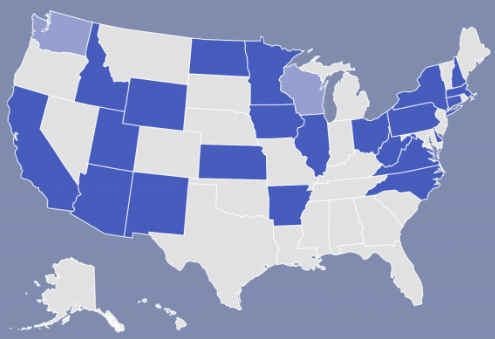
As you all know, I love a good infographic.  This one reflects the states that require attorneys to stay abreast of changes in technology relating to law practice.  Does your state have a technology competence requirement for its attorneys?

This infographic is available courtesy of Percipient, which is an eDiscovery and legal technology company that provides managed document review and managed eDiscovery services.  As they note in their post about the topic, in 2012 the American Bar Association amended Comment 8 to Model Rule of Professional Conduct 1.1 (Duty of Competence) to address changes in technology. That Comment now reads as follows:

“To maintain the requisite knowledge and skill, a lawyer should keep abreast of changes in the law and its practice, including the benefits and risks associated with relevant technology, engage in continuing study and education and comply with all continuing legal education requirements to which the lawyer is subject.”

According to Percipient, twenty-four states have either adopted the amended comment or otherwise require attorneys to stay abreast of changes in technology relating to law practice, with twenty-two of them effective today.  The other two states (represented in light blue on the map) – Washington State (September 1, 2016) and Wisconsin (January 1, 2017) – will be effective within the next few months.  So, by their assessment, less than half of all states have a technology competence requirement for its attorneys.

I have no reason to believe that they missed any states that have such a requirement, but they note to inform them if they missed any.  Regardless, the infographic (available here as a standalone PDF) is a great resource for identifying the current status of technology competence requirements across the country.  Thanks, Percipient!

So, what do you think?  Does your state have a technology competence requirement for attorneys?  Please share any comments you might have or if you’d like to know more about a particular topic.

Disclaimer: The views represented herein are exclusively the views of the author, and do not necessarily represent the views held by CloudNine. eDiscovery Daily is made available by CloudNine solely for educational purposes to provide general information about general eDiscovery principles and not to provide specific legal advice applicable to any particular circumstance. eDiscovery Daily should not be used as a substitute for competent legal advice from a lawyer you have retained and who has agreed to represent you.
 

Is a Blended Document Review Rate of $466 Per Hour Excessive?: Best of eDiscovery Daily

Even those of us at eDiscovery Daily have to take an occasional vacation (which, as you can see by the picture above, means taking the kids to their favorite water park); however, instead of “going dark” for a few days, we thought we would take a look back at some topics that we’ve covered in the past.  Today’s post is our all-time most viewed post ever.  I guess it struck a nerve with our readers!  Enjoy!

______________________________

Remember when we raised the question as to whether it is time to ditch the per hour model for document review?  One of the cases we highlighted for perceived overbilling was ruled upon here.

In the case In re Citigroup Inc. Securities Litigation, No. 09 MD 2070 (SHS), 07 Civ. 9901 (SHS) (S.D.N.Y. Aug. 1, 2013), New York District Judge Sidney H. Stein rejected as unreasonable the plaintiffs’ lead counsel’s proffered blended rate of more than $400 for contract attorneys—more than the blended rate charged for associate attorneys—most of whom were tasked with routine document review work.

In this securities fraud matter, a class of plaintiffs claimed Citigroup understated the risks of assets backed by subprime mortgages. After the parties settled the matter for $590 million, Judge Stein had to evaluate whether the settlement was “fair, reasonable, and adequate and what a reasonable fee for plaintiffs’ attorneys should be.” The court issued a preliminary approval of the settlement and certified the class. In his opinion, Judge Stein considered the plaintiffs’ motion for final approval of the settlement and allocation and the plaintiffs’ lead counsel’s motion for attorneys’ fees and costs of $97.5 million. After approving the settlement and allocation, Judge Stein decided that the plaintiffs’ counsel was entitled to a fee award and reimbursement of expenses but in an amount less than the lead counsel proposed.

One shareholder objected to the lead counsel’s billing practices, claiming the contract attorneys’ rates were exorbitant.

Judge Stein carefully scrutinized the contract attorneys’ proposed hourly rates “not only because those rates are overstated, but also because the total proposed lodestar for contract attorneys dwarfs that of the firm associates, counsel, and partners: $28.6 million for contract attorneys compared to a combined $17 million for all other attorneys.” The proposed blended hourly rate was $402 for firm associates and $632 for firm partners. However, the firm asked for contract attorney hourly rates as high as $550 with a blended rate of $466. The plaintiff explained that these “contract attorneys performed the work of, and have the qualifications of, law firm associates and so should be billed at rates commensurate with the rates of associates of similar experience levels.” In response, the complaining shareholder suggested that a more appropriate rate for contract attorneys would be significantly lower: “no reasonable paying client would accept a rate above $100 per hour.” (emphasis added)

Judge Stein rejected the plaintiffs’ argument that the contract attorneys should be billed at rates comparable to firm attorneys, citing authority that “clients generally pay less for the work of contract attorneys than for that of firm associates”:

“There is little excuse in this day and age for delegating document review (particularly primary review or first pass review) to anyone other than extremely low-cost, low-overhead temporary employees (read, contract attorneys)—and there is absolutely no excuse for paying those temporary, low-overhead employees $40 or $50 an hour and then marking up their pay ten times for billing purposes.”

Furthermore, “[o]nly a very few of the scores of contract attorneys here participated in depositions or supervised others’ work, while the vast majority spent their time reviewing documents.” Accordingly, the court decided the appropriate rate would be $200, taking into account the attorneys’ qualifications, work performed, and market rates.

For this and other reasons, the court found the lead counsel’s proposed lodestar “significantly overstated” and made a number of reductions. The reductions included the following amounts:

  • $7.5 million for document review by contract attorneys that happened after the parties agreed to settle; 20 of the contract attorneys were hired on or about the day of the settlement.
  • $12 million for reducing the blended hourly rate of contract attorneys from $466 to $200 for 45,300 hours, particularly where the bills reflected that these attorneys performed document review—not higher-level work—all day.
  • 10% off the “remaining balance to account for waste and inefficiency which, the Court concludes, a reasonable hypothetical client would not accept.”

As a result, the court awarded a reduced amount of $70.8 million in attorneys’ fees, or 12% of the $590 million common fund.

So, what do you think?  Was the requested amount excessive?   Please share any comments you might have or if you’d like to know more about a particular topic.

Disclaimer: The views represented herein are exclusively the views of the author, and do not necessarily represent the views held by CloudNine. eDiscovery Daily is made available by CloudNine solely for educational purposes to provide general information about general eDiscovery principles and not to provide specific legal advice applicable to any particular circumstance. eDiscovery Daily should not be used as a substitute for competent legal advice from a lawyer you have retained and who has agreed to represent you.

Craig Ball of Craig D. Ball, P.C.: eDiscovery Trends

This is the fifth of the 2016 LegalTech New York (LTNY) Thought Leader Interview series.  eDiscovery Daily interviewed several thought leaders at LTNY this year to get their observations regarding trends at the show and generally within the eDiscovery industry.  Unlike previous years, some of the questions posed to each thought leader were tailored to their position in the industry, so we have dispensed with the standard questions we normally ask all thought leaders.

Today’s thought leader is Craig Ball.  A frequent court appointed special master in electronic evidence, Craig is a prolific contributor to continuing legal and professional education programs in the United States and abroad, having delivered over 1,700 presentations and papers.  Craig’s articles on forensic technology and electronic discovery frequently appear in the national media and he teaches E-Discovery and Digital Evidence at the University of Texas School of Law.  He currently blogs on eDiscovery topics at ballinyourcourt.com.

What are your general observations emerging eDiscovery trends for 2016?

{Interviewed Craig after LTNY, as he did not make it to the show this year}

I skipped LegalTech this year – first time in twenty years – because Mardi Gras was early this year, I chose the circus on the Mississippi over the one on the Hudson.  Still, I got lots of feedback from those who attended LTNY while I was catching beads at 29 parades.  I wanted to see if I’d missed anything of note.  The only trend that emerged was lack of change in the focus of the show.  LTNY is still dominated by electronic discovery as it has been for almost a decade; but, there are continued signs of consolidation within the industry as organizations fold into one another.

Not surprisingly, we don’t see outright failure in this space.  Companies don’t disappear, but instead reach a point where whatever is left is absorbed by a national brand for its equipment or core technology.  So, we’ve seen steady consolidation within the industry, and that trend continues.  As the broader economy goes, so goes litigation and discovery.

Another trend that I’ve observed is an increased focus on eDiscovery automation and considerable growth of, and investment in, eDiscovery automation providers.  What are your thoughts about that trend?

The term “automation” has gotten some play lately.  I’m trying to figure out what each usage means because it’s still in the buzzword phase as marketers deploy the term in the never-ending struggle to differentiate their products. Automated workflows are key to Cloud SaaS offerings.  Hosted systems must be capable of programmatic routines to ingest and process data, effecting ready hand-off of data across processing and review.    An automated SaaS offering should be sufficiently autonomous to facilitate workflow across multiple stages of the EDRM with little manual intervention.

Assuming “automation” means  we can put something into the hopper and it will emerge ready for review or production in forms we were expecting, then automation is a necessary precursor to growth and cost effectiveness in hosted products.  That’s positive for consumers if it means price reductions and commoditization of features of electronic discovery.  It may not be so great for the vendor community unless they can scale up the volume.

In the case Nuvasive v. Madsen Medical, the Court recently vacated an adverse inference instruction sanction previously applied against the plaintiff because of the amendment to Rule 37(e).  Do you see that as a trend for other cases and do you expect that other parties that have been sanctioned will file motions to have their sanctions re-considered?

I don’t think it signals a trend. There are relatively few cases that fall into the transition point.  I don’t expect to see a rash of sanctions being reconsidered by virtue of the latest amendments.

Nuvasive is interesting because it goes to the issue of whether it’s fundamentally fair to impose the new Rules retroactively.  The Rules speak to that issue and make it clear that they can be applied retroactively as long as they operate fairly.  The amendments to the Rules make clear that serious sanctions (such as adverse inference instructions) require proof of an intent to deprive a discovering party of the particular information.  Nuvasive involved serious sanctions, so I can see why the Court might want to weigh amended Rule 37(e).  Still, I’m not sure why the parties and the Court failed to anticipate the Rule changes, as the amendment process was pretty far along in July 2015, when sanctions were imposed.  The tenor of the Court’s opinion in reversing himself was that it was just ‘bad luck’ that the amended rules kicked in when they did.

I think that we will see judicial action once termed “sanctions” couched in less-loaded terms.  After Rule 37(e), Courts will distinguish punitive responses from remedial actions designed to rectify unwarranted failure to preserve relevant information. New Rule 37(e) won’t tie the hands of jurists determined to rectify discovery abuse.  We’re already seeing push back from jurists unwilling to surrender discretionary authority when the facts demand fairness.   As well, we’ve seen at least one case where the Court reversed himself, citing 37(e) as the basis for reconsideration.  As is apparent in Nuvasive and in Judge Francis’ recent order in Cat 3, the Rules are tools, and they can be turned this way and that in determined hands.

Sanctions aren’t going away, and that’s a good thing.  We are mired in the last century when it comes to discovery.  Lawyers need direction, and sanctions opinions supply guidance.  There is little in the way of a “carrot” for eDiscovery – all we have is the “stick.”  If courts fail to sanction incompetence and abuse, then lawyers won’t pursue competence, and parties will continue to “twiddle their thumbs” until evidence disappears.  Few lawyers maliciously hide damaging evidence; but, they’re expert at rationalizing it away or, in the case of e-discovery, content to let their ignorance serve as their armor.  “What you don’t know, can’t hurt me,” is their credo.

What are you working on that you’d like our readers to know about?

I’m going back to basics.  Last year was about trying to develop a core curriculum and re-engineer my teaching to make it an engaging foundation in information technology for lawyers.  I hope 2016 will bring an increased ability to push out more information and reach more people.  I’m doing a project for the DC Bar where I will be providing evening CLE programs by live semi-weekly webcasts.  Small groups of motivated people are my sweet spot.  As always, I’m looking forward to this year’s Georgetown University Law School eDiscovery Training Academy, during the first full week in June.  Both the faculty and the students are delightful.  I’ve come to recognize that anyone willing to work at it can learn the technology they need to be formidable in e-discovery in just three solid days.  That’s less time than most of us spend at Starbucks each year.

I’m using the California ethics decision (which we covered here when it was still a Proposed Opinion) as a jumping off point for the concept of core competencies for lawyers.  As you know, the State Bar of California issued an advisory opinion last year identifying nine areas in which lawyers must either be competent in order to accept a case involving eDiscovery or must associate competent counsel or decline representation. That courageous opinion serves as an effective touchstone for talking to lawyers– not just in California, but all over– about the skills they must embrace to be competent to accept a case involving eDiscovery.

There are virtually no cases without electronic evidence, only cases where the lawyers choose to ignore it.  And there is so much more coming!  Never in history have advocates had so much powerful evidence at their disposal, and never have they been so content to look away.  Three days per advocate could change all that—a long weekend.  But, finding the time is only half the battle.  The other half is finding the course that doesn’t give short shrift to the “e” in e-discovery.

Candidly, 2016 is also about taking some time for me.  I’ve been doing 50 to 70 presentations a year for twenty years.  I average about four flights a week; so, I’m hoping to cut all that down by half.  I’m saying “no” more and stopping to smell the roses.  That’s why I’ve gotten a second home in New Orleans, and will spend more time reading, thinking and working on fewer projects with greater focus.  Every teacher needs a sabbatical, right?

Thanks, Craig, for participating in the interview!

And to the readers, as always, please share any comments you might have or if you’d like to know more about a particular topic!

Disclaimer: The views represented herein are exclusively the views of the author, and do not necessarily represent the views held by CloudNine. eDiscovery Daily is made available by CloudNine solely for educational purposes to provide general information about general eDiscovery principles and not to provide specific legal advice applicable to any particular circumstance. eDiscoveryDaily should not be used as a substitute for competent legal advice from a lawyer you have retained and who has agreed to represent you.

No Matter Where You Are, You Can Still Attend the UF EDRM E-Discovery Conference: eDiscovery Trends

This year’s University of Florida EDRM E-Discovery Conference is coming up on March 30.  If you plan to attend in person, great!  But, if you can’t attend in person, the good news is that you don’t have to be there, or even in the state of Florida, to attend.

The fourth annual one-day conference provides a pathway for attorneys, paralegals and support professionals to move beyond simple keyword searching to basic data analytics, covering simple tools such as near duplicates analysis, automatic document grouping through technology assisted review, document clustering, and the process of finding “more like this” to manage your data collection during eDiscovery more efficiently.

The conference features a special kick off in the morning with Craig Ball speaking on the nine eDiscovery skills every litigator and trial attorney must have, includes a luncheon address by the Hon. Ralph Artigliere on emerging eDiscovery ethics and includes several sessions with a number of knowledgeable speakers and panelists covering a variety of data analytics topics, concluding with a judicial panel discussion on court expectations of attorney eDiscovery competence, the new federal eDiscovery rules, and “the good, the bad, and the ugly e-discovery hearing and motion practice.”  A link to the Agenda is here.

General and Ethics CLE credits for the conference are currently awaiting approval.  If you plan to attend in person, the event will take place in Holland Hall at the University of Florida, Levin College of Law.  But, if you can’t attend in person, the event will also be streamed online.  So, you don’t have to be present to win!  Or, at least to learn.  :o)

The conference costs $99 to attend in person or $49 to attend online.  It’s free to attend (either in person or online) if you’re a currently enrolled student in an ABA Accredited Law School, Accredited eDiscovery Graduate program, or Accredited Paralegal program or are University and College Faculty or Professional Staff, Judicial Officials, Clerks, or Employees of Government Bodies and Agencies.  To register for the conference, click here.

So, what do you think?  Are you attending the conference?  Please share any comments you might have or if you’d like to know more about a particular topic.

Disclaimer: The views represented herein are exclusively the views of the author, and do not necessarily represent the views held by CloudNine. eDiscovery Daily is made available by CloudNine solely for educational purposes to provide general information about general eDiscovery principles and not to provide specific legal advice applicable to any particular circumstance. eDiscovery Daily should not be used as a substitute for competent legal advice from a lawyer you have retained and who has agreed to represent you.
Tom O’Connor of Advanced Discovery: eDiscovery Trends

This is the fourth of the 2016 LegalTech New York (LTNY) Thought Leader Interview series.  eDiscovery Daily interviewed several thought leaders at LTNY this year to get their observations regarding trends at the show and generally within the eDiscovery industry.  Unlike previous years, some of the questions posed to each thought leader were tailored to their position in the industry, so we have dispensed with the standard questions we normally ask all thought leaders.

Today’s thought leader is Tom O’Connor.  Tom is a nationally known consultant, speaker and writer in the area of computerized litigation support systems.  A frequent lecturer on the subject of legal technology, Tom has been on the faculty of numerous national CLE providers and has taught college level courses on legal technology.  Tom’s involvement with large cases led him to become familiar with dozens of various software applications for litigation support and he has both designed databases and trained legal staffs in their use on many of the cases mentioned above. This work has involved both public and private law firms of all sizes across the nation.  Tom is the Director of the Gulf Coast Legal Technology Center in New Orleans and he is the Senior ESI Consultant with Advanced Discovery.

What are your general observations about LTNY this year and about emerging eDiscovery trends overall?

{Interviewed the first morning of LTNY, so the focus of the question to Tom was more about his expectations for the show and also about general industry trends}.

When I got here to the show, I bounced around a bit and talked to several people here and I think there’s a lot of uncertainty in people’s minds.  I hate to say that we’re at a crossroads, but a couple of different things are going on in technology right now and I think people are worried that they made the right decision.  I’m talking about both vendors making the right technology decision on where to take their company and clients making the right choice.

I was at a presentation given by the CEO of a major company in our space recently and he was asked “what keeps you up at night?”  He responded that what he was most worried about was whether his company was flexible enough to make quick changes and adaptations in the market, because if you can’t do that, you can lose business really quickly.  You can sink in 18 months no matter what your market share is.  So, as a vendor, you have to be thinking “can I see something and react and respond?”  I think that goes across the board in every segment of the EDRM.  Technology changes so fast and we’re a profession that works by looking in the rearview mirror.  We work with precedent; we don’t want to be that first person out there trying something new.  So, there’s a lot of uncertainty.

Related to that, I think that tension between corporate clients and big law firms is becoming intensified.  Once again, it revolves around questions such as “am I getting the best technology?”, “am I getting the best ROI?”, “should I be bringing eDiscovery in house?”.  I’m seeing a lot of corporations going to master services agreements (MSAs).  That’s something that we do a lot of at Advanced Discovery.  It’s almost like an in-between state where corporations are deciding not to bring eDiscovery fully in-house, but not giving it to the law firms either and they’re saying to companies like ours “why don’t you run it for us?”  If there’s a trend right now, I would say that’s it, especially based on discussions that I had with other show attendees last night.

I always seem to ask you about the state of attorneys and their knowledge (or, rather, their lack thereof) about eDiscovery.  Do you think there has been any positive change in the past year with regard to attorneys’ knowledge about eDiscovery?

A couple of months ago, I asked a well-known judge in the field that question and he said that he’s seen minimal change.  I’ve seen some change, but I think the word I would use to describe it is “glacial”.  There has been some movement.  We’re seeing many more law schools embrace technology training of some sort.  Unfortunately, many of those are not full-time faculty, they are either adjunct faculty or CLE, like the Georgetown eDiscovery Training Academy that I’m part of – that’s actually run by their CLE department, it’s not part of their core curriculum.  Judge Facciola teaches two courses at the school full time and Craig Ball is teaching one at the University of Texas Law School.  But, overall, I haven’t seen schools really embrace the idea that this should be part of the curriculum.  Until that happens, I think the change will continue to be slow.

A great case in point: I think Craig and I did one our standup routine videos for the eDiscovery Channel, where we talked about the California Bar’s recent Formal Opinion (No. 2015-193, which we covered here when it was still a Proposed Opinion) and they listed nine things you need to be able to know how to do.  But, are they going to train people on this?  Who is going to be responsible for educating people on this new duty that they’ve imposed?  Now, it’s only early February, so maybe the Bar in California is going to come up with some sort of program.  But, that’s the quandary that I see – “you have this duty, good luck with that!”

Of course, nobody has the resources to provide that for a million lawyers.  There are some excellent resources out there, like the Georgetown Academy, but we cap that at about sixty students.  Do the math – once a year, sixty students.  Mike Arkfeld has a great course at Arizona State that he has been developing – let’s say, maybe, a couple of hundred people show up there and half of them probably already know everything.  It’s a little bit here and a little bit here, but there hasn’t been a sea change.  I don’t mean to point the finger at the law schools, but it’s just that they would be the most obvious to implement change, along with the bar associations.  But, nobody wants to own responsibility.

I think the third thing is that I’m surprised that there hasn’t been a big commercial attempt at this.  That somebody like a Thomson Reuters or a LexisNexis hasn’t said “we’re going to offer a course”.  It’s almost like everyone is afraid – no one wants to say they’re offering certifications because they’re not willing to take the risk that something might “go south”.  It’s the quandary that ACEDS has had from day one – how to you say that someone is certified when, in many states, it’s considered the providence of the bar association to say that you’re a specialist in a field.  There was a Federal court decision in Florida, I think back in September or October, where a firm who had people with 20+ years of experience indicated that they were specialists and the Florida Bar challenged their right to call themselves specialists without taking the Bar exam to designate specialists.  The firm sued and the court agreed that they had every right to call themselves specialists if they had that much experience.  After that, the bar association backed off and decided not to go after anybody else who does that.  Of course, there’s no standard as to who can call themselves an expert or specialist – is it 10 years or 15 years?  Who knows?  But, it seems to me that’s a door opener that benefits organizations like ACEDS that provide training.

So, in that regard, maybe this year things will open up.  But, it’s like pulling teeth.  Actually, it’s worse than that, it’s like pulling teeth without Novocain.  It’s frustrating.  I remember going around with Browning Marean to law schools 14 or 15 years ago and trying to get education programs going back then, so people have been trying for a long time.  It’s just frustrating.  I understand that people don’t go to law school to learn technology and their wish is fulfilled.  Unless they seek out one of these specialty courses, they don’t get it.

Part of the issue is that we’re faced with bureaucracy – we’ve got state bar associations and the ABA.  You’d think that maybe somebody like the ABA would take the lead on it, but that hasn’t happened.  Without naming names, there are a couple of bar associations where just getting a CLE course approved is like joining the Navy – there are ten page forms to fill out and certify.  Thankfully, not all states are like that.  I do a CLE 3 or 4 times a year for the Louisiana Bar on the basics of technology where we don’t even focus so much on eDiscovery as opposed to just helping them understand how a computer works – teaching them things like what a “bit” is, what a “byte” is, what’s a “temp file”, what is “slack space”, how data is actually stored on the computer.  We’re not trying to give them a PhD in Computer Science in this course, we’re just trying to teach them some basic concepts.  If you want to take on a medical malpractice case, you need to know the difference between an aorta and a fibula.  That’s the level we’re trying to teach – basic stuff.

In the meantime, we’re still encountering people who don’t understand things like why metadata is important and still get in fights over productions about that where they propose to give us just TIFF and text files and we say “no, you’re not”.  There was an appellate decision recently in Texas where Craig was the expert and the producing party claimed it was actually more expensive to produce native files.  What is your native file system, stone tablets?  How can you say that with a straight face?  Of course, if they already have the documents in a Relativity database, maybe they think it’s less expensive than producing native files, because they can simply perform an export.  But, the native files must still be there in the database, the client probably provided them to you and they can be produced.

Advanced Discovery just acquired Millnet, a London-based company.  We’ve been having meetings, trying to do the “vulcan mind-meld” and we were talking about this and they were laughing and I didn’t understand why.  They said that over in the UK, everybody produces native files.  I said “what about Bates numbers” and they started laughing again.  They said that nobody cares about Bates numbers over there.  Of course, it’s a different system over there, less adversarial, and loser pays, but it was like “wow, somebody understands the best way to do this”.  They were aghast to hear that it’s commonplace here.

What are you working on that you’d like our readers to know about?

It’s been literally a year now (since last year’s show) since I’ve been with Advanced Discovery.  I’m doing a lot of CLE, a lot of “lunch and learns” and a lot of client consulting – all about these various issues that you and I have been discussing.  The company has grown a great deal, so I’m jumping around like a “cat on a hot tin roof” (to use a New Orleans analogy) as we have offices from DC to all over California, just purchased a small service bureau in Pittsburgh and have a couple more on the horizon.  As one of my colleague said this morning, “Tom is in New York preaching the gospel of ESI”.  I also write a weekly blog for Advanced Discovery and put it up on my personal blog as well.  So, I’ve been doing a lot of education work.

Also, about once a month or so, Craig Ball and I amuse each other on the eDiscovery Channel on Youtube.  Craig has stepped in where Browning was.  We think we’re the funniest guys in eDiscovery.  Occasionally, we’ll get somebody else to sit down with us as well.

I miss Browning, especially when I come to a show like this.  He was just a genuinely nice guy.  He and I were opposites in so many ways.  Though we were both from the Boston area, he was what they call a “Boston Brahmin”, a “yankee”, a protestant and a partner at a huge firm. I’m South Shore, Irish and a blue-collar worker.  He was hard-core Republican and I’m a hard-core Democrat.  Despite all that, we got along famously.  I think much of that related to our sense of humor, but he also reminded me of the lawyers I knew when I was growing up that made me want to be a lawyer, where the profession was much more collegial.  He became Of Counsel for the firm and I asked him “don’t you miss having a clientele?” and he said “I miss going to court, I miss trials”.  But, he added, “the last ten years, the majority of my clients only wanted a ‘hammer’ – they wanted me to beat the crap out of the opposition, they weren’t concerned about getting a solution.”  Despite that, Browning never lost that collegiality.  I’ve never known anyone who had a bad word to say about him – he was universally liked and respected, even when he didn’t agree with you, he could disagree with you in a very respectful way.

Thanks, Tom, for participating in the interview!

And to the readers, as always, please share any comments you might have or if you’d like to know more about a particular topic!

Disclaimer: The views represented herein are exclusively the views of the author, and do not necessarily represent the views held by CloudNine. eDiscovery Daily is made available by CloudNine solely for educational purposes to provide general information about general eDiscovery principles and not to provide specific legal advice applicable to any particular circumstance. eDiscovery Daily should not be used as a substitute for competent legal advice from a lawyer you have retained and who has agreed to represent you.

Less Than Half the States Still Have an Ethics Opinion Regarding Lawyer Cloud Usage: eDiscovery Best Practices

From time to time, we like to take a look back at stories we’ve covered in the past and provide an update.  About a year and a half ago, we published a blog post regarding the states that have published ethics opinions for lawyers regarding using and storing client data in the cloud.  At that time, only 14 states (less than one third) had published an ethics opinion regarding lawyer cloud usage.  Eighteen months later, only a few more states have done so.

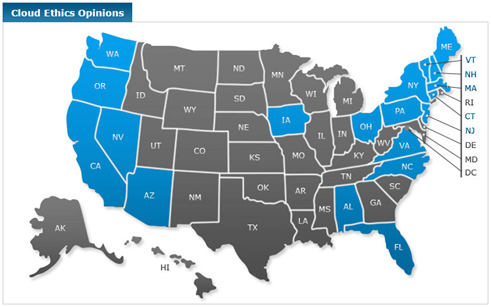
The Legal Technology Resource Center (LTRC) of the American Bar Association’s (ABA) web site has a page titled Cloud Ethics Opinions Around the U.S., where the ABA provides an interactive map of the states (see the image of it above), with the states that have published ethics opinions shown in blue.  Oddly enough, Wisconsin is not shown in blue, though they appear to have published an ethics opinion earlier this year.  On the actual site, you can either click on the state to scroll down to it or manually scroll down to the state by name alphabetically (the list still has “Nevada” after “New Hampshire”, “New Jersey” and “New York” for some reason).  Anyway, according to the ABA, here are the states that have published ethics opinions – with links to each state’s opinion (note that several of the links on the ABA site are not working, so we found the correct links and are providing them below):

If you counted, we’re up to 20 total states with opinions – less than 40% of the total state jurisdictions (when you include DC).

As noted previously, the ABA site provides two tabs below the interactive map to highlight the opinions:

  • Quick Reference tab that identifies whether cloud usage for client data is permitted (so far, all states say “Yes”), the standard for use (currently all states with opinions enforce a reasonable care standard) and a bullet point list of specific requirements or recommendations;
  • Opinion Summaries tab that provides a brief summary for each of the opinions.

Hopefully, the next time we check, a majority of the states will have published their own opinions by then.

So, what do you think? Are you surprised that more states don’t have published cloud ethics opinions?  Please share any comments you might have or if you’d like to know more about a particular topic.

Disclaimer: The views represented herein are exclusively the views of the author, and do not necessarily represent the views held by CloudNine. eDiscovery Daily is made available by CloudNine solely for educational purposes to provide general information about general eDiscovery principles and not to provide specific legal advice applicable to any particular circumstance. eDiscovery Daily should not be used as a substitute for competent legal advice from a lawyer you have retained and who has agreed to represent you.
Even Lawyers Need Love Sometimes: eDiscovery Trends

If you work in the legal industry, you’ve probably heard this joke.  What do you call 5,000 lawyers at the bottom of the ocean?  A good start.  Get it?  It’s easy to joke about hating lawyers and some of us may not be joking.  But, even lawyers need love sometimes.  Believe it or not, today is National Love Your Lawyer Day.

As noted in this press release, National Love Your Lawyer Day was established in 2001 by the American Lawyers Public Image Association (ALPIA).  It’s a day in which lawyers and judges are celebrated for all the good they do, often thanklessly. On this day, the public is asked to let their favorite legal eagles know how much they love and appreciate them. “Call your attorney and say Happy Lawyer’s Day! or thanks for a doing a great job, or even send a gift, flowers or a card,” says Nader Anise, Executive Director of ALPIA. “Lawyers are always painted as the bad guy, even if they pull off some crazy Houdini-esque maneuvers to help their clients. We’re hoping this day will spark public interest in commending lawyers rather than condemning them.”  She didn’t say write a blog post about them, but that’s how I show my love.  :o)

And don’t even think about bad-mouthing lawyers on Love Your Lawyer Day – that is, unless you’re holding a wad of cash. Not only is lawyer bashing a big no-no and considered in poor taste, but anyone unable to bridle his tongue from verbally jabbing lawyers (late-night talk show hosts take note) is being asked to donate a $20 “fine” per joke to the charity of his choice.  Hope that joke in the intro of this post doesn’t count, I’m tapped out.  :o(

Anyway, those of us in the eDiscovery industry have been known to grumble from time to time about how the expertise of lawyers in eDiscovery continues to be lacking, despite ethics guidance from sources such as American Bar Association (ABA) Model Rule 1.1, which discusses competent representation to a client and includes a comment (Comment 8) which states that “a lawyer should keep abreast of changes in the law and its practice, including the benefits and risks associated with relevant technology”.  And, states are beginning to provide opinions regarding an attorney’s ethical duties in the handling of discovery of electronically stored information, as California did recently (Proposed Formal Opinion Interim No. 11-0004 has now become Formal Opinion No. 2015-193).

At CloudNine, we love lawyers every day, not just today.  To do our part in helping lawyers get up to speed on eDiscovery, we have, of course, provided this blog each day for over five years now to help educate lawyers (as well as others in our profession).  We have also begun offering a one-hour session (CLE approved in Texas) titled What Every Attorney Should Know about eDiscovery in 2015 (pretty soon, we’ll have to update the title).  We cover key terms to know, the EDRM model, Federal and State rules and resources, ethics considerations (the course includes a .25 ethics credit) and we cover key cases important to the evolution of electronic discovery.

We have conducted this CLE session for a few firms in the past few months and it has been very well received.  If your firm might be interested in this presentation (especially if you’re in the Houston area or somewhere in Texas), drop me a line at daustin@cloudnincloudnine.comm.  We’ll be happy to show you our love!

So, what do you think?  Are you looking for some CLE credit opportunities?  Please share any comments you might have or if you’d like to know more about a particular topic.

Disclaimer: The views represented herein are exclusively the views of the author, and do not necessarily represent the views held by CloudNine. eDiscovery Daily is made available by CloudNine solely for educational purposes to provide general information about general eDiscovery principles and not to provide specific legal advice applicable to any particular circumstance. eDiscovery Daily should not be used as a substitute for competent legal advice from a lawyer you have retained and who has agreed to represent you.

If You’re Going to Mine for Metadata in New Jersey, You May Want to Think Twice: eDiscovery Best Practices

A newly proposed adjustment to ethics rules in New Jersey would restrict attorneys from accessing metadata in documents if the metadata was inadvertently sent.

As discussed in the New Jersey Law JournalProposal Burdens Recipient in Ethics of Metadata E-Discovery, by David Gialanella (subscription required) – attorneys would be permitted to access the embedded metadata of documents produced in electronic discovery, but only as long as the metadata doesn’t appear to have been transmitted in error – the same way New Jersey lawyers have been required to treat the paper and electronic documents themselves.  The recommendation came from the Working Group on Ethical Issues Involving Metadata in Electronic Documents, which also urged discovery rule amendments.

In some cases, metadata can be accessed easily, and in others it must be “mined” using sophisticated software.  One big issue is that many (if not most) in the legal profession don’t know how metadata works and some don’t even know what it is.  Reviewing ethics opinions of other jurisdictions, the Working Group “found no consensus – indeed, no clear majority view – in the opinions of other jurisdictions with respect to the ethical implications of a lawyer’s review of unrequested metadata in a document transmitted to that lawyer.”  So, the Group had to make its own recommendations.

In its Report and Recommendations to the Supreme Court, dated September 14, 2015, the Working Group recommended:

  • That an Official Comment be added to New Jersey Rule of Professional Conduct 4.4(b) stating that lawyers who receive electronic documents may review unrequested metadata, provided that the receiving lawyer reasonably believes that the metadata was not inadvertently sent;
  • That the civil discovery rules be amended (and new Official Comments added) to highlight issues pertaining to metadata;
  • That steps be taken to minimize the disclosure of metadata in documents electronically filed with the Judiciary; and
  • That judges, lawyers, and law students be educated about metadata issues as a component of judicial education programs, continuing legal education, and law school curricula.

The Working Group recommended the following changes to Rule of Professional Conduct 4.4(b) (additions underlined and shown in red, deletions bracketed and shown in blue):

(b) A lawyer who receives a document or electronic information and has reasonable cause to believe that the document or information was inadvertently sent shall not read the document or information or, if he or she has begun to do so, shall stop reading [the document,] it. The lawyer shall (1) promptly notify the sender[,] and (2) return the document or information to the sender and, if in electronic form, delete it and take reasonable measures to assure that the information is inaccessible.

With regard to metadata in discovery, the Working Group “decided not to recommend any particular approach to metadata in discovery as a general default position”, but did recommend that the general Civil Part discovery rule, Rule 4:10-2, be amended to specifically address metadata in electronic documents.

A copy of the report can be found in the New Jersey Courts website here.

So, what do you think?  Is it unethical for attorneys to review inadvertently sent metadata?  Should discovery rules address the ethics of receiving metadata specifically?  Please share any comments you might have or if you’d like to know more about a particular topic.

Disclaimer: The views represented herein are exclusively the views of the author, and do not necessarily represent the views held by CloudNine. eDiscovery Daily is made available by CloudNine solely for educational purposes to provide general information about general eDiscovery principles and not to provide specific legal advice applicable to any particular circumstance. eDiscovery Daily should not be used as a substitute for competent legal advice from a lawyer you have retained and who has agreed to represent you.