eDiscoveryDaily

Befuddled by BYOD? The Sedona Conference Has a New Set of Principles to Guide You: eDiscovery Best Practices

Many organizations are permitting (or even encouraging) their employees to use their own personal devices to access, create, and manage company related information – a practice commonly referred to as Bring Your Own Device (BYOD).  But, how can those organizations effectively manage those BYOD devices to meet their discovery obligations?  To help with that issue, The Sedona Conference® (TSC) has published an initial Public Comment Version of a Commentary to help.

In late January, TSC and its Working Group 1 on Electronic Document Retention and Production (WG1) rolled out the Public Comment version of its Commentary on BYOD: Principles and Guidance for Developing Policies and Meeting Discovery Obligations.  The Commentary is designed to help organizations develop and implement workable – and legally defensible – BYOD policies and practices. This Commentary also addresses how creating and storing an organization’s information on devices owned by employees impacts the organization’s discovery obligations.  It focuses specifically to mobile devices that employees “bring” to the workplace (not on other “BYO” type programs) and does not specifically address programs where the employer provides the mobile device.

The Commentary begins with five principles related to the use of BYOD programs and continues with commentary for each.  Here are the five principles:

  • Principle 1: Organizations should consider their business needs and objectives, their legal rights and obligations, and the rights and expectations of their employees when deciding whether to allow, or even require, BYOD.
  • Principle 2: An organization’s BYOD program should help achieve its business objectives while also protecting both business and personal information from unauthorized access, disclosure, and use.
  • Principle 3: Employee-owned devices that contain unique, relevant ESI should be considered sources for discovery.
  • Principle 4: An organization’s BYOD policy and practices should minimize the storage of––and facilitate the preservation and collection of––unique, relevant ESI from BYOD devices.
  • Principle 5: Employee-owned devices that do not contain unique, relevant ESI need not be considered sources for discovery.

The Commentary weighs in at a tidy 40 page PDF file, which includes a couple of appendices.  So, it’s a fairly light read, at least by TSC standards.  :o)

TSC is encouraging public comment on the Commentary on BYOD, which can be downloaded free from their website here (whether you’re a TSC member or not). They encourage Working Group Series members and others to spread the word and share the link (you’re welcome!) so they can get comments in before the public comment period closes on March 26. Questions and comments may be sent to comments@sedonaconference.org.  So, you have a chance to be heard!

Speaking of mobile devices, I’m excited to be speaking this year for the first time at the University of Florida Law E-Discovery Conference on March 29.  I’m on a panel discussion in a session titled Getting Critical Information From The Tough Locations – Cloud, IOT, Social Media, And Smartphones! with Craig Ball, Kelly Twigger, and with The Honorable Amanda Arnold Sansone, Magistrate Judge in Florida, moderating.  As always, the conference will be conducted in Gainesville, FL (as well as being livestreamed), with CLE-accredited sessions all day from 8am to 5:30pm ET, with an all-star collection of speakers.  I’ll have more to say about the conference as we get closer to it.  Click here to register!

So, what do you think?  Does your organization have a BYOD policy?  Please share any comments you might have or if you’d like to know more about a particular topic.

Sponsor: This blog is sponsored by CloudNine, which is a data and legal discovery technology company with proven expertise in simplifying and automating the discovery of data for audits, investigations, and litigation. Used by legal and business customers worldwide including more than 50 of the top 250 Am Law firms and many of the world’s leading corporations, CloudNine’s eDiscovery automation software and services help customers gain insight and intelligence on electronic data.

Disclaimer: The views represented herein are exclusively the views of the author, and do not necessarily represent the views held by CloudNine. eDiscovery Daily is made available by CloudNine solely for educational purposes to provide general information about general eDiscovery principles and not to provide specific legal advice applicable to any particular circumstance. eDiscovery Daily should not be used as a substitute for competent legal advice from a lawyer you have retained and who has agreed to represent you.

Glitch in the Matrix – The Vital Role of Communication Between All Stakeholders in eDiscovery: eDiscovery Best Practices

Editor’s Note: Jim Gill’s writing about eDiscovery and Data Management has been twice recognized with JD Supra Reader’s Choice Awards and he holds an MFA in Creative Writing from Southern Illinois University, Carbondale.  Before working in eDiscovery, Jim taught college writing at a number of institutions and his creative work has been published in numerous national literary journals, as well as being nominated for a Pushcart Prize.

Jim’s post below highlights the importance of communications between all stakeholders in the discovery process.  Here’s an example of what can happen when communications break down.  For more information on how CloudNine manages communications for our clients, contact us at info@cloudnine.com.

But first, this week’s eDiscovery Tech Tip of the Week is about Filtering Your Document Collection.  Some attorneys like to load data and get started right away with searching, before they cull out duplicates and clearly non-responsive files.  This can drive up review and production costs and lead to inconsistency in review.  If data for several custodians in an organization is collected for review, many of them will have the same files and emails, especially when those emails are sent to large groups or all employees, so there’s generally no need to review them more than once.  Every file has a digital fingerprint known as a HASH value and all files with the same content in the same format will have the same HASH value, so you can set aside all of the duplicates after the first file.  Domain categorization and relevant date range identification are other areas where you can effectively cull before searching.  The ability to select specific clearly non-responsive domains or collected files outside of the relevant date range and put them quickly into the non-responsive “bucket” can save a lot of time in review and production.

The good news is that the process of filtering that redundant or clearly non-responsive ESI today can be largely automated.  To see an example of how Filtering Your Document Collection is conducted using our CloudNine platform, click here (requires BrightTalk account, which is free).

—————————————————–

In an article by Morgan Chalfant at The Hill posted on January 25th, it was reported that text messages between two FBI employees that were sought by Congressional and Justice Department investigators had not been preserved due to a “glitch” that not only affected the messages in question, but nearly 3,500 FBI devices, “close to 10 percent of cell phones used by bureau employees”.

In this day and age, where data hacks and cyber-espionage are no longer the realm of near-future science fiction, cries of a conspiracy were quickly sounded. But the reality, according to FBI officials, was “that the messages were not preserved as a result of misconfiguration issues related to software upgrades of FBI-provided Samsung 5 mobile phones that conflicted with the bureau’s archiving efforts.”

As more and more tools and applications move to cloud-based platforms, particular awareness has to be taken when it comes to automatic system updates. Last year, when it seemed everyone in eDiscovery was moving or planning to move to Microsoft Office 365, one thing that users noted (particularly those in legal departments) was that they weren’t notified about the updates, either because IT didn’t communicate the updates to users in Legal, or the users in Legal didn’t notice when IT did communicate the updates. Some of these early O365 updates would change settings back to a default, resulting in problems related to retention and preservation. It seems a similar issue is what happened with the FBI’s phones.

This brings up a couple of challenges that are common in eDiscovery:

  • First, the need for clear communication between all stakeholders involved in the process — Legal, IT, Lit Support, Project Managers, Security, Business Units, etc. Information moves fast enough as it is, and when you add elements like automatic updates to the mix, it’s extremely difficult to keep up. Most people don’t track when the apps on their phone update. You might notice it happening via a push notification, but unless the app stops working the same way or a new feature or interface pops up, we simply move on. Apparently, even the FBI does this. So this is why it’s important to create communication protocols surrounding technology changes ahead of time, so that things like this aren’t missed.
  • And second, the need for having a good working relationship with software vendors / providers. More and more, the role of industry third-parties can provide insight, training, and support for the smooth operation of your team’s information governance and eDiscovery operations. With software platforms moving to the cloud, vendors have more and more control over your organization’s processes (which isn’t a bad thing, because they most likely have more technical knowledge on making things run successfully). If you can find a vendor that understands your organization’s needs and is willing to develop a solid working relationship with your eDiscovery team, then when glitches do arise, it’s much easier to handle them.

When things go wrong in a big way, it’s tempting to blame it on the technology (or even better the unknown wizards behind the curtain who created it). Which is all the more reason why legal teams need to incorporate experts who understand the technology and how it affects (or could potentially affect) operations, and then foster regular and open communications with all parties involved, so that everyone knows how to avoid potential problems, or when they do, there are policies and protocols in place for quickly bringing things back in working order.

So, what do you think?  How do you manage communications with stakeholders in your organization?  Please share any comments you might have or if you’d like to know more about a particular topic.

Sponsor: This blog is sponsored by CloudNine, which is a data and legal discovery technology company with proven expertise in simplifying and automating the discovery of data for audits, investigations, and litigation. Used by legal and business customers worldwide including more than 50 of the top 250 Am Law firms and many of the world’s leading corporations, CloudNine’s eDiscovery automation software and services help customers gain insight and intelligence on electronic data.

Disclaimer: The views represented herein are exclusively the views of the author, and do not necessarily represent the views held by CloudNine. eDiscovery Daily is made available by CloudNine solely for educational purposes to provide general information about general eDiscovery principles and not to provide specific legal advice applicable to any particular circumstance. eDiscovery Daily should not be used as a substitute for competent legal advice from a lawyer you have retained and who has agreed to represent you.

Court Denies Plaintiffs’ Request to Email All Defendant Employees as “Simply Unreasonable”: eDiscovery Case Law

In Firefighters’ Ret. Sys., et al. v. Citco Grp. Ltd., et al., No. 13-373-SDD-EWD (M.D. La. Jan. 3, 2018), Louisiana Magistrate Judge Erin Wilder-Doomes denied the plaintiffs’ renewed motion to compel after the parties previously agreed upon search terms and document custodians, stating that the plaintiffs’ request to “email everyone in every Citco entity to ask whether anyone employed by any Citco entity has knowledge relevant to this litigation, and thereafter require the Citco Defendants to conduct additional electronic and hard copy searches for documents” was “simply unreasonable” and would be “unduly burdensome”.

Case Background

In this case regarding claims of unjust enrichment and breach of contract (among others) regarding fund shares purchased for $100 million that ultimately turned out to be worthless, the plaintiffs previously filed a Motion to Compel seeking an order compelling Citco Group to respond to multiple interrogatories and requests for production based upon the knowledge of entities controlled by Citco Group and/or possession of documents by entities controlled by the Citco Group.  In response, the Citco Defendants argued that granting Plaintiffs’ motion would ignore the substantial discovery efforts already made in the case (as the parties had previously agreed to a scope of 56 search terms to be applied against 21 custodians) and would be incompatible with the proportionality requirement of the federal rules.

The Initial Motion to Compel was discussed during an October 2017 status conference with the parties, and the court found that Plaintiffs’ concerns should be addressed with a 30(b)(6) deposition of defendant’s corporate counsel to describe the process for locating responsive documents (and denied the Initial Motion without prejudice to re-urging following the corporate deposition).  After the 30(b)(6) deposition, the plaintiffs filed a Renewed Motion to Compel, contending that the defendants’ responses to these interrogatories “were incomplete and inaccurate” and resulted in “a flawed list of custodians” and a “flawed electronic search for documents.”  They also contended that the defendants’ 30(b)(6) deponent confirmed that “one email can be sent to everyone in the Citco organization and ask them limited questions about their personal knowledge of the issues in this lawsuit”.  The defendants objected, asserting that any additional searches (beyond the previously agreed scope) based on an e-mail questionnaire to all employees “would be disproportional to the needs of this case”.  A December 2017 status conference failed to resolve the dispute.

Judge’s Ruling

Judge Wilder-Doomes reiterated that “Based on the parties’ correspondence, the parties agreed upon 56 search terms and…21 document custodians”.  She also observed that “Plaintiffs still have not explained why the custodians and search terms used were unreasonable. Moreover, although the Citco Defendants have been willing to add additional search terms during the course of this litigation, and note in opposition to the Renewed Motion to Compel that they are ‘prepared to discuss with Plaintiffs additional document custodians (if Plaintiffs identify any),’ Plaintiffs failed to identify proposed additional custodians in either their Renewed Motion to Compel or during the December 12, 2017 status conference.”

In denying the Renewed Motion to Compel, Judge Wilder-Doomes stated: “Instead, Plaintiffs seek permission from this court to email everyone in every Citco entity to ask whether anyone employed by any Citco entity has knowledge relevant to this litigation, and thereafter require the Citco Defendants to conduct additional electronic and hard copy searches for documents. That is simply unreasonable, and in essence is a request for the Citco Defendants to ‘go back to square one’ of their document production efforts despite the parties’ agreement regarding custodians and search terms, the Citco Defendants apparent willingness to consider additional custodians and search terms, and Plaintiffs failure to identify or explain the necessity of any additional custodians or search terms. Further, such a large scale search raises proportionality concerns and, especially in light of the parties’ previous agreements and efforts, would be unduly burdensome.”

So, what do you think?  Was this request a “fishing expedition” by the plaintiffs?  Please share any comments you might have or if you’d like to know more about a particular topic.

Case opinion link courtesy of eDiscovery Assistant.

Sponsor: This blog is sponsored by CloudNine, which is a data and legal discovery technology company with proven expertise in simplifying and automating the discovery of data for audits, investigations, and litigation. Used by legal and business customers worldwide including more than 50 of the top 250 Am Law firms and many of the world’s leading corporations, CloudNine’s eDiscovery automation software and services help customers gain insight and intelligence on electronic data.

Disclaimer: The views represented herein are exclusively the views of the author, and do not necessarily represent the views held by CloudNine. eDiscovery Daily is made available by CloudNine solely for educational purposes to provide general information about general eDiscovery principles and not to provide specific legal advice applicable to any particular circumstance. eDiscovery Daily should not be used as a substitute for competent legal advice from a lawyer you have retained and who has agreed to represent you.

Thoughts About Legaltech New York 2018: eDiscovery Trends

We’ve completed another LegalTech New York (LTNY) (a subset of “Legalweek”).  What did attendees at the conference think about this year’s show?  Let’s take a look.

As I’ve done the past couple of years, I reached out to several attendees (some of whom I met with during the show) to get their thoughts and impressions of this year’s show.  As always, these should be taken as their personal opinions and observations regarding the show, not those of their employer or clients.  With that in mind, here is what they had to say:

Shawn Gaines, Director of Product and Community Marketing at Relativity: “Although every conversation I had at the show seemed to hit on the fact that the show itself seemed much cozier than in the past—exemplified by the consolidated expo hall—there was still plenty of energy in the places the show really happens: conference rooms and meeting suites, restaurants and happy hours, and even some local venues.  Beyond that, conversations tended to turn away from typical e-discovery topics to the innovations coming out on top of it—the folks doing more with their existing platforms, developing new applications and integrations to make the best use of what they have.”

Tom O’Connor, Director at Gulf Coast Legal Technology Center: “Attendance was clearly down and the number of exhibitors was spread out over half a dozen local hotels.  Educational content continues to be predominantly infomercials for major sponsors. Main benefit to me was as a B2B forum and that aspect was very good.”

Ralph Losey, E-Discovery Lawyer at Jackson Lewis, P.C. and Author of E-Discovery Team: “LegalTech seems to have outgrown its old home at the Hilton. They should find a bigger space elsewhere.”

Rob Robinson, Data and Legal Discovery Technologist, ComplexDiscovery Blog and CloudNine: “On the eDiscovery front, Legaltech continues to be a galvanizing and polarizing conference at the same time. Galvanizing in the fact of the idealistic yet tangible excitement generated during the event by the sharing and championing of new technologies and approaches to solving eDiscovery challenges. Polarizing in the fact that when viewed through the lens of event participation, the gap between the well-funded and well-connected companies and commentators and those not as well financed or connected appears to be increasing. This increasing gap prevents many great products and points of view from breaking through the noise of paid advertising, sponsorships, and relationships and may be one of the contributing factors to the perceived decrease in status and the actual decrease in provider participation in one of the most successful event franchises in the history of eDiscovery. The benefits of galvanization may continue to outweigh the detriments of polarization, but not by as much as in past years.”

Michele C.S. Lange, Freelance writer and attorney: “If you left Legalweek and learned nothing about machine learning, deep learning or supervised learning, you attended some other random conference. This was the year to dig deep on AI.”

Jason R. Baron, Of Counsel at Drinker Biddle & Reath LLP: “I was heartened to see “AI” being discussed everywhere one travelled at Legaltech this year.  The movement toward embracing smarter analytics in e-discovery (predictive coding, TAR, etc.) now looks to be a “feature” of a more comprehensive discussion we are engaged in as to how the law should embrace all manner of artificial intelligence in connection with the Internet of Things and beyond.    I also appreciated more sophisticated attention being paid to ethical aspects of the coming AI revolution, in sessions such as the one moderated by Martin Tully and including Ralph Losey and Shannon Kirk discussing E-Discovery in the Year 2048: What the Future Holds.  In my mind, however, we need not wait until 2048 to discuss whether public and private sector institutions should be creating algorithmic review boards (similar to existing IRBs for human subjects) to review potential bias and discrimination in the use of algorithmic inputs, or other novel issues involving big data aggregation and surveillance.  The future is coming faster than anyone in the “ESI” universe of ediscovery ever imagined, as this year at Legaltech made abundantly clear.

David Horrigan, Discovery Counsel & Legal Education Director at Relativity: “Not surprisingly, just about every poll will put “artificial intelligence” at the top of the Legalweek 18 takeaway list, but it was a different conversation this time. The educational sessions did a good job of taking the discussions beyond the HAL 9000 nightmare of the robots taking all jobs, bitcoins, and lives as we know them. There were efforts made to define artificial intelligence—not unlike those erstwhile attempts to define “information governance”—but there were also practical privacy analyses, such as the HIPAA considerations of robots dispensing medications. Overall, the conversation went beyond fear and loathing to embracing and regulating.”

Craig Ball, eDiscovery Thought Leader and Author of Ball in Your Court blog: “LegalTech is like a party that keeps going long after the host has gone to bed.  Its deep value lies in the conversations in the halls, balls and barroom stalls of Midtown West. “What are you working on?”  “Have you heard about…?”  “We bought their product and it was a disaster/delight.”  The Hilton’s still the hub, but the action’s in its orbit.  New York supplies the juice.”

– – – – – – – – – – – – – – – – – – – – – – –

As for my own thoughts, the conference seemed smaller yet again this year, especially in the exhibit hall.  One colleague pointed out to me that the number of exhibitors (not companies that were listed as “LegalCIO” or “Business of Law” participants) was down again this year.  Industry consolidation or lack of willingness of providers to participate or both?  You decide.  As for the sessions, I attended a handful in between meetings and they were high quality once again.  I heard some raise concerns that the sessions were mere vendor infomercials, but I didn’t see that in the ones I attended – they were good quality with knowledgeable panelists.  AI and GDPR were the topics of the year, and rightly so.

I think ALM needs to (finally) consider moving Legaltech to a new venue as much of the activity is conducted in suites in hotels like the London and Warwick.  Rob used the terms “galvanizing” and “polarizing” above and I think those terms wonderfully describe the state of the conference today.  A lot of people rarely or never make it over to the exhibit hall or the sessions.  A venue that includes plenty of breakout rooms onsite would – if the breakout rooms were priced reasonably – keep all attendees plugged into the heart of the conference instead of disbursed.  And, it could keep those vendors who currently don’t participate engaged at some level so that a $2,500 attendance fee for non-participating vendors wouldn’t be necessary.  Creative thinking is needed for Legaltech to remain among the most important conferences each year.

So, what do you think?  Did you attend this year’s Legaltech?  If so, what did you think of the conference?  Please share any comments you might have or if you’d like to know more about a particular topic.

Sponsor: This blog is sponsored by CloudNine, which is a data and legal discovery technology company with proven expertise in simplifying and automating the discovery of data for audits, investigations, and litigation. Used by legal and business customers worldwide including more than 50 of the top 250 Am Law firms and many of the world’s leading corporations, CloudNine’s eDiscovery automation software and services help customers gain insight and intelligence on electronic data.

Disclaimer: The views represented herein are exclusively the views of the author, and do not necessarily represent the views held by CloudNine. eDiscovery Daily is made available by CloudNine solely for educational purposes to provide general information about general eDiscovery principles and not to provide specific legal advice applicable to any particular circumstance. eDiscovery Daily should not be used as a substitute for competent legal advice from a lawyer you have retained and who has agreed to represent you.

Ready for GDPR? Here’s a Webcast that Can Help You Get Ready: eDiscovery Best Practices

If you think that your organization isn’t subject to the requirements of Europe’s impending General Data Protection Regulation (GDPR), you may be wrong about that.  If it is, are you on target to be compliant by May 25?  Here’s a chance to find out what you need to know to be compliant.

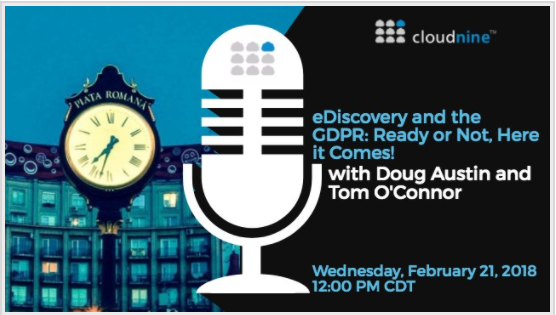
On Wednesday, February 21 at noon CST (1:00pm EST, 10:00am PST), CloudNine will conduct the webcast eDiscovery and the GDPR: Ready or Not, Here it Comes! In this one-hour webcast that’s CLE-approved in selected states, we will discuss how data privacy requirements have evolved over time, the parameters associated with the GDPR, what they mean to your organization and what steps your organization needs to take to ensure compliance with the GDPR.  Topics include:

  • How Data Privacy Requirements Have Evolved in the US and Europe
  • Scope of the GDPR Beyond the EU
  • A Definitional Baseline for GDPR
  • Important Changes and Organizational Impact
  • Data Existence and GDPR Compliance
  • Challenges Presented by Privacy Rights Associated with the GDPR
  • Fines: The Potential Cost of Non-Compliance
  • Business of the GDPR: Controllers and Processors
  • Steps to Take to Comply with the GDPR

Once again, I’ll be presenting the webcast, along with Tom O’Connor, who recently wrote an article about GDPR that we covered as a four part blog series.  To register for it, click here.  Even if you can’t make it, go ahead and register to get a link to the slides and to the recording of the webcast (if you want to check it out later).  Doing so might just keep you from a fine of the GREATER of €10 million or 2% of global annual revenue!

So, what do you think?  Are you ready for GDPR?  Please share any comments you might have or if you’d like to know more about a particular topic.

Sponsor: This blog is sponsored by CloudNine, which is a data and legal discovery technology company with proven expertise in simplifying and automating the discovery of data for audits, investigations, and litigation. Used by legal and business customers worldwide including more than 50 of the top 250 Am Law firms and many of the world’s leading corporations, CloudNine’s eDiscovery automation software and services help customers gain insight and intelligence on electronic data.

Disclaimer: The views represented herein are exclusively the views of the author, and do not necessarily represent the views held by CloudNine. eDiscovery Daily is made available by CloudNine solely for educational purposes to provide general information about general eDiscovery principles and not to provide specific legal advice applicable to any particular circumstance. eDiscovery Daily should not be used as a substitute for competent legal advice from a lawyer you have retained and who has agreed to represent you.

Do You Know How Many eDiscovery Blogs There Are? Maybe More Than You Think: eDiscovery Trends

If you want to go to one place to find as many as 60 good eDiscovery blogs, Feedspot has created a list of the Top 60 eDiscovery Blogs and Websites For eDiscovery Professionals.

According to their listing here, these are the “Best eDiscovery blogs from thousands of top eDiscovery blogs in our index using search and social metrics.”  Data regarding the blogs “will be refreshed once a week.”

Feedspot has ranked the blogs based on following criteria:

  • Google reputation and Google search ranking
  • Influence and popularity on Facebook, twitter and other social media sites
  • Quality and consistency of posts.
  • Feedspot’s editorial team and expert review

According to those criteria, these are the top 10 blogs:

  1. CloudNine – eDiscoveryDaily
  2. KLDiscovery | The Ediscovery Blog
  3. Complex Discovery
  4. E-Discovery Team
  5. Ball in your Court | Musings on e-discovery & forensics
  6. eDisclosure Information Project
  7. eDiscovery Journal
  8. D4: eDiscovery and Data Management Blog
  9. Bow Tie Law – Knotty Issues of eDiscovery
  10. Casepoint | Full-strength eDiscovery platform

That’s right, eDiscovery Daily is ranked the top blog by Feedspot!  We’re honored and grateful for the recognition.  Feedspot also gave all of the blogs a nice little badge that we can display on our site to reflect their recognition (which is displayed at the top of this post).

For each blog, Feedspot identifies the number of Facebook fans (we have 97), Twitter followers (5,597) and Alexa rank (1,496,973 – there’s a lot of blogs out there, clearly).  The site also indicates the Frequency of posts and how long the blog has been around (for us, that’s since Sept 2010).

As someone who writes a daily blog, I have tremendous respect for all of the blogs on this list and couldn’t write this one without referencing some of the great stories and info in these other blogs.  There’s a lot of great information about eDiscovery on these blogs!

So, what do you think?  How many of these blogs do you read?  Besides ours, of course!  :o)  As always, please share any comments you might have or if you’d like to know more about a particular topic.

Sponsor: This blog is sponsored by CloudNine, which is a data and legal discovery technology company with proven expertise in simplifying and automating the discovery of data for audits, investigations, and litigation. Used by legal and business customers worldwide including more than 50 of the top 250 Am Law firms and many of the world’s leading corporations, CloudNine’s eDiscovery automation software and services help customers gain insight and intelligence on electronic data.

Disclaimer: The views represented herein are exclusively the views of the author, and do not necessarily represent the views held by CloudNine. eDiscovery Daily is made available by CloudNine solely for educational purposes to provide general information about general eDiscovery principles and not to provide specific legal advice applicable to any particular circumstance. eDiscovery Daily should not be used as a substitute for competent legal advice from a lawyer you have retained and who has agreed to represent you.

In the Market for an eDiscovery Solution? Check Out this Buyers Guide: eDiscovery Trends

If you’re a small to medium sized law firm and you have yet to “dip your toe” into the water of selecting an eDiscovery solution (or are unhappy with the one you have selected), a couple of legal technologists have created a terrific new 2018 eDiscovery Buyers Guide to provide education about the alternatives to help you select a solution that’s right for you.

Brett Burney of Burney Consultants and Chelsey Lambert of Lex Tech Review have reviewed twenty different products in the guide, which is contained in a comprehensive (but easy to read) 89 page PDF document.  As noted in the Introduction, their eDiscovery Buyers Guide has two primary goals:

First, it is a literal “Buyers Guide” to “provide you with options available to you and your firm so you can avoid the manual, time-wasting, and ineffective processes you’re currently using”. Each review is written to explain exactly what features and capabilities each tool offers to facilitate an informed decision.

Second, the eDiscovery Buyers Guide “empowers you to be a more knowledgeable, competent, and trusted counselor. While you personally won’t use all of the products featured in this Guide, your clients might benefit from them in their own data collection efforts based on your recommendation. Plus having some knowledge about other products means you can talk intelligently with opposing counsel on the products they’re using so you don’t look ignorant or uninformed.”

Knowledge is power, right?

Anyway, the key differentiator between this guide and others that have been written over the years is that this one is tailored to the small to mid-size firm audience, so it’s written with the idea that you’re at a firm that doesn’t have a huge budget for eDiscovery.  Fortunately, there are still solutions for you.

The guide includes reviews for products in several categories, including Case Analysis & Chronologies, Social Media Collection & Web Capture, Data Identification & Collection and three categories of Processing & Review applications: Desktop Software, Hosted Solutions and Cloud-Based SaaS Platforms.  A.I. & Data Analysis in eDiscovery, eDiscovery Managed Services and Utilities for Litigators reviews are included as well.  Each review includes a “Why You Should Consider” the product section that sums up several key benefits of the offering and succinctly describes differentiation points.

CloudNine is included in the largest category – Cloud-Based SaaS Platforms for Processing & Review (seven total applications reviewed), which maybe means that this is a good area to be in, right?  :o)  Regardless, we appreciate the opportunity to be included and Brett’s review of our platform covers a number of key functional areas and their benefits to the user of the product, as well as addressing pricing info.

However, the Buyer’s Guide doesn’t just include reviews, it also includes articles from several key thought leaders in the industry, including Amy Bowser Rollins, Craig Ball, Tom O’Connor and Rob Robinson.  Chelsey also wrote a terrific article on Artificial Intelligence and Machine Learning Innovation in eDiscovery.  And, they were also nice enough to include an article from me on cloud automation and how it has made eDiscovery more affordable than ever.

All of the reviews and articles can serve to educate you to make a more informed decision when you decide to consider selecting the eDiscovery solution for your firm.

You can download the guide – for free! – here.

So, what do you think?  Do you have an eDiscovery solution in house?  As always, please share any comments you might have or if you’d like to know more about a particular topic.

Sponsor: This blog is sponsored by CloudNine, which is a data and legal discovery technology company with proven expertise in simplifying and automating the discovery of data for audits, investigations, and litigation. Used by legal and business customers worldwide including more than 50 of the top 250 Am Law firms and many of the world’s leading corporations, CloudNine’s eDiscovery automation software and services help customers gain insight and intelligence on electronic data.

Disclaimer: The views represented herein are exclusively the views of the author, and do not necessarily represent the views held by CloudNine. eDiscovery Daily is made available by CloudNine solely for educational purposes to provide general information about general eDiscovery principles and not to provide specific legal advice applicable to any particular circumstance. eDiscovery Daily should not be used as a substitute for competent legal advice from a lawyer you have retained and who has agreed to represent you.

Thursday LTNY 2018 Sessions: eDiscovery Trends

As noted yesterday and Tuesday, Legaltech® New York (LTNY) is happening this week and eDiscovery Daily is here to report about the latest eDiscovery trends being discussed at the show.  This is the last day to check out the show if you’re in the New York area with a number of sessions available and over 200 exhibitors providing information on their products and services, including our company, CloudNine at booth #533.

While at the show, we will (for the eighth year in a row!) be interviewing several industry thought leaders to see what they think are the significant trends for 2017 and, which of those are evident at LTNY.  After the show, we will announce the series of thought leader interviews and identify when each will be published, so mark your calendars!

There are plenty of interesting sessions today.  Sessions in the main conference tracks include:

11:00 AM – 12:00 PM:

George Orwell’s The Animal Farm and Prepping for Disaster

Are your information assets properly protected? Hurricanes Maria, Harvey and Irma. Earthquakes in Mexico City. Equifax hacks and security breaches. All of these and a host of other events present real risks and hazards to your organization’s information assets. And your information is the lifeblood of critical business operations. In this session, the panelists will discuss how risk assessments and ranking risk should be applied in managing and protecting information assets. What are the hallmarks of vital records? How do you know if an information system is vital? What if the vital records and systems are stored in the cloud? And most of all, what can we learn from George Orwell and the Animal Farm?

Speakers to include: MODERATOR: Jason Stearns, Director – Legal and Compliance Group, BlackRock; SPEAKERS: Patsy Pritchett, Sr. Business Continuity Consultant, Aflac; Jeffrey Sharer, Partner, Co-Chair, Data Law Practice, Akerman LLP; Joe Mazza.

IoT, AI and Intelligent Algorithms: Our Connected Lives & The Coming War for Control

Online services have become so popular with consumers and business alike: it is estimated that 10B devices by the end of 2018 will be connected to the internet – listening, recording and analyzing our movements, conversations, behaviors, likes, dislikes and most secret habits. As we retire ‘disruption’ as the word of 2017, IoT technology has become much more than a supplement to many industries and now comprises core operations. In this session, we’ll take a deep dive into moral, ethical and legal issues surrounding the explosion of smart devices, the vast troves of data they produce and the ways in which that data should be used and protected.

Speakers to include: MODERATOR: Robert Brownstone, Chair, Electronic Information Management (EIM) Group, Technology & eDiscovery Counsel, Litigation, Fenwick & West LLP; SPEAKERS: Olga Rodstein, Head of Legal, Electric Imp, Inc.; Pallab Chakraborty, Cyber Security & Privacy Counsel, AI & Legal Technology Thought Leader; Hanley Chew, Partner, Fenwick & West LLP; Bert G. Kaminski, Chief Commercial Counsel, GE Digital.

1:00 – 2:00 PM:

Making Disposition Defensible: The Tools You Need

Despite advances in technology and legal clarifications, organizations continue to struggle with hitting the delete button on their information assets. Sometimes this is due to fundamental misunderstandings of what is legally required. But, if most organizations are honest, the reluctance to dispose of information results from lack of guidance and a proper policy framework. But, information governance experts know that such reluctance presents risks to the organization that could be mitigated. This panel of experts will identify critical components of those mitigation efforts. Among the components to be discussed will be: necessary policies and procedures, clearly defined role and accountability for the Governance Committee, collaborating with IT and Legal during the process, and guidance for handling disposition when the decision to keep or destroy is unclear.

Speakers to include: MODERATOR: John Jablonski, Managing Partner, Gerber Ciano Kelly Brady LLP; SPEAKERS: John Isaza, Partner, Records & Information Governance, Rimon; Richard Kessler, Director, KPMG.

2:15 – 3:15 PM:

Planning for Cloud Services: Records Considerations

Gartner predicts that by 2020, a ‘no cloud’ policy will be as rare as a ‘no internet’ policy is today. In fact, many organizations have a ‘cloud first’ policy. Every organization is expected to have a hybrid combination of in-house architecture and cloud-based services. They recognize the benefits of flexibility, cost efficiencies and quick implementation of new technology. However, the risks posed by legal and security concerns are often ignored. But it doesn’t have to be that way. With planning, an organization can protect its cloud-based information, make sure the information is easily accessible, while meeting its ethical, legal and compliance obligations. Our panel of experts will address critical aspects of the planning process and give ‘live from the trenches’ tips for implementation success.

Speakers to include: MODERATOR: Galina Datskovsky, CEO, Vaporstream; SPEAKERS: Ron Hedges, Senior Counsel, Dentons; John Isaza, Partner, Records & Information Governance, Rimon; Jeffrey Beard, Formerly Legal, Information Governance & GRC Leader, IBM Analytics.

In addition to these, there are other eDiscovery-related sessions today.  For a complete description for all sessions today (and for the entire show, since they’re all on one page), click here.

So, what do you think?  Did you attend LTNY this year?  If so, what did you think?  Please share any comments you might have or if you’d like to know more about a particular topic.

Sponsor: This blog is sponsored by CloudNine, which is a data and legal discovery technology company with proven expertise in simplifying and automating the discovery of data for audits, investigations, and litigation. Used by legal and business customers worldwide including more than 50 of the top 250 Am Law firms and many of the world’s leading corporations, CloudNine’s eDiscovery automation software and services help customers gain insight and intelligence on electronic data.

Disclaimer: The views represented herein are exclusively the views of the author, and do not necessarily represent the views held by CloudNine. eDiscovery Daily is made available by CloudNine solely for educational purposes to provide general information about general eDiscovery principles and not to provide specific legal advice applicable to any particular circumstance. eDiscovery Daily should not be used as a substitute for competent legal advice from a lawyer you have retained and who has agreed to represent you.

Wednesday LTNY 2018 Sessions: eDiscovery Trends

As noted yesterday, Legaltech® New York (LTNY) is happening this week and eDiscovery Daily is here to report about the latest eDiscovery trends being discussed at the show.  There’s still time to check out the show if you’re in the New York area with a number of sessions available and over 200 exhibitors providing information on their products and services, including our company, CloudNine at booth #533.

While at the show, we will (for the eighth year in a row!) be interviewing several industry thought leaders to see what they think are the significant trends for 2017 and, which of those are evident at LTNY.  After the show, we will announce the series of thought leader interviews and identify when each will be published, so mark your calendars!

I would be remiss if I didn’t also mention that CloudNine and ACEDS is hosting Drinks with Doug (that’s me!) and Mary (as in Mary Mack, Executive Director of ACEDS) and Marc Zamsky (from ComplianceDS) at Ruth’s Chris Steak House at 148 West 51st Street on Wednesday from 4:00pm to 6:00pm.  Online registration is closed, but you can join the waiting list here if you’re at the show and want to attend.  Come join us!

There are plenty of interesting sessions today.  Sessions in the main conference tracks include:

9:00 – 10:00 AM:

Legaltech Keynote – The ESI of Today and the ESI of Tomorrow

The Legaltech Judges Panel returns for 2018 to examine critical issues in ESI:

  • Rule 34(b) Implications: why are courts still struggling with lawyers who don’t know the rules have changed and why lawyers are still struggling with “reasonable time specified to respond”
  • Rule 502(d) Non-Waiver Option
  • ESI sources: now that we routinely deal with email, text messages and mobile discovery, what is happening with data sources like Bluetooth connections, wearables, medical devices or smart home video?
  • Will we see lawyers subpoena the connected car for its sensor data? How will a warrant be served on home appliances?
  • How to manage consumers’ expectations on privacy with these new ESI sources

Speakers to include: Moderator: Patrick Oot, Partner, Shook Hardy & Bacon; Panelists: Hon. Andrew J. Peck, United States Magistrate Judge, Southern District of New York, Hon. Xavier Rodriguez, United States District Judge, Western District of Texas, Hon. Joy Flowers Conti, Chief District Judge – U.S. District Court, Western District of Pennsylvania, Hon. William Matthewman, United States Magistrate Judge, Southern District of Florida.

11:00 AM – 12:00 PM:

The Role of Artificial Intelligence in Legal and Business Processes and How to Defend Its Use

A panel of leading experts will discuss what AI is (and what it is not) and explain why legal and compliance professionals may be ethically required to understand and adopt this technology. Discussion points will include how to adequately understand the technology from a governance and controls point of view to be able to withstand regulatory scrutiny. The panel will also review how professionals are integrating big data and machine learning in e-discovery, compliance, and regulatory matters. Finally, the panel will share best practices for implementing the use of advanced technology to boost productivity and ensure the use of AI remains defensible.

Speakers to include: MODERATOR: Amy Hinzmann, Managing Director, Consilio LLC; SPEAKERS: Marla Crawford, Vice President, Associate General Counsel Legal and Regulatory Proceedings, Goldman Sachs; Christian Mahoney, Senior Staff Attorney, Cleary Gottlieb Steen & Hamilton LLP; Farrah Pepper, Executive Counsel, Discovery, GE.

Email Investigations with Machine Learning—See How it All Comes Together!

Tired of looking at Enron data? So are we! We’ve compiled intriguing data from high-profile FOIA releases to contextualize how leading practitioners are using visualizations, analytics, and AI as a force multiplier for investigations. Learn how phrase analysis, concepts, communication maps, Predictive Coding and other tools are helping lean teams find persons of interest and prove negatives fast.

Speakers to include: MODERATOR: Adam Kuhn, eDiscovery Attorney and Senior Product Marketing Manager, OpenText; SPEAKERS: Laura Roman, Litigation Operations and E-Discovery Specialist, NYSE; Mira Edelman, Director of eDiscovery Services, Facebook; Warren Singh, Supervisor of Practice Technology Consulting, Latham Watkins.

2018 Global Discovery: International Compliance in the Cloud

With the EU General Data Protection Regulation (GDPR) taking effect in May, the Schrems II litigation challenging the EU-US Privacy Shield Framework and standard contractual clauses, and the US Supreme Court considering the Dublin warrant dispute in United States v. Microsoft, 2018 promises to be an important year for international data law and cross-border e-discovery. With more organizations conducting e-discovery in the cloud, these developments take on even greater significance. Join us for a session examining legal and regulatory changes in store for 2018 and best practices for compliance in the cloud.

Speakers to include: SPEAKERS: Chris Dale, eDisclosure Information Project; Meribeth Banaschik, Partner, EY Germany GmbH; Johnny Lee, Principal, Practice Leader, Forensic Technology, Forensic Advisory Services, Grant Thornton; Rachi Messing, Senior Program Manager, Microsoft; Steve Couling, Vice President of International, Relativity.

Leveraging IG Practices to Prepare for the GDPR

Any seasoned legal, technology, or data professional knows that an effective IG strategy is a key weapon when addressing new compliance regulations. Accordingly, with the General Data Protection Regulation (GDPR) coming into effect in May 2018, many multinational companies are refocusing their data protection, privacy, and IG efforts. Organizations with well-developed IG programs will be more prepared to deal with stringent GDPR requirements such as the right to be forgotten, the right to data access, and the right to data portability and consent to the use of personal data. This session will focus on areas of overlap between IG practices and the GDPR and reiterate how the GDPR is another compelling reason to develop an IG framework in your organization. Topics covered will include:

  • How implementing IG best practices improves an organization’s GDPR compliance posture
  • How to leverage data security practices to ensure appropriate protection of personal data under the GDPR
  • How data remediation can help mitigate GDPR non-compliance risks

Speakers to include: MODERATOR: Aaron Gardner, Vice President, Enterprise Solutions, KLDiscovery; SPEAKERS: James Sherer, Partner, BakerHostetler; Derek Silverman, Vice President, eDiscovery Counsel, Barclays; Brian Hengesbaugh, Partner, Baker & McKenzie LLP.

1:15 – 2:15 PM:

An Introduction to Technology-Assisted Review (TAR)

A panel of industry leaders discuss Technology Assisted Review and its practical application in today’s discovery process. Panelists ranging from corporate counsel to attorney practitioners will discuss handling historical objections, how to overcome impediments and where they are seeing the most practical adoption of TAR in everyday use. The panel will also examine practical use of TAR beyond predictive coding and offer a glimpse at the future.

Speakers to include: MODERATOR: Shamus Flower, Senior Vice President, Consilio LLC; SPEAKERS: John Koss, Special Counsel, E-Discovery, Mintz Levin Cohn Ferris Glovsky and Popeo PC; Judith Beall, Associate General Counsel & Senior Vice President, Bank of America; Danielle Panetta, Attorney, Goodwin Procter LLP; Brian Chebli, Executive Director & Assistant General Counsel – JPMorgan Chase & Co.

Where’s our Flying Car? Charting a Path to Secure, Seamless Enterprise Discovery

In our 2017 survey, 74% of corporate legal ops professionals say it would benefit the entire legal department if ECM were integrated with eDiscovery, yet the silos persist and grow! How can we make real progress on IG, InfoSec, and repeatable discovery processes in an ever-evolving information climate? Learn how eDiscovery leaders are uniquely positioned to help drive consensus and solve these challenges.

Speakers to include: MODERATOR: Hal Marcus, eDiscovery Attorney and Product Marketing Executive, OpenText; Jay Brudz, Partner, Drinker Biddle & Reath LLP; Bennett Borden, Chief Data Scientist and Chair, Information Governance and eDiscovery Group, Drinker Biddle & Reath LLP; Ethan Ackerman, Associate, Morgan Lewis; Sharika de Freitas, Senior Manager of Discovery Solutions & Technology, Viacom.

From AI to e-Discovery: Innovation in Legal and Technology Education

Technology has been one of the driving forces behind profound changes in legal education, and e-discovery education has become an important part of law school curricula around the nation. In this div, directors of law school e-discovery programs will discuss their programs and what they see as the future of legal education.

From artificial intelligence to distance learning about the law and technology to law school programs dedicated to e-discovery, legal education is changing at a rapid pace.  As more states add technology competency requirements for attorneys, how will the profession meet these challenges?  Whether you’re a lawyer, paralegal, or litigation support professional, join us for this session as a noted U.S. district judge who teaches e-discovery law, prominent law professors, and the executive director of the national e-discovery certification association discuss how you can keep up with requirements for legal and technical education—while making some predictions about how legal and tech training will be done in the future.

Speakers to include: MODERATOR: David Horrigan, Discovery Counsel & Legal Education Director, Relativity; SPEAKERS: Honorable Xavier Rodriguez, US District Judge (W.D. Tex.) and Adjunct Professor of Law, St. Mary’s University School of Law; Mary Mack, Executive Director, Association of Certified E-Discovery Specialists (ACEDS); Daniel Martin Katz, JD, PhD, Associate Professor of Law and Director, The Law Lab, IIT Chicago-Kent College of Law; William Hamilton, Legal Skills Professor and E-Discovery Project Executive Director, University of Florida Levin College of Law; Laura Norris, Assistant Clinical Professor, Santa Clara University School of Law and Director, Entrepreneurs’ Law Clinic.

Dealing with Difficult Data: Collecting and Reviewing Complex Data from Challenging or Emerging Locations

Text messages, social media data, mobile devices, audio files, Office 365, archives, databases. Data containing PII or PHI. Multilingual data.

What must in-house attorneys and outside counsel do to adapt to the new information landscape? How can you avoid data loss or simply overlooking an emerging data type? How do you handle privacy concerns in international collections? What tools and technologies can assist if you decide to collect data using in-house resources? How can analytics help with the review of uncommon data types?

Speakers to include: MODERATOR: Julian Sheppard, KLDiscovery; SPEAKERS: Wendy Curtis, Chair of eDiscovery & Information Governance, Orrick; Jason Lichter, Director of Discovery Services & Litigation Support, Pepper Hamilton; Marla Crawford, Vice President, Associate General Counsel, Goldman Sachs; Kamal Gad-el-Hak, Information Risk Consultant, MassMutual.

2:45 – 3:45 PM:

Looking Ahead: How to Get the Most Out of TAR 2.0

Much has changed since TAR first gained judicial approval in the landmark 2012 Da Silva Moore v. Publicis Groupe decision. This panel will consider how TAR’s capabilities have grown over the last few years, evolving from an inscrutable “black box” to a powerful technology that can drive litigation strategy. In this session, attendees will learn key workflows for optimizing the use of TAR, accelerating document review and ensuring defensibility as our expert panelists discuss advanced TAR 2.0 workflows.

Speakers to include: MODERATOR: Xavier Diokno, Director Data Analytics, Consilio LLC; SPEAKERS: Michelle Briggs, Counsel, Goodwin Procter LLP; Dave Lewis, Chief Data Scientist, Brainspace Corporation; Martha Louks, Director of Discovery Services, McDermott Will & Emery LLP; Matthew Poplawski, Senior e-Discovery Attorney, Winston & Strawn.

The Intersection of Data Privacy, Security, and Investigations: What Law Firms Need to Know

It all comes down to data—securing it, collecting it, investigating it—and that comes down to the endpoint. Endpoint visibility is the cornerstone of incident avoidance and response, as well as the starting point for fact investigations and eDiscovery. Learn how data privacy, security, and investigation are converging, creating risks and opportunities for corporations and the law firms that counsel them.

Speakers to include: MODERATOR: Charles Choe, Senior Product Marketing Manager, OpenText; SPEAKERS: Kari Rollins, Partner, Sheppard Mullin; Darin Sands, Shareholder/Partner, Lane Powell PC.

From the Iron Rooster to Amazon Alexa: Mobile Discovery and the Internet of Things

Whether it’s missing mobile data (Montgomery v. Iron Rooster-Annapolis, LLC), digital data in a truck (Below v. Yokohama Tire Corp.), Fitbit data (State v. Dabate), or data from an Amazon Alexa (State v. Bates) mobile discovery and data from the Internet of Things (IoT) devices present challenges, not only for litigants and their lawyers, but for corporate organizations, paralegals, and technologists as well. In this session, lawyers and consultants, including a former Department of Justice cybercrime coordinator, a prominent discovery attorney, a corporate information governance expert, and a leading legal industry analyst, will address the legal, technical, and practical considerations of mobile, social, and IoT data, including preservation requirements and data privacy limitations.

Speakers to include: MODERATOR: David Horrigan, e-Discovery Counsel and Legal Content Director, Relativity; SPEAKERS: Ari Kaplan, Principal, Ari Kaplan Advisors; Kelly Twigger, Principal, ESI Attorneys LLC; Ed McAndrew, Partner, Ballard Spahr LLP; Jake Frazier, Senior Managing Director, FTI Consulting.

The Metrics Don’t Lie: Alternative Ways to Measure eDiscovery Provider Performance & Value

eDiscovery technologies and processes continue to evolve. However, the economics of discovery remain largely unchanged, with costs spiraling upwards. Legal service providers are not incentivized to tackle the main driver of cost: the exponential growth of data. Savvy businesses have successfully moved law firms away from the billable hour. Surprisingly, many businesses continue to negotiate unit rates for eDiscovery projects, allowing discovery providers to increase their profit margins.

By adopting new ways to measure eDiscovery effectiveness, businesses can better understand how to manipulate the levers that defensibly drive significant cost reduction. During this hands-on workshop, professionals in legal and procurement will work through a structured methodology to:

  • Understand the true cost of discovery
  • Share best practices for managing the efficiency of the discovery process
  • Define quantitative metrics that will hold providers to new performance standards
  • Explore and establish alternative fee arrangements to drive substantial cost savings and provide true cost predictability

Speakers to include: MODERATOR: Geoff Wilcox, Managing Director, UnitedLex; SPEAKERS: Constance Mockaitis, Senior Manager, Information Governance & eDiscovery Operations, AbbVie; Brett Burney, eDiscovery Consultant, Burney Consultants; William Gratsch, Associate Director, Legal Operations, Ally; Charisma Starr, Legal Information Systems, Legal Operations and Administration, Exelon.

A Day in the Life of a Futurist Jurist Empowered by Artificial Intelligence: An Ethical Dilemma

The practice of law is poised for radical change. The use of machine learning algorithms in discovery is only the beginning of how Artificial Intelligence (AI) could possibly impact the legal industry in years to come. However, these changes pose significant ethical dilemmas for legal practitioners. This session will look into the future at the day in the life of an attorney empowered by artificial intelligence, and the ethical challenges associated with AI. How will today’s use of predictive coding and discovery analytics propel tomorrow’s lawyers to leverage AI in alternative applications across the entire legal process? Specific topics will include:

  • Legal ethics scenarios involving the use of AI
  • Current limitations of AI
  • Future of AI in the legal industry

Speakers to include: MODERATOR: Anthony DeJohn, KLDiscovery; SPEAKERS: Ralph Losey, Principal, Jackson Lewis PC; Shannon Copone Kirk, E-Discovery Counsel, Ropes & Gray; Martin Tully, Litigation Partner, Akerman.

In addition to these, there are other eDiscovery-related sessions today.  For a complete description for all sessions today (and for the entire show, since they’re all on one page), click here.

So, what do you think?  Are you planning to attend LTNY this year?  Please share any comments you might have or if you’d like to know more about a particular topic.

Sponsor: This blog is sponsored by CloudNine, which is a data and legal discovery technology company with proven expertise in simplifying and automating the discovery of data for audits, investigations, and litigation. Used by legal and business customers worldwide including more than 50 of the top 250 Am Law firms and many of the world’s leading corporations, CloudNine’s eDiscovery automation software and services help customers gain insight and intelligence on electronic data.

Disclaimer: The views represented herein are exclusively the views of the author, and do not necessarily represent the views held by CloudNine. eDiscovery Daily is made available by CloudNine solely for educational purposes to provide general information about general eDiscovery principles and not to provide specific legal advice applicable to any particular circumstance. eDiscovery Daily should not be used as a substitute for competent legal advice from a lawyer you have retained and who has agreed to represent you.