
eDiscovery Daily Blog
2025 Year in Review: Turning Complexity into Clarity Across eDiscovery, AI, and Information Governance
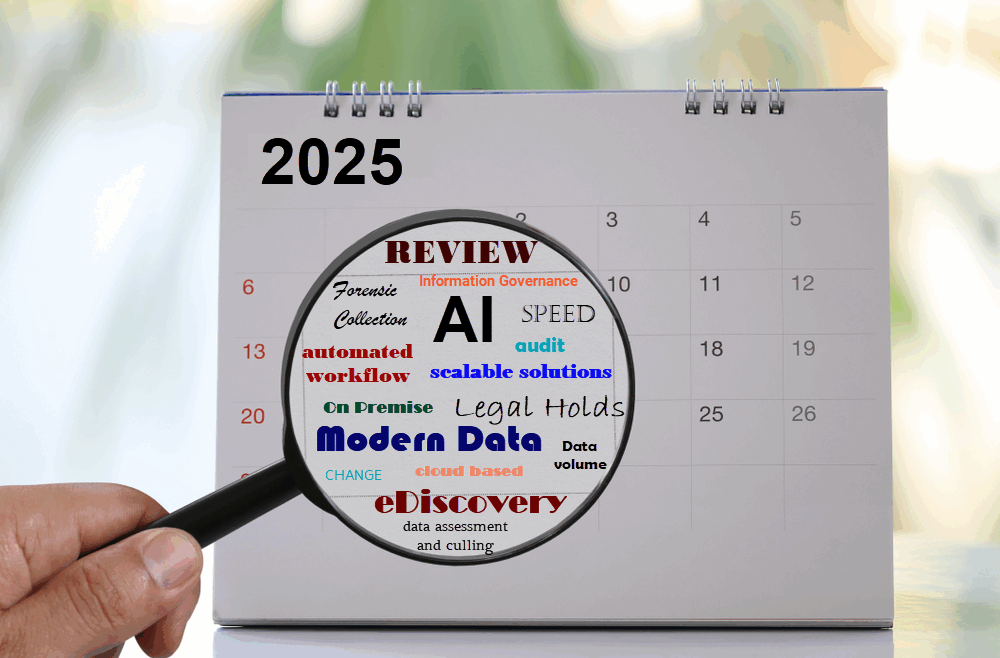
If one theme defined the past year in eDiscovery and Information Governance, it was acceleration. Data volumes grew. Data types multiplied. Expectations around speed, defensibility, and insight continued to rise. At the same time, artificial intelligence moved from an abstract promise to a practical component of everyday legal, compliance, and investigative workflows.
Across the industry, the conversation shifted away from whether change was coming and toward how organizations could keep pace without sacrificing accuracy, transparency, or control. For CloudNine and the broader eDiscovery community, 2025 became a year of turning complexity into clarity.
Modern Data Is No Longer “Emerging”; It’s the New Normal
Email certainly still matters, but it is no longer the center of the discovery universe. Text messages, collaboration platforms, mobile devices, social media, and cloud-based applications continued to dominate discovery and investigation matters this year.
These data sources introduced new challenges:
- Short-form, conversational communications with limited context
- Data spread across devices, platforms, and custodians
- Increased reliance on forensic tools to capture volatile or ephemeral content
Organizations increasingly recognized that collection is no longer a simple, one-time event. Instead, it requires repeatable, defensible forensic processes that preserve metadata, maintain chain of custody, and align with downstream review requirements.
The growing emphasis on tight integration between forensic collection and review reflected a broader reality: modern data demands end-to-end workflows, not disconnected tools.
Legal Hold: The Foundation That Can’t Be an Afterthought
Why our Partnership With Mitratech was Launched
As data complexity increased, the importance of a proper legal hold process and platform became more visible and more urgent.
Too many organizations continued to rely on manual, email and spreadsheet-based hold processes that struggle to scale and fail to account for modern data sources. Over the past decade, that approach has proved increasingly risky. Courts and regulators expect organizations to demonstrate not just that holds were issued, but that they were tracked, acknowledged, enforced, and defensible.
A mature legal hold process:
- Identifies relevant custodians and data sources early
- Automates notifications and acknowledgments
- Integrates with Information Governance and collection workflows
- Provides clear audit trails and reporting
The year reinforced a simple truth: you cannot preserve what you cannot identify or track. Legal hold sits at the intersection of IG, discovery, and investigations, and when it breaks down, every downstream process is impacted. The CloudNine integration with Mitratech’s Legal Hold Solution with CloudNine Review, organizations can now move from legal holds to processing, review, and production in a single seamless, automated workflow.
AI in eDiscovery: From Buzzword to Business Reality
Why our Partnership With eDiscovery AI was Launched
AI remained one of the most discussed topics of the year, but the conversation matured significantly. Instead of speculative hype, organizations focused on practical, defensible use cases that delivered measurable value.
Applications like technology-assisted review, automated classification, clustering, and communication analysis gained momentum because they addressed core challenges:
- Reducing review volumes
- Improving consistency
- Surfacing patterns and anomalies faster
At the same time, organizations became more intentional about governance, transparency, and human oversight. The prevailing mindset shifted toward AI as an accelerator and not a replacement for expertise. Partnering with eDiscovery AI and their continual innovations in GAI reinforces CloudNine’s mission to modernize and simplify the eDiscovery process and brings cutting-edge GenAI technology with our CloudNine Review, delivering scalable solutions that dramatically accelerate early insights and review workflows for our customers.
The lesson from 2025 was clear: AI delivers the most value when embedded within well-designed workflows and guided by experienced legal and review professionals.
Information Governance Moved from Strategy to Operational Reality
Why our Partnership With Infinnium was Launched
Information Governance continued its evolution from high-level policy discussions to day-to-day operational impact.
As discovery demands intensified, organizations felt the cost of inconsistent retention policies, unclear data ownership, and fragmented systems. The result was predictable: higher discovery costs, longer timelines, and greater risk exposure.
This year highlighted an important realization: you can’t review your way out of poor data hygiene. Effective IG is supported by realistic policies and cross-functional alignment and has become essential to controlling discovery scope, improving response times, and supporting defensibility across matters. CloudNine and Infinnium offer a joint offering that bridges the gap with corporate information governance and litigation’s requirements for discovery of sensitive corporate data.
Forensic Collection Became a Critical Capability
Why our Partnerships With Oxygen Forensics, Pinpoint Labs and ModeOne were Launched
The expansion of mobile and cloud data made forensic collection a focal point in 2025, and we noticed that no one solution solved everything and we understand that collections are cross validated with other platforms.
Investigations and discovery matters increasingly required:
- Targeted, defensible collections
- Support for mobile devices and cloud-based sources
- Preservation of message threads, attachments, and metadata
Organizations learned that cutting corners at the collection stage often creates downstream review challenges with missing context, broken conversation threads, or incomplete datasets that complicate analysis.
Strong forensic collection processes now serve as a bridge between legal holds, investigations, and review, reinforcing the need for repeatable, well-documented methodologies that stand up to scrutiny.
Managed Review at Scale: Where Strategy Meets Execution
Why our Partnership With Integreon was Launched
As data volumes continued to grow, large-scale managed review workflows became more critical and complex. We see that AI is working its way into the review stage of the EDRM, human interaction with the evidence will always be necessary especially as the data volumes and variety continue to grow.
Organizations faced increasing pressure to:
- Review more data in less time
- Control costs without sacrificing quality
- Adapt review strategies to evolving data types
Successful managed review in 2025 required more than staffing; it demanded thoughtful workflow design, intelligent use of AI, and close collaboration between technology, process, and people.
Teams that succeeded focused on:
- Early data assessment and culling
- AI-assisted prioritization
- Clear review protocols and quality control
- Continuous communication between stakeholders
The year reinforced that managed review is no longer a downstream task; it is a strategic component of modern eDiscovery and investigations.
The Convergence of Discovery, Investigations, and Compliance
Another defining trend of the year was the continued convergence of discovery, investigations, and compliance workflows. Data collected for one purpose increasingly needed to support multiple objectives and sometimes simultaneously.
This convergence elevated the importance of:
- Defensible legal holds
- Forensic collection and chain-of-custody integrity
- Flexible review environments capable of supporting varied use cases
Silos between legal, IT, compliance, and security teams continued to erode, replaced by more integrated, collaborative approaches to data response and risk management.
What 2025 Taught Us
Looking back, the past year reinforced several enduring lessons:
- Data complexity will continue to increase
- Legal hold and IG failures amplify downstream risk
- Forensic collection quality directly impacts review outcomes
- AI is most effective when paired with expertise and governance
- Managed review requires strategy, not just scale
For CloudNine and its partners, the focus remained on helping organizations navigate this complexity with confidence by connecting legal hold, collection, review, and AI into cohesive, defensible workflows.
Looking Ahead
As we move into 2026, the challenge won’t be whether eDiscovery, AI, and Information Governance continue to evolve, but how quickly organizations can align people, process, and technology to keep pace.
The pace of change may be relentless, but with the right foundation and partners, it remains full of opportunity.
