
eDiscovery Daily Blog
Why Government Agencies and Corporate Legal Teams Should Reconsider On-Premise eDiscovery
Balancing Security, Cost, and Control in an Era Dominated by SaaS
For years, Software-as-a-Service (SaaS) has become the default deployment model for legal technology. The convenience of cloud-based platforms has led many organizations to assume that SaaS is the only viable path forward for eDiscovery, investigations, and Freedom of Information Act (FOIA) request management.
But for government agencies and corporate legal departments, that assumption deserves a closer look.
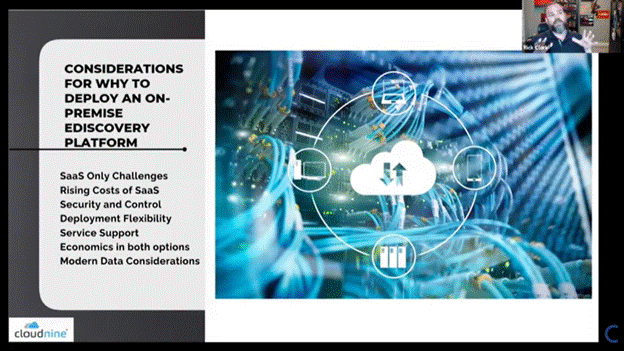
In a recent webinar hosted by Carahsoft, Richard Clark, VP of Marketing and Strategic Partnerships at CloudNine, and Brian Kelly, VP of Products and Engineering at CloudNine, explored why many organizations are reevaluating their technology strategies and discovering that an on-premise deployment can provide significant advantages in today’s legal and regulatory environment.
Watch the full webinar: Right Sizing eDiscovery for Sensitive and Regulated Environments
Rather than viewing the decision as cloud versus on-premise, the discussion focused on selecting the deployment model that best aligns with an organization’s security requirements, operational priorities, and long-term financial objectives.
The Hidden Challenges of SaaS-Only Deployments
Cloud platforms offer speed and accessibility, but they are not without tradeoffs.
Many organizations have discovered that the convenience of SaaS often comes with challenges that become more pronounced as data volumes increase and legal matters become more complex.
These challenges include:
- Subscription costs that continue to grow year after year
- Limited control over infrastructure and system configuration
- Dependence on vendor release schedules and feature availability
- Restrictions around data residency and compliance requirements
- Ongoing costs associated with storing inactive or archived matters
For organizations managing sensitive investigations, regulated information, or large collections of electronically stored information (ESI), these considerations can have a meaningful impact on both budgets and operational efficiency.
Rising SaaS Costs Are Changing the Economics
One of the most significant themes of the webinar was the changing financial equation.
As organizations retain more digital information than ever before, recurring subscription fees can become one of the largest expenses in an eDiscovery program.
Unlike traditional infrastructure investments that can be depreciated over time, SaaS pricing often scales directly with data volumes, active users processing requirements, storage consumption and review activity.
For legal departments managing hundreds of matters or government agencies responding to ongoing public records requests, these recurring operational costs can quickly exceed budgets.
An on-premise deployment offers a different financial model: one that allows organizations to better predict costs while maximizing the value of their infrastructure investment.
Security and Control Matter More Than Ever
Security remains one of the primary reasons organizations continue to evaluate on-premise solutions.
Government agencies, defense contractors, financial institutions, healthcare organizations, highly regulated corporations and enterprises handling highly confidential information often face strict requirements surrounding:
- Data sovereignty
- Chain of custody
- Internal security policies
- Regulatory compliance
- Controlled access to sensitive information
With an on-premise deployment, organizations maintain direct control over where their data resides, how it is secured, and who has access to it.
This level of control can simplify compliance while reducing the risks associated with transferring sensitive information outside organizational boundaries.
Flexibility to Deploy the Way Your Organization Operates
Every legal department has unique operational requirements, and some organizations require isolated environments, while others need disconnected or air-gapped systems.
Many have already invested heavily in secure data centers and internal infrastructure.
An on-premise deployment allows organizations to leverage existing investments while integrating with established security frameworks and IT policies.
Rather than forcing every organization into a single deployment model, today’s technology should adapt to the organization’s operational needs and not the other way around.
Support Doesn’t End After Deployment
Technology alone does not determine success.
Successful eDiscovery and investigation programs rely on knowledgeable support teams that understand legal workflows, technical challenges, and evolving data sources.
The webinar emphasized that deployment flexibility should also include service availability, with CloudNine having a fully operational services and support team.
Organizations benefit from having experienced professionals available to assist with implementation, optimization, troubleshooting, and long-term success regardless of whether the environment is cloud-based, on-premise, or hybrid.
Understanding the True Economics
When evaluating deployment models, organizations often focus on initial costs.
A more meaningful comparison considers the total cost of ownership over several years that include infrastructure investment, licensing, storage, operational expenses, subscription fees, data growth, internal resource utilization and long-term scalability.
For many organizations with predictable workloads or significant data volumes, an on-premise solution can provide substantial long-term savings while delivering greater operational control.
Modern Data Requires Modern eDiscovery
The explosion of modern communication platforms has fundamentally changed digital investigations.
Today’s legal teams must manage data from Microsoft Teams, Slack, mobile devices, cloud collaboration platforms, email, traditional file shares, social media and emerging communication applications.
Whether deployed in the cloud or on-premise, modern eDiscovery platforms must efficiently collect, process, review, and produce this increasingly diverse data landscape. CloudNine give choice in the matter by giving modern data review in both SaaS and On-Premise platforms.
The deployment model should support these capabilities while meeting the organization’s security, compliance, and operational objectives.
Choosing the Right Deployment Strategy
Perhaps the most important takeaway from the webinar is that there is no universal answer.
Cloud deployments remain an excellent choice for many organizations, but choice now matters the most.
However, government agencies, corporate legal departments, compliance teams, and organizations with strict security requirements should not overlook the benefits that a modern on-premise platform can provide.
The right deployment strategy is one that balances security, cost predictability, operational flexibility, and long-term scalability.
As legal data continues to grow and budgets remain under pressure, organizations are increasingly recognizing that on-premise eDiscovery is not a legacy approach but is a modern deployment option designed for organizations that require greater control over their data and infrastructure.
Watch the full webinar to hear Richard Clark and Brian Kelly discuss these considerations in greater detail and learn how organizations are evaluating deployment strategies that best align with their legal, investigative, and FOIA response requirements.