
Information Governance

Tom O’Connor of Advanced Discovery: eDiscovery Trends

This is the fourth of the 2015 LegalTech New York (LTNY) Thought Leader Interview series. eDiscovery Daily interviewed several thought leaders at LTNY this year and generally asked each of them the following questions:

  1. What are your general observations about LTNY this year and how it fits into emerging trends? Do you think American Lawyer Media (ALM) should consider moving LTNY to a different time of year to minimize travel disruptions due to weather?
  2. After our discussion last year regarding the new amendments to discovery provisions of the Federal Rules of Civil Procedure, additional changes were made to Rule 37(e). Do you see those changes as being positive and do you see the new amendments passing through Congress this year?
  3. Last year, most thought leaders agreed that, despite numerous resources in the industry, most attorneys still don’t know a lot about eDiscovery. Do you think anything has been done in the past year to improve the situation?
  4. What are you working on that you’d like our readers to know about?

Today’s thought leader is Tom O’Connor. Tom is a nationally known consultant, speaker and writer in the area of computerized litigation support systems. A frequent lecturer on the subject of legal technology, Tom has been on the faculty of numerous national CLE providers and has taught college level courses on legal technology. Tom’s involvement with large cases led him to become familiar with dozens of various software applications for litigation support and he has both designed databases and trained legal staffs in their use on many of the cases mentioned above. This work has involved both public and private law firms of all sizes across the nation. Tom is the Director of the Gulf Coast Legal Technology Center in New Orleans and he just joined Advanced Discovery as a Senior ESI Consultant in January.

What are your general observations about LTNY this year and how it fits into emerging trends? Do you think American Lawyer Media (ALM) should consider moving LTNY to a different time of year to minimize travel disruptions due to weather?

Like all LegalTech shows, it’s hectic. I come to New York thinking, “hey, I’m going to go have a good dinner one night, maybe go down to Times Square” and by 8pm, I’m exhausted. You talk to people all day and at the end of the show day there’s a group of people who want to go out to parties and I’m going across the street to the 24 hour deli and getting a sandwich. It’s always busy and there’s always a ton of things going on at the show. It is great, though, that I get people that I don’t get to see on a regular basis, like Michael Arkfeld and George Socha, so this show is really priceless for me to get to talk to them. Craig (Ball) and George and I just had lunch and talked about Continuous Active Learning and those are the sorts of discussions that LTNY facilitates.

Last night, when I was grabbing my sandwich at the end of the day, Henry Dicker (Executive Director of LegalTech) came walking in and we had a great talk about LegalTech and their worldwide schedule. Henry and I have been doing these shows for about the same amount of time. So, it was interesting getting his perspective in a quiet moment about how the show is going and the attendance and so forth. ALM has apparently been having great success with their overseas shows. I think Henry said that, at the end of the year, he was in Singapore, Taiwan, Hong Kong and mainland China – all within five weeks. So, they have been having great success internationally.

As for the show itself, if you’re looking for new product information and what the latest and greatest is across a wide swath of product types (i.e., every type of legal software imaginable), LTNY, because it is in late January/early February has always been the “granddaddy of them all”. Vendors like to get new releases out for the show, make announcements, etc. ILTA is probably the better show for highly technical information and IT types because it’s where they start opening the hood and popping the carburetor off and boring out the engine. That being said, Henry has a great relationship with ILTA and they have an ILTA track here. But, for what LTNY does, which is cut across all products, it’s unbeatable.

The one issue I have with LTNY (which is not really a negative because the slack is picked up by the ABA Tech Show) is the over-emphasis on BIG firm solutions. BIG firms, BIG corporations, BIG data – everything’s BIG. But, the ABA Tech Show does a good job in picking up and emphasizing small to mid-sized firms and solutions for them.

As for trends for this year, every year there’s a buzzword or two that interests people. The one that I think is particularly discussed a lot this year (again, by big firms) is cybersecurity. After last year, with the big security breaches at Sony and Home Depot, I think that’s in the forefront of people’s discussions right now. I think that’s a very hot topic. Information Governance continues to be a hot topic as well – Patrick Burke had a great program on Monday at the Cardozo Law School – so, I think that continues to be (if you’ll pardon the pun) a huge interest for attendees here. The third area of interest that I’m hearing a lot about is analytics – how to use computer tools of all sorts before you get to review and, in some cases, before you even get to the processing stage and pare down that huge amount of data. Using those tools to try to reduce that volume and get a handle on what’s relevant. A few years ago, the hot topic was early case assessment. It’s a continuation of that trend, but with much more sophisticated tools and ability to do it.

As for moving LTNY to a different time of year, yes, I’ve been advocating for years that they consider flipping LegalTech West and LegalTech East. Have LegalTech West at this time of year and go to San Francisco (where the show will be held this year) or Los Angeles (where the show has been held in past years) during the wintertime and New York in the late spring or early summer. I understand there are long term contracts and it would take a while, but it sure would help things with the weather and travel issues. Once you delay a flight for bad weather by half an hour or 45 minutes, everything goes “to hell in a hand basket” quickly. So, yes, I would love to see it moved.

After our discussion last year regarding the new amendments to discovery provisions of the Federal Rules of Civil Procedure, additional changes were made to Rule 37(e). Do you see those changes as being positive and do you see the new amendments passing through Congress this year?

I don’t think the changes were necessarily for the better. The revised Rule 37(e) still benefits corporate defendants, lowering their burden and making it easier for them to not preserve data. Again, I think that only affects a small percentage of litigants. To paraphrase Judge (Shira) Scheindlin, she essentially said that she just doesn’t think it will have an “in the trenches” sort of an impact. It may in one or two cases, but she didn’t see it as being all that big a deal with the amount of cases that they see, at least in her court. Certainly where I live, in New Orleans and throughout the southeast, the people who I work with in more rural or semi-rural jurisdictions with smaller cases and smaller case loads, there is no impact.

Last year, most thought leaders agreed that, despite numerous resources in the industry, most attorneys still don’t know a lot about eDiscovery. Do you think anything has been done in the past year to improve the situation?

Clearly, we’ve advanced. I think there is better understanding by some attorneys, especially corporate counsel, which I think have a much firmer grasp of what’s going on in eDiscovery. Four or five years ago, Michael Arkfeld said probably only 2% of attorneys really got eDiscovery and understood all of the rules. We’ve improved, but, unfortunately, I think we’ve only gone to about 10%. I think there’s still a lot of work to be done. Law schools are still dragging their feet on what they see as some sort of technical training. It’s not in their “wheelhouse”, not in their charter. I think that’s changing and I think you’re going to see a lot more aggressive legal education around these issues in law schools in the next year or so.

I think that you’re seeing the judiciary be very aggressive in demanding competence and, with some of the local rules changes and ethics opinions (such as the recent one in California), requiring some sort of affidavit or certification that you have enough knowledge to make a pleading in this field. I think we will continue to see more of that. It’s great when we see Judge Scheindlin say that or Judge (John) Facciola or Judge (Andrew) Peck or other big names in the field, but I see judges in the federal district courts in places like New Orleans, Mobile and Mississippi also be much more demanding of competence. So, I don’t think it’s isolated to the northeast or the big name judges, it’s something that the judiciary as a whole is pushing. That has probably been the biggest change.

What are you working on that you’d like our readers to know about?

I have a new position – doing what I’ve always been doing, but now for a national company – heading up the consulting services for Advanced Discovery. I’m working with clients on cases, trying to help them find the right tools to answer these problems that we’re talking about in this interview. And, as always, I’m performing a lot of pro bono work for the Louisiana and Mississippi state bars because we have a very high concentration of solo and small firm attorneys “in our neck of the woods”. They are struggling with all sorts of education issues, especially around eDiscovery and technology updates. That’s a major undertaking, from Houston to Pensacola, in states that are poorer and mostly rural. You think about New Orleans or Mobile, but when you get above that I-10 line, you get to an area that’s underserved by the legal community in general and by technology. Courts, attorneys and clients are all struggling with these issues down there.

Thanks, Tom, for participating in the interview!

And to the readers, as always, please share any comments you might have or if you’d like to know more about a particular topic!

Disclaimer: The views represented herein are exclusively the views of the author, and do not necessarily represent the views held by CloudNine. eDiscovery Daily is made available by CloudNine solely for educational purposes to provide general information about general eDiscovery principles and not to provide specific legal advice applicable to any particular circumstance. eDiscoveryDaily should not be used as a substitute for competent legal advice from a lawyer you have retained and who has agreed to represent you.

James D. Zinn, Managing Director of Huron Consulting Group: eDiscovery Trends

This is the second of the 2015 LegalTech New York (LTNY) Thought Leader Interview series. eDiscovery Daily interviewed several thought leaders at LTNY this year and generally asked each of them the following questions:

  1. What are your general observations about LTNY this year and how it fits into emerging trends? Do you think American Lawyer Media (ALM) should consider moving LTNY to a different time of year to minimize travel disruptions due to weather?
  2. After our discussion last year regarding the new amendments to discovery provisions of the Federal Rules of Civil Procedure, additional changes were made to Rule 37(e). Do you see those changes as being positive and do you see the new amendments passing through Congress this year?
  3. Last year, most thought leaders agreed that, despite numerous resources in the industry, most attorneys still don’t know a lot about eDiscovery. Do you think anything has been done in the past year to improve the situation?
  4. What are you working on that you’d like our readers to know about?

Today’s thought leader is James D. Zinn. James is Managing Director of Huron Consulting Group. James is responsible for leading Huron Legal’s technology vision and strategy globally. He directs the practice’s software engineering, information technology, and product management teams. James is responsible for driving innovation by identifying and incubating emerging technologies and technology-driven solutions with relevance to Huron Legal. He has more than twenty years of experience developing and delivering services and solutions to clients.

{Editor’s Note: Because of travel issues, James did not make it to LTNY this year, but we were able to re-schedule the interview for after the show.}

What are your general observations about LTNY this year and about emerging trends in general for 2015? Do you think American Lawyer Media (ALM) should consider moving LTNY to a different time of year to minimize travel disruptions due to weather?

While I didn’t make it to the show, from what I’ve heard from my colleagues, all of the themes from last year seem to be continuing to mature, including information governance and the convergence of IG and discovery. Also, the focus on security certainly took a step forward this year and the use of predictive coding and other analytical technologies has become a perennial topic and has continued to move forward. So, what I saw was a continued maturing and growth of last year’s themes, which I think will continue throughout 2015.

As for the possibility of moving LTNY to a different time of year, I think that’s a big change. Certainly, New York is much nicer in the fall than in the winter, so I’d love to see a change from that perspective. Realistically, I think that there is a lot of inertia behind the current scheduling, so it would be a big change and disruption to the industry to try and move it.

After our discussion last year regarding the new amendments to discovery provisions of the Federal Rules of Civil Procedure, additional changes were made to Rule 37(e). Do you see those changes as being positive and do you see the new amendments passing through Congress this year?

I don’t think there will be any roadblocks. I think the proposed changes to the Federal rules are useful and I think we’re already starting to see the impact as our clients have started to act consistent with the proposed changes. So, I don’t really see any challenge with them being adopted and incorporated into current practices; in fact, I think that adoption has already begun.

Some of this could be due to the pending rules changes and some could be due to the maturing of organizations and the industry in general. We have seen the increased use of technology to try to wrestle down the volumes of information. We’re seeing more targeted collection, more targeted use of analytics earlier in the process to reduce data volumes, even before the more traditional review stages begin. We are seeing an increasing number of projects where the data volumes are getting culled much more quickly than they have in the past. The days of collecting large volumes and dumping those large volumes indiscriminately into the discovery process and then sorting it all out are evolving into much more careful efforts. As a result, we see the downstream benefits already starting to appear where there’s less need for brute forcing your way through a corpus of documents.

Last year, most thought leaders agreed that, despite numerous resources in the industry, most attorneys still don’t know a lot about eDiscovery. Do you think anything has been done in the past year to improve the situation?

I think that there has been a continued progress in that area. Our client attorneys that we see on a regular basis are absolutely more knowledgeable about eDiscovery, aware of the issues associated with it and how to address those issues more efficiently. From our view, there’s a clear maturing of that knowledge in the industry.

What are you working on that you’d like our readers to know about?

At Huron Legal, we’re continuing to try to support these trends by offering technology everywhere where it can improve the process and make the process as cost-efficient as possible. We’ve continued, much as the industry has, to try to advance and mature those solutions. I mentioned predictive coding earlier and that has been a recurring theme for years and I think predictive coding technology has slowly continued to get better and easier and, as a result, become more adopted within the industry. We’re also seeing a lot more interest in security and with the increase in security breaches and those breaches becoming more publicized, there has been a lot more interest from our clients in understanding how we’re protecting their data, as well as what steps they can also take to protect their data. So, we have a lot of exciting things going on in that area as well.

Also, a little outside the eDiscovery realm but closely related, is cost management. We recently acquired a technology company called Sky Analytics, which focuses on helping lawyers, predominantly corporate law departments, to analyze and understand their external spend (of which discovery is a large component). It helps them to evaluate the efficiency of the services that are being provided by their outside counsel. This fits in well with our efforts to support organizations in managing their legal costs by using analytics and technology to provide meaningful, real-time insight. We’ve made some big strides in this area in the past few months and it will continue to be a significant focus for Huron Legal.

Thanks, James, for participating in the interview!

And to the readers, as always, please share any comments you might have or if you’d like to know more about a particular topic!

Disclaimer: The views represented herein are exclusively the views of the author, and do not necessarily represent the views held by CloudNine. eDiscovery Daily is made available by CloudNine solely for educational purposes to provide general information about general eDiscovery principles and not to provide specific legal advice applicable to any particular circumstance. eDiscoveryDaily should not be used as a substitute for competent legal advice from a lawyer you have retained and who has agreed to represent you.

Information Governance vs. Search Doesn’t Have to Be a Battle After All: eDiscovery Trends

As will soon be reinforced in our upcoming thought leader interviews, one of the major focus areas at this year’s LegalTech® New York 2015 (LTNY) was a continued emphasis on Information Governance (IG). One of our perennial interviewees, Ralph Losey, has some thoughts about the battle in the legal tech world between IG and Search and reveals that it doesn’t have to be a battle after all.

In the post Information Governance v Search: The Battle Lines Are Redrawn on his excellent e-Discovery Team® blog, Ralph states that last year, he “came to believe that Information Governance’s preoccupation with classification, retention, and destruction of information was a futile pursuit”, termed IG activities as “inefficient and doomed to failure” and instead “embraced the googlesque approach of save and search”.

When Ralph expressed those viewpoints, he (not surprisingly) “created a controversy” and received quite a backlash, including “a distinguished leader of IG who bristled at my challenges” who “insisted that everyone in her very large corporation could easily comply with her lengthy retention schedules”. However, other members of the IG leadership “responded to the opposition with dialogue”, which enabled Ralph to learn that “IG, like Search, is not a monolith, that there are various factions and groups within IG”. Ultimately, Ralph determined that his “quarrel is, instead, with the old-liners, the Records Manager strata of IG who are obsessed with ESI classification and killing” (that Ralph categorizes as “caterpillars”). “To those” (a.k.a., the “butterflies”) “who have let go of that traditional role, and already been reborn as multimodal, AI-enhanced Information experts, I have no quarrel.”

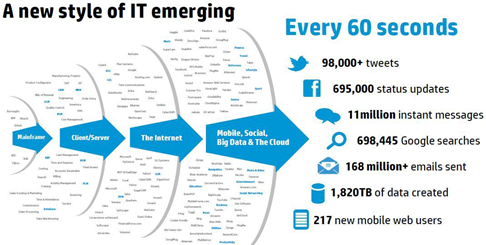
Ralph has a lot more to say in the post, noting that ESI “grows and changes too fast for traditional governance” and concludes that “Information Governance is actually a sub-set of Search, not visa versa”. He also provides a nice graphic to illustrate just how much data is created in the digital universe every 60 seconds (see the top of this post). Remember a little over a year ago, when we noted that 3.4 sextillion bytes of information had been created in close to ten months in 2013? Well, according to EMC’s latest ticker, 6.1 sextillion bytes have been created since January 1, 2014. Yikes! We’ve provided a link to another infographic at the bottom of this post, courtesy of Domo.com, that provides even more info about the amount of data created every 60 seconds. Enjoy!

By the way, Ralph just posted his 500th blog post, which is a tremendous milestone. Congrats, Ralph! Up to now, Ralph noted that he has been posting weekly (since November 2006) and his posts have “morphed into several thousand word essays”. At eDiscoveryDaily, we probably write 2,500 to 4,000 words per week over five posts; Ralph writes that much (and often more) in his one post a week.

Now, Ralph has indicated that his e-Discovery Team® blog will be changing to a monthly format and that he will begin writing the blog “for advanced readers only”. I look forward to see how the future posts will look, but will miss my Monday morning routine of sitting down with a cup of coffee and reading Ralph’s latest post (at least for the weeks without a new post). Keeping a blog going day after day (or even week after week) is not easy. Kudos to Ralph for keeping it going for over eight years (so far).

So, what do you think? Do you think the old way of information governance is “inefficient and doomed to failure”? Please share any comments you might have or if you’d like to know more about a particular topic.

P.S. — Happy Birthday to my wonderful and beautiful wife, Paige Austin!  We got engaged one year ago today.  Best thing that’s ever happened to me!  🙂

infographic

Disclaimer: The views represented herein are exclusively the views of the author, and do not necessarily represent the views held by CloudNine. eDiscoveryDaily is made available by CloudNine solely for educational purposes to provide general information about general eDiscovery principles and not to provide specific legal advice applicable to any particular circumstance. eDiscoveryDaily should not be used as a substitute for competent legal advice from a lawyer you have retained and who has agreed to represent you.

Thursday LTNY 2015 Sessions: eDiscovery Trends

As noted yesterday and Tuesday, LegalTech® New York 2015 (LTNY) is happening this week and eDiscoveryDaily is here to report about the latest eDiscovery trends being discussed at the show. This is the last day to check out the show if you’re in the New York area with a number of sessions (both paid and free) available and over 199 exhibitors providing information on their products and services.

While at the show, we will (also for the fifth year in a row!) be interviewing several industry thought leaders to see what they think are the significant trends for 2015 and, which of those are evident at LTNY. After the show, we will announce the series of thought leader interviews and identify when each will be published. Mark your calendars!

Perform a “find” on today’s LTNY conference schedule for “discovery” or “information governance” and you’ll get 33 hits. So, there is plenty to talk about! Sessions in the main conference tracks include:

10:30 – 11:45 AM:

Information Governance in the Now

According to the Information Governance Initiative’s Annual Report, Information Governance (IG) practitioners “are taking action on a wide variety of IG projects right now. On average, SMBs have four IG projects under way, and large organizations have six.” This session will explore where IG stands today as a concept, as a practice and as a market; uncovering the projects that are getting funding, the technologies that are enabling action and the governance structures that are getting the most attention.

At the end of this session you will have a clear picture of where the IG market really is so you can catch the wave and get started delivering value to your clients and organizations right now.

Speakers to include: Julie Colgan (Discussion Leader), Head of Information Governance Solutions, Nuix; James Arnold, Managing Director of Forensic Services, KPMG; Lauren Barnes, VP Records and Information Management, Credit Suisse; Jay Brudz, Partner, Drinker Biddle & Reath LLP; Fred Pulzello, President, ARMA International.

Transforming Discovery Through Data Management

With data growing exponentially, legal counsel is struggling to control eDiscovery costs. However, they can now effectively find potentially relevant documents earlier in the process with greater accuracy than ever before.   By combining technology and analytical expertise, it is now possible to gather early stage legal intelligence to develop case strategy and limit that amount of data promoted to review.

Speakers to include: Dave Deppe, President, UnitedLex Corporation; Jacob J. Herstek, Vice President and Senior Legal Counsel, HSBC Bank USA, NA; Lynn S. Looby, Managing Counsel for Litigation, Regulatory & U.S. Operations, The Dow Chemical Company; Farrah Pepper, Executive Counsel – Discovery, General Electric Company.

12:15 – 1:30 PM:

The Convergence of Information Security and IG

Gartner analysts Ted Friedman and Tom Scholtz have forecast that “by 2017, 40% of Global 1000 organizations will have aligned their information management governance and information security governance programs.” However, this prediction raises a variety of questions about how and why such a convergence might occur.

Nuix engaged Ari Kaplan Advisors to interview Fortune 1000 IS leaders to answer some of these questions for a benchmarking report and, among other conclusions, found that organizations know they must adopt a new set of information security disciplines to protect high-value and high-risk data. IG professionals must also play a critical role in helping to identify where important data is stored, understanding what it’s worth and making sure it’s protected.

Information security disciplines are at the heart of a good information governance framework. And failing to implement a robust information governance framework can be costly if it fails to prevent a data breach or minimize its consequences.

Speakers to include: Ari Kaplan (Discussion Leader), Principal, Ari Kaplan Advisors; Jim Kent, Global Head of Investigations & Cybersecurity, Nuix; Andre McGregor, Special Agent, Federal Bureau of Investigation; Alison North, Director, ARMA International Board of Directors, CEO, AN Information Ltd.; Amie Taal, Vice President, Security and Investigations Deutsche Bank.

Protecting Employee and Customer Privacy in an Era of ‘Big Data’ Monitoring

Corporations and governments are accelerating the collection and analysis of data about our personal and professional lives. The Internet of Things has not only enhanced consumer convenience, but also spawned a vast network of data collection mechanisms, such as smart phones, computer operating systems, websites, point-of-sale terminals, email accounts, social media postings, watches, automobile navigation systems and even asthma inhalers. One of the greatest challenges to an organization is balancing the benefits—such as product development, sales and marketing—of this data avalanche with the need to protect the privacy of its employees and customers.

In this session, panelists will review the myriad ways in which we are monitored and how that information is used, and share best practices in policy and security controls to protect employees and customers. The panelists will address the following:

  • How and why we are monitored — and how that information is used
  • Best practices in policy and security controls to protect employees and customers
  • Effective privacy, computer, BYOD and network usage policies
  • Reasonable expectations of privacy
  • The evolution of U.S. privacy laws and their effects on employees and consumers

Speakers to include: Jason R. Baron (Discussion Leader), Of Counsel, Drinker Biddle & Reath LLP; Alan Friel, Partner, BakerHostetler; Julia Horwitz, Consumer Protection Counsel, Electronic Privacy Information Center (EPIC); Heidi Wachs, Special Counsel, Jenner & Block; Sheryl Ann Yamuder, Senior Managing Counsel, Privacy & Data Protection, MasterCard.

2:00 – 3:00 PM:

Information Governance 2020 and Beyond

Over the next decade, technological and economic changes will challenge businesses; new data consumers, types, sources and endpoints will require businesses to continually adapt their information governance and security policies or risk losing data integrity. But what does the future really hold for Information Governance (IG)?

This panel of IG visionaries will look into their crystal balls and deliver predictions about IG of the future, considering topics such as cloud, mobility and the Internet of Things (IoT).

This is a must-attend session that will get your creativity flowing and inspire you to embrace the future to deliver best-in-class governance to your organizations and clients.

Speakers to include: Julie Colgan (Discussion Leader), Head of Information Governance Solutions, Nuix; Barclay Blair, Founder and Executive Director, IG Initiative, Principal and Founder, ViaLumina LLC; Chris Dale, The eDisclosure Information Project; Leigh Isaacs, Director of Records and Information Governance, Orrick, Herrington and Sutcliffe LLP, Advisory Board Member, IG Initiative.

In addition to these, there are other eDiscovery-related sessions today. For a complete description for all sessions today, click here.

eDiscoveryDaily will also be “tweeting” periodically throughout LTNY, so feel free to check out our updates at twitter.com/Cloud9Discovery.

So, what do you think? Are you planning to attend LTNY this year? Please share any comments you might have or if you’d like to know more about a particular topic.

Disclaimer: The views represented herein are exclusively the views of the author, and do not necessarily represent the views held by CloudNine. eDiscoveryDaily is made available by CloudNine solely for educational purposes to provide general information about general eDiscovery principles and not to provide specific legal advice applicable to any particular circumstance. eDiscoveryDaily should not be used as a substitute for competent legal advice from a lawyer you have retained and who has agreed to represent you.

Wednesday LTNY 2015 Sessions: eDiscovery Trends

As noted yesterday, LegalTech® New York 2015 (LTNY) is happening this week and eDiscoveryDaily is here to report about the latest eDiscovery trends being discussed at the show. There’s still time to check out the show if you’re in the New York area with a number of sessions (both paid and free) available and over 199 exhibitors providing information on their products and services.

While at the show, we will (also for the fifth year in a row!) be interviewing several industry thought leaders to see what they think are the significant trends for 2015 and, which of those are evident at LTNY. After the show, we will announce the series of thought leader interviews and identify when each will be published. Mark your calendars!

Perform a “find” on today’s LTNY conference schedule for “discovery” or “information governance” and you’ll get 66 hits. So, there is plenty to talk about! Sessions in the main conference tracks include:

10:30 – 11:45 AM:

Data Preservation in a User-Centric Mobile, Social and Cloud World

The cloud is no longer a novelty, social is not just for social, and mobile is fast becoming central, yet for eDiscovery professionals these environments are still often seen as unavoidable annoyances. Learn how successful corporations are implementing proactive litigation readiness plans for cloud solutions, social networks, and mobile endpoints — saving time, cost, risk, and hassles while letting their users work the way they want to.

Speakers to include: Neil Etheridge (Discussion Leader), Vice President, Product Marketing, Recommind; Robert Owen, Partner , Sutherland Asbill & Brennan LLP; Dave Packer, Sr. Director, Product Marketing, Druva; Alex Ponce de Leon, Discovery Counsel, Google; Justin Somaini , Chief Trust Officer, Box, Inc..

Analytics and Information Governance

As information proliferates, organizations need to adopt enterprise-wide Information Governance practices and make proactive policy decisions about what information is important to the organization, how to keep and manage it, and how to defensibly dispose of it. Data analytics are a smart way to gain an understanding of an organization’s information, both broadly and specifically, and to analyze or categorize it in order to facilitate business decisions, support defensible disposition, and more. This interactive panel discussion will address the information governance challenges organizations face and how analytics can help, including specific examples such as defensible destruction.

Speakers to include: Laurie Fischer (Discussion Leader) , Managing Director, Huron Legal; Jon M. Talotta , Partner, Hogan Lovells; Brett Tarr, Counsel Litigation & E-Discovery , Caesars Entertainment; Kurt Wilhelm , Director – Information Governance, NBCUniversal.

Predictive Coding: Succeed or Screw Up? How to Evaluate (and Validate) Results in Your Next Predictive Coding Project

It is no longer a matter of “if” you use predictive coding; “how” you conduct predictive coding is the critical question. With the training, prediction, and evaluation stages being an iterative process, how do you validate results and know when to stop review? This session will help you understand the methods and key metrics for evaluating effectiveness in your next predictive coding project.

Speakers to include: Jonathan Sachs (Discussion Leader), Senior Account Executive, Kroll Ontrack; Cliff Dutton, Senior Vice President & Director of eDiscovery and Vendor Management , AIG; Shannon Kirk, E-Discovery Counsel, Ropes & Gray; Ralph Losey, Shareholder, Jackson Lewis P.C.

12:30 – 1:30 PM:

Future-Proof Your eDiscovery Practices – OPEN TO ALL

It’s clear that the eDiscovery landscape is constantly changing. Trends and vendors often come and go, leaving organizations in a constant state of reacting to what’s next. Those organizations that are prepared for evolving conditions can better balance value and risk – thus future proofing their eDiscovery practices. In this panel, learn from proven eDiscovery experience and historical perspective on how the market has evolved in the past two decades – and how previous trends and market forces will help determine where the industry may be headed. You’ll leave knowing what your organizations can do now to minimize future risk and how to take full advantage of the value that emerging technologies will offer.

Speakers to include: George Tziahanas (Discussion Leader) , VP, Legal and Compliance Solutions, HP; Patrick Collins, Partner, Perkins Coie; Dr. Bruce V. Hartley, CISSP, VP, Celerity Consulting Group, Inc.; Jessica Watts, Associate General Counsel,, eDiscovery HP.

2:00 – 3:15 PM:

User-Defined Predictive Coding for Fact Finding and Prioritized Review

It’s easy to think of machine learning only when reviewing for large productions, however, forward-thinking users are applying it to drive internal investigations, analyze government-seized data stores, quality-check manual review, and much more. Come learn creative strategies for combining search and analytics for powerful fact finding and cost savings across a range of real-world use cases.

Speakers to include: Hal Marcus (Discussion Leader), Product Marketing Manager, Recommind; Florinda Baldridge, Global Director of Practice Support, Norton Rose Fulbright; Jay Brudz, Partner, Drinker Biddle & Reath LLP; David L. Stanton, Partner, Pillsbury Winthrop Shaw Pittman LLP.

Analytics to Enhance Litigation and Discovery Strategy

The “buzz” in the past few years has been about predictive coding as an analytical tool to facilitate document review. Predictive coding is just one of many analytical tools that can aid the discovery process, however, and document production is just one use for discovery analytics. This panel will discuss the range of analytical tools for discovery and creative ways they can be used to assist with early case assessment, litigation strategy, and discovery strategy, allowing counsel to better focus on developing the legal case and clients to make more informed decisions about case disposition. As an added bonus, their effective use can result in significant cost savings.

Speakers to include: Nathalie Hofman (Discussion Leader) , Managing Director, Huron Legal; Ignatius Grande, Senior Discovery Attorney/Director of PracticeSupport, Hughes Hubbard & Reed LLP; Mollie C. Nichols , Partner, Redgrave LLP; Glenn O’Brien , Director, Electronic Discovery, Liberty Mutual Insurance; Farrah Short, Associate , Mintz, Levin, Cohn, Ferris, Glovsky and Popeo, P.C..

Machine Learning from Pre-Discovery to eDiscovery and Everything In-between

Find out how machine learning is impacting all areas of information governance, realizing the promises of knowledge management, records management, and eDiscovery.

  • How can machine learning enable organizations to get ahead of the curve in eDiscovery and be better prepared for a matter?
  • How does machine learning facilitate areas of information governance such as defensible deletion, surveillance and compliance, records management and applying retention policies to electronic archiving?
  • How do corporate counsel and attorneys apply machine learning capabilities to unstructured content to better address information governance requirements?

Hear our expert panelists share ways machine learning technology is being applied throughout all areas of the information governance spectrum, with compelling, pragmatic examples and case studies demonstrating an entirely new paradigm with unstructured corporate content.

Speakers to include: Ari Kaplan (Discussion Leader), Principal, Ari Kaplan Advisors; Jeff Fehrman, Chief Strategy Officer, Mindseye; Constantine Pappas, Product Specialist, Computer-assisted Review, kCura; Rick Wilson, Vice President of Strategy and Solutions, Sherpa Software.

Global: Around the World in Less than 80 Minutes – Delivering Successful eDiscovery Projects Across the Globe

EDiscovery is approached differently in almost every country around the world, and international eDiscovery best practices are evolving quickly in response to international litigation and investigations. Knowing the country’s approach to eDiscovery is integral to ensuring that a multi-national eDiscovery project goes smoothly. This panel, comprised of eDiscovery experts from around the world, will discuss:

  • The biggest differences in approaches to eDiscovery in the US, EU and APAC
  • How the extraterritorial effect of US regulation affects global companies’ eDiscovery tactics
  • Why eDiscovery is on the rise in European countries like Germany and France and how to handle local requirements
  • Political, cultural and legislative sensitivities towards eDiscovery in China, Japan, Singapore and other countries in the APAC region – and how to deal with them

Techniques for managing eDiscovery in international cases and on multiple fronts.

Speakers to include: Andrew Szczech (Discussion Leader) , Director of Legal Technologies Services, EMEA, Legal Technologies, Kroll Ontrack UK; Brian Calla, Member, Eckert Seamans; Kate Chan, Managing Director, Kroll Ontrack APAC; Emily A. Cobb, Associate, Ropes & Gray; Jerami D. Kemnitz, Senior Discovery Counsel – Global Head of eDiscovery, Wells Fargo.

3:45 – 5:00 PM:

User-Centric Protocols for Advanced Review

Recent noteworthy judicial opinions have a lot to say about practical aspects of predictive coding-enabled review – such as search term culling, seed set sharing, workflow transparency, ESI orders, and the timing of discovery challenges. Come learn what these opinions do (and don’t yet) tell us, and how the new CTRL Initiative’s open-source guidelines can help users chart a flexible course for advanced review.

Speakers to include: Philip Favro (Discussion Leader), Senior Discovery Counsel, Recommind; Honorable James C. Francis IV, U.S. Magistrate Judge , U.S. District Court, Southern District of New York; Dawson Horn, III, Esq., Associate General Counsel, AIG; Darin Sands, Shareholder, Lane Powell.

Information Governance: Applying Technology to Information Governance: Data Management, Litigation Holds, Records Retention and Destruction

This panel will help attendees understand how information governance maturity can be developed from much of what we have learned in eDiscovery. The panel will talk about what information governance (IG) is, how to develop IG programs, and what IG projects companies are undertaking today, such as defensible data remediation, intelligent migration, and using eDiscovery and analytics technology for information governance purposes.

Speakers to include: Cathleen Peterson (Discussion Leader), Senior Vice President, Consulting and Advanced Review Services, Kroll Ontrack; Bennett Borden, Partner, Drinker Biddle & Reath LLP; Jessica Escalera, Global Head of Legal Discovery Operations, Barclays; D. Casey Flaherty, Corporate Counsel, Kia Motors America, Inc.; David L. Stanton, Partner, Pillsbury Winthrop Shaw Pittman LLP.

In addition to these, there are other eDiscovery-related sessions today. For a complete description for all sessions today, click here.

eDiscoveryDaily will also be “tweeting” periodically throughout LTNY, so feel free to check out our updates at twitter.com/Cloud9Discovery.

So, what do you think? Are you planning to attend LTNY this year? Please share any comments you might have or if you’d like to know more about a particular topic.

Disclaimer: The views represented herein are exclusively the views of the author, and do not necessarily represent the views held by CloudNine. eDiscoveryDaily is made available by CloudNine solely for educational purposes to provide general information about general eDiscovery principles and not to provide specific legal advice applicable to any particular circumstance. eDiscoveryDaily should not be used as a substitute for competent legal advice from a lawyer you have retained and who has agreed to represent you.

Welcome to LegalTech New York 2015!: eDiscovery Trends

Today is the start of LegalTech® New York 2015 (LTNY) and, for the fifth year in a row, eDiscoveryDaily is here to report about the latest eDiscovery trends being discussed at the show. Over the next three days, we will provide a description each day of some of the sessions related to eDiscovery to give you a sense of the topics being covered. If you’re in the New York area, I encourage you to check out the show – there are a number of sessions (both paid and free) available and over 199 exhibitors providing information on their products and services.

While at the show, we will (also for the fifth year in a row!) be interviewing several industry thought leaders to see what they think are the significant trends for 2015 and, which of those are evident at LTNY. After the show, we will announce the series of thought leader interviews and identify when each will be published. Mark your calendars!

Perform a “find” on today’s LTNY conference schedule for “discovery” or “information governance” and you’ll get 84 hits. So, there is plenty to talk about! Sessions in the main conference tracks include:

10:30 – 11:45 AM:

Information Management in the Age of the New Attorney

Some of the biggest changes currently in the legal IT environment are coming from the changing expectations and methods by which today’s attorneys want to work. As a new generation of attorneys rises to firm management, how does traditional information management need to change to accommodate the always-on, mobile, social, attorney? How can firms take advantage of new approaches to gain greater agility and better meet attorney – and client – demands for access to key information?

In this panel discussion, we will explore these topics with a panel of CIOs and IT Directors, and review what their organizations are doing to meet attorney and client expectations today as well as plans and ideas for the (near) future.

Speakers to include: Dan Carmel (Discussion Leader), Head of ECM Strategy and Solutions, HP Big Data; Marat Borodovskiy, IS Director, Prudential; Bill Koch, Director of Technology Services, Womble Carlyle Sandridge & Rice, LLP; Glenn O’Brien, Director, Electronic Discovery, Liberty Mutual Insurance; Usman Nayyar, Director of Applications and Technology Solutions, Proskauer.

Information Governance and E-Discovery – Working Across Disciplines to Improve Outcomes and Add Value

In conversations among thought-leading legal professionals and technologists, the subject of “information governance” features prominently. But how do these leaders define information governance, and why has the topic become so important? And what is the relationship to e-discovery?

In this program, panelists at the forefront of information governance will discuss the various ways in which their discipline relates to e-discovery. They will explain how a sound information governance initiative can help make e-discovery more efficient and effective, and less expensive. And they will help us understand how, in turn, a thoughtful and strategic e-discovery program can contribute back to the organization’s information governance. The panel will offer practical advice on breaking down silos and working across disciplines to create and enhance that information value loop.

Speakers to include: Maureen O’Neill (Discussion Leader), Senior Vice President, Discovery Strategy, DiscoverReady; Lauren Barnes, VP Records and Information Management, Credit Suisse; Juliet M. Hanna, Associate General Counsel, Fannie Mae; Julie Heller, VP & Global Head of eDiscovery Programs, Legal Operations Center, AIG.

Advice from Counsel: Case Studies of What’s Working in E-Discovery Today

Forget the theoretical. This is pure brass tacks. E-discovery practitioners are streamlining their processes, using advanced technology, and dramatically reducing the cost of e-discovery. In-house counsel, litigation support, outside counsel and service providers are all playing a part in transforming chaotic e-discovery procedures into a regular business process. This case study session will showcase what’s working today for corporations and law firms handling e-discovery matters large and small. Results from the 6th annual Advice from Counsel study on in-house e-discovery trends will supplement the case study discussions.

Speakers to include: Sophie Ross (Discussion Leader), Senior Managing Director, FTI Technology; Shari Aberle, Partner, Dorsey; Ari Kaplan, Principal, Ari Kaplan Advisors; Nicole Schaefer, Litigation Support Director, Janney Montgomery Scott.

Data Analytics for eDiscovery and Investigations – A Practical Approach

Data analytics on structured information (Oracle/SQL databases, mainframe data, etc.) is a specialized discipline that can help companies address issues related to litigation and sophisticated fraud and white collar crime. Forensic data analytics professionals must understand issues particular to the review of data contained in a structured format (i.e., enterprise financial systems and operational data stores). As with traditional computer forensic analysis on unstructured data, successful structured data eDiscovery is comprised of key work steps including identification, preservation, collection, processing, hosting, review, and production of structured data. This discussion will provide an overview and practical approach detailing the processes related to the analysis of structured data for eDiscovery and investigations.

Speakers to include: Tom Keegan (Discussion Leader), Principal Forensic Advisory Services, KPMG LLP; Elizabeth Asali, Litigation Counsel, GlaxoSmithKline; Jeffrey Greene, Shareholder, Greenberg Traurig; Wendy Predescu, Principal, KPMG LLP.

12:30 – 1:30 PM:

Taking TAR to the Next Level: Recent Research and the Promise of Continuous Active Learning — OPEN TO ALL

Three years ago, panelists Judge Andrew J. Peck and Maura R. Grossman introduced Technology-Assisted Review (TAR) to a standing-room-only crowd at LegalTech 2012. Since then, TAR—with its promise of substantial reduction in review costs—has entered the mainstream of high-volume discovery, both in the U.S. and around the world.

In 2015, the grand challenge is to make TAR even more accessible and more effective while addressing the real-world limitations of first-generation TAR products. Our panel will talk about the latest research on TAR protocols, focusing on newer methods like Continuous Active Learning, which have been shown to identify relevant documents more quickly, and to further reduce review costs. Discussion topics include:

  • How does Continuous Active Learning work, and how does it differ from earlier TAR protocols?
  • Which kinds of seed are most effective in TAR training, random or judgmental and why?
  • Are subject-matter experts required for TAR training, or can review teams do the job just as well?
  • How will the courts evaluate TAR and Continuous Active Learning? What kind of evidence is required to move best practices forward?
  • What kinds of savings can you expect from Continuous Active Learning versus other protocols? Should different protocols be used for different types of cases?

Join us for an informative hour focusing on the future of TAR for 2015 and beyond. Learn about the first peer-reviewed study comparing TAR protocols and how its findings may be applied in judicial and corporate settings. Pick up your free guide to Continuous Active Learning so you can learn more about this powerful new option for TAR review.

Speakers to include: John Tredennick (Discussion Leader), CEO and Founder, Catalyst Repository Systems, Inc.; Gordon V. Cormack, Professor, David R. Cheriton School of Computer Science, University of Waterloo; Maura R. Grossman, Of Counsel, Wachtell, Lipton, Rosen & Katz; Susan Nielsen Hammond, Records, eDiscovery & Forensics Counsel, Regions Financial Corporation; Honorable Andrew J. Peck, Magistrate Judge, United States District Court for the Southern District of New York.

2:00 – 3:15 PM:

Counsel’s Secret Weapon in the Information Wars: Governance Strategies and Tactics

Organizations face increasing pressure when responding to litigation, investigations, and regulatory compliance demands. Factors adding to this pressure are shortened time frames, increasingly disparate information, and tight budgets. It is essential to proactively prepare for these challenges with an information governance strategy that ensures your data can be accessed, analyzed, and understood quickly and cost effectively.

In this session, learn how to evaluate technology solutions, best practices for deploying these solutions in conjunction with IG policies, and how you can gain strategic insight from your data.

Speakers to include: Matt Levy (Discussion Leader), eDiscovery Subject Matter Expert, HP; Jason R. Baron, Of Counsel, Drinker Biddle & Reath LLP; Gareth Evans, Partner, Gibson, Dunn & Crutcher LLP; Marty Provin, Executive VP, Jordan Lawrence; Jason Van Volkenburgh, Associate General Counsel, Hunter Douglas.

E-Discovery Insourcing vs Outsourcing

This session will focus on the key issues attorneys, paralegals and litigation support staff should consider when deciding whether to insource or outsource e-discovery. While they may seem elementary, time, cost and complexity continue to be some of the greatest challenges e-discovery practitioners face today. Join us as our panel discusses some of the key elements to consider when deciding on an e-discovery solution.

Speakers to include: Edward Sohn (Discussion Leader), Global Director, Legal Managed Services, Thomson Reuters; Anthony J. Diana, Partner, Reed Smith; Glen McFarlane, Managing Director, JPMorgan Chase; Karin Scholz Jenson, Partner and National Co-Leader, E-Discovery Advocacy and Management Team, BakerHostetler.

The Predictive Coding Soundtrack: Rewind, Play, Fast-Forward

Over the last several years, predictive coding dominated conversations among e-discovery practitioners. But as we move into 2015, it seems the hype about predictive coding – and the too-good-to-be-true marketing promises – have quieted down. So what are we talking about now? What are organizations actually doing today with predictive coding? And how have these conversations about predictive coding impacted other aspects of e-discovery?

This program will take a look back at the promises made about predictive coding as these powerful tools came to the e-discovery market. And then our panel of experts – including corporate practitioners who actively use predictive coding – will discuss how the tools are being deployed today. They will explain what they have learned about the most effective ways to “train” predictive coding software; how to combine predictive coding with keyword terms and other methods of narrowing and searching data sets; the importance of statistical testing and validation in e-discovery generally; and developing a strategy for involving the other side (or not) in an e-discovery process. Finally, the panel will take a look towards the future, and explore how they expect to use predictive coding and other analytics tools going forward.

Speakers to include: Amy Hinzmann (Discussion Leader), Senior Vice President, Managed Review, DiscoverReady; Marla Bergman, Vice President, Associate General Counsel, Goldman Sachs; Elizabeth A. Jaworski, Director, Legal Operations, Motorola a Lenovo Company; Daniel S. Pariser, Partner, Arnold & Porter.

3:45 – 5:00 PM:

How to Take Advantage of the Cloud for eDiscovery

Today’s eDiscovery professionals must be able to quickly respond to requests and investigations, while reducing costs at the same time. But technology can be the stumbling block that prevents many from achieving these goals—especially when legal teams spend more time and money managing hardware and software than they spend on their litigation process. Fortunately, cloud environments offer a more secure and cost-effective way.

Join this panel session to learn how emerging cloud-based, self-service deployments can empower legal professionals to focus on managing the eDiscovery process while allowing the experts to manage the technology operations and security.

Speakers to include: Eric Crespolini (Discussion Leader), eDiscovery Subject Matter Expert, HP; Johnny Lee, MD, Forensic, Investigations & Dispute Services, Grant Thornton LLP; Robert Levy, Counsel, Civil Justice Reform and Law Technology, Exxon Mobil Corporation; Alan M. Winchester, Partner, Harris Beach PLLC.

E-Discovery Challenges in Government Investigations and Regulatory Matters

When dealing with the government in an investigation or regulatory matter, organizations face unique challenges around e-discovery. The lack of e-discovery expertise among many government legal professionals, and the lack of technical support and resources available to them, can make it difficult for companies to work with the government in connection with discovery requests. Other issues that compound this difficulty include:

  • The “cooperative” posture often associated with governmental investigations;
  • the increased transparency requested by the government;
  • the broad breadth and compressed timelines associated with many government requests; and
  • the government’s increasing tendency to request the use of specific discovery protocols, including technology assisted review.

In this program, the panelists will explore how organizations can overcome these challenges and more effectively handle discovery in government matters. They will discuss how to identify the scope of the government’s request and work to appropriately tailor a discovery solution that is reasonable, cost efficient, and defensive – and if necessary, educate the agency about e-discovery along the way. The program will also explain the obligations to preserve information relevant to a government matter, and the ramifications – including criminal liability – for spoliation of evidence. Finally, the panelists will discuss the role of predictive coding and other advanced analytics in government discovery.

Speakers to include: Matt Miller (Discussion Leader), Senior Vice President, Discovery Strategy; DiscoverReady, Josh Durham, Partner, Poyner Spruill LLP; Jill Griset, Partner, McGuire Woods; Allan Hsu, Director, Fannie Mae; Jerami D. Kemnitz, Senior Discovery Counsel – Global Head of eDiscovery, Wells Fargo; Michelle Spak, Associate General Counsel, Duke Energy Corporation.

Killing Two Birds With One Stone: Optimizing Information Governance for Easier E-Discovery

From protecting sensitive customer data from cyber threats, to complying with data privacy laws, corporate information governance projects are quickly becoming “must do” projects. How can legal teams leverage these information governance projects for their own e-discovery needs? What are some of the practical steps corporations can take to produce measurable benefits from information governance? How do these information governance projects impact the role of outside counsel?

Attend this session to hear corporate practitioners discuss best practices for implementing practical information governance programs and their impact on e-discovery.

Speakers to include: Jake Frazier (Discussion Leader), Senior Managing Director, FTI Technology; Michael Lisi, Director of Litigation Support, Fidelity Investments; Rachel Rubenson, Vice President-Global eDiscovery Counsel, Barclays; Joseph Steffan, Chief Privacy Compliance Officer, Morgan Stanley.

Achieving Global Consistency Across your eDiscovery Processes

As multi-national companies continue to manage a portfolio of litigation and investigations, it has become a priority for organizations to achieve global consistency in their eDiscovery processes. Key elements in putting in place a global approach to eDiscovery include defensible processes, predictable outcomes, reduced cost and gain in efficiencies.

This presentation will detail how to achieve global consistency and ideas on areas of focus including use of discovery playbooks, standard operating procedures, checklists, using a consistent technology workflow, and the role of outside service providers.

Speakers to include: Lucie Miller (Discussion Leader), Director, KPMG LLP; Denise Backhouse, Shareholder, Littler Mendelson; Kelly Clay, Senior Counsel and Director of Information Management, GlaxoSmithKline; Michelle Mattei, Associate Director, Healthcare Compliance, Medivation, Inc.; Jeff Sharer, Partner, Sidley Austin LLP.

In addition to these, there are other eDiscovery-related sessions today. For a complete description for all sessions today, click here.

eDiscoveryDaily will also be “tweeting” periodically throughout LTNY, so feel free to check out our updates at twitter.com/Cloud9Discovery.

So, what do you think? Are you planning to attend LTNY this year? Please share any comments you might have or if you’d like to know more about a particular topic.

Disclaimer: The views represented herein are exclusively the views of the author, and do not necessarily represent the views held by CloudNine. eDiscoveryDaily is made available by CloudNine solely for educational purposes to provide general information about general eDiscovery principles and not to provide specific legal advice applicable to any particular circumstance. eDiscoveryDaily should not be used as a substitute for competent legal advice from a lawyer you have retained and who has agreed to represent you.

Get a Jump on Information Governance Best Practices at LegalTech with this Boot Camp: eDiscovery Trends

Last year, the Information Governance Initiative (IGI), a cross-disciplinary consortium and think tank focused on advancing information governance was launched (we covered it here and here). Now, for New Yorkers and early birds to next week’s LegalTech® show, the IGI has partnered with Cardozo School of Law, in association with LegalTech New York, to bring you a one-day information governance boot camp next Monday, February 2.

The boot camp is designed exclusively for corporate legal, IT, RIM, and compliance professionals to help them begin implementing information governance (IG) programs in their organizations. The workshop will provide a forum for IG practitioners to exchange experiences, best practices, and ideas related to current and emerging issues with planning and executing an IG strategy while gaining knowledge from the IGI Executive Team. The boot camp runs from 9:30am to 3:00pm, with a cocktail hour afterward – the first of many cocktail hours that will happen next week at the show, no doubt. 🙂

Here are titles of the sessions during the boot camp (interspersed with networking/bio breaks and lunch at 12:15):

  • 10 – 11 a.m.: Identifying and Coordinating the Facets of IG
  • 11:15 a.m. – 12:15 p.m.: Forming & Running an IG Steering Committee
  • 1 – 2 p.m.: Taking Action: Quick & Dirty or Big Bang?
  • 2:15 – 2:45 p.m.: Technology Presentation

The boot camp is being held at Benjamin N. Cardozo School of Law, 55 Fifth Avenue (at 12th Street), Room 1008, New York, New York 10003. Registration starts at 9:00am, with an initial “Setting the Stage” session starting at 9:30am. The workshop registration fee is $795. Registration includes meeting materials; a reception following the boot camp; lunch; and breaks while the workshop is in session. The deadline for workshop registration is tomorrow – to register, click here. Hurry if you want to attend!

So, what do you think? Has Information Governance become a big focus in your organization? Please share any comments you might have or if you’d like to know more about a particular topic.

Disclaimer: The views represented herein are exclusively the views of the author, and do not necessarily represent the views held by CloudNine. eDiscoveryDaily is made available by CloudNine solely for educational purposes to provide general information about general eDiscovery principles and not to provide specific legal advice applicable to any particular circumstance. eDiscoveryDaily should not be used as a substitute for competent legal advice from a lawyer you have retained and who has agreed to represent you.

The First 7 to 10 Days May Make or Break Your Case: eDiscovery Best Practices

Having worked with a client recently that was looking for some guidance at the outset of their case, it seemed appropriate to revisit this topic here.

When a case is filed, several activities must be completed within a short period of time (often as soon as the first seven to ten days after filing) to enable you to assess the scope of the case, where the key electronically stored information (ESI) is located and whether to proceed with the case or attempt to settle with opposing counsel. Here are several of the key early activities that can assist in deciding whether to litigate or settle the case.

Activities:

  • Create List of Key Employees Most Likely to have Documents Relevant to the Litigation: To estimate the scope of the case, it’s important to begin to prepare the list of key employees that may have potentially responsive data. Information such as name, title, eMail address, phone number, office location and where information for each is stored on the network is important to be able to proceed quickly when issuing hold notices and collecting their data. Some of these employees may no longer be with your organization, so you may have to determine whether their data is still available and where.
  • Issue Litigation Hold Notice and Track Results: The duty to preserve begins when you anticipate litigation; however, if litigation could not be anticipated prior to the filing of the case, it is certainly clear once the case if filed that the duty to preserve has begun. Hold notices must be issued ASAP to all parties that may have potentially responsive data. Once the hold is issued, you need to track and follow up to ensure compliance. Here are a couple of posts from 2012 regarding issuing hold notices and tracking responses.
  • Interview Key Employees: As quickly as possible, interview key employees to identify potential locations of responsive data in their possession as well as other individuals they can identify that may also have responsive data so that those individuals can receive the hold notice and be interviewed.
  • Interview Key Department Representatives: Certain departments, such as IT, Records or Human Resources, may have specific data responsive to the case. They may also have certain processes in place for regular destruction of “expired” data, so it’s important to interview them to identify potentially responsive sources of data and stop routine destruction of data subject to litigation hold.
  • Inventory Sources and Volume of Potentially Relevant Documents: Potentially responsive data can be located in a variety of sources, including: shared servers, eMail servers, employee workstations, employee home computers, employee mobile devices, portable storage media (including CDs, DVDs and portable hard drives), active paper files, archived paper files and third-party sources (consultants and contractors, including cloud storage providers). Hopefully, the organization already has created a data map before litigation to identify the location of sources of information to facilitate that process. It’s important to get a high level sense of the total population to begin to estimate the effort required for discovery.
  • Plan Data Collection Methodology: Determining how each source of data is to be collected also affects the cost of the litigation. Are you using internal resources, outside counsel or a litigation support vendor? Will the data be collected via an automated collection system or manually? Will employees “self-collect” any of their own data? If so, important data may be missed. Answers to these questions will impact the scope and cost of not only the collection effort, but the entire discovery effort.

These activities can result in creating a data map of potentially responsive information and a “probable cost of discovery” spreadsheet (based on initial estimated scope compared to past cases at the same stage) that will help in determining whether to proceed to litigate the case or attempt to settle with the other side.

So, what do you think? How quickly do you decide whether to litigate or settle? Please share any comments you might have or if you’d like to know more about a particular topic.

Disclaimer: The views represented herein are exclusively the views of the author, and do not necessarily represent the views held by CloudNine. eDiscoveryDaily is made available by CloudNine solely for educational purposes to provide general information about general eDiscovery principles and not to provide specific legal advice applicable to any particular circumstance. eDiscoveryDaily should not be used as a substitute for competent legal advice from a lawyer you have retained and who has agreed to represent you.

Three “C”s, Cowboys, Cannibals and Craig (Ball) – eDiscovery Best Practices

They say that a joke is only old if you haven’t heard it before. In that vein, an article about eDiscovery is only old if you haven’t read it before. Craig Ball is currently revisiting some topics that he covered ten years ago with an updated look, making them appropriate for 1) people who weren’t working in eDiscovery ten years ago (which is probably a lot of you), 2) people who haven’t read the articles previously and 3) people who have read the articles previously, but haven’t seen his updated takes.  In other words, everybody.

So far, Craig has published three revisited articles to his terrific Ball in your court blog. They are:

Starting Over, which sets the stage for the series, and covers The DNA of Data, which was the very first Ball in your court (when it was still in print form). This article discusses how electronic evidence isn’t going away and claims of inaccessible data and how technological advances have rendered claims of inaccessibility mostly moot.

Unclear on the Concept (originally published in Law Technology News in May of 2005), which discusses some of the challenges of early concept searching and related tools (when terms like “predictive coding” and “technology assisted review” hadn’t even entered our lexicon yet). Craig also pokes fun at himself for noting back then how he read Alexander Solzhenitsyn and Joyce Carol Oates in grade school. 🙂

Cowboys and Cannibals (originally published in Law Technology News in June of 2005), which discusses the need for a new email “sheriff” in town (not to be confused with U.S. Magistrate Judge John Facciola in this case) to classify emails for easier retrieval. Back then, we didn’t know just how big the challenge of Information Governance would become. His updated take concludes as follows:

“What optimism exists springs from the hope that we will move from the Wild West to Westworld, that Michael Crichton-conceived utopia where robots are gunslingers. The technology behind predictive coding will one day be baked into our IT apps, and much as it serves to protect us from spam today, it will organize our ESI in the future.”

That day is coming, hopefully sooner rather than later. And, you have to love a blog post that references Westworld, which was a terrific story and movie back in the 70s (wonder why nobody has remade that one yet?).

eDiscovery Daily has revisited topics several times as well, especially some of the topics we covered in the early days of the blog, when we didn’t have near as many followers yet. It’s new if you haven’t read it, right? I look forward to future posts in Craig’s series.

So, what do you think? How long have you been reading articles about eDiscovery? Please share any comments you might have or if you’d like to know more about a particular topic.

Image © Metro Goldwyn Mayer

Disclaimer: The views represented herein are exclusively the views of the author, and do not necessarily represent the views held by CloudNine. eDiscoveryDaily is made available by CloudNine solely for educational purposes to provide general information about general eDiscovery principles and not to provide specific legal advice applicable to any particular circumstance. eDiscoveryDaily should not be used as a substitute for competent legal advice from a lawyer you have retained and who has agreed to represent you.

Most Big Companies Have a Big Data Program, But They’re Not Crazy about the Term “Big Data” – eDiscovery Trends

Yesterday, we discussed some amazing facts about just how “BIG” that Big Data has gotten to be.  Today, let’s look at what BIG companies are doing about BIG data.

NewVantage Partners has just released a new survey (their third annual survey) of Fortune 1000 senior business and technology executives regarding their companies’ investments in Big Data entitled Big Data Executive Survey 2014: An Update on the Progress of Big Data in the Large Corporate World.  Survey respondents are Fortune 1000 senior business and technology executives who have a vested interest in the success of an organization’s data and analytics, and Big Data, initiatives.  This year, 59 companies participated, with 125 individual executive respondents.  78% of the participating organizations were in the financial services sector, including companies such as American Express, Fidelity Investments, General Electric, Johnson & Johnson, Lincoln Financial and Wells Fargo.  Here’s a link to the Executive Summary for the report.

As noted in their press release, here are some key findings from the survey:

  • Big Data is Becoming Mainstream: Executives report that their corporate investments in Big Data are projected to grow from 35% to 75% by 2017 for investments greater than $10MM, and by a remarkable 6% to 28% for investments greater than $50MM67% of executives now report that they have Big Data initiatives running in production within the corporation.
  • Enthusiasm for Big Data Initiatives is Widespread: 82% of executives say that Big Data is “important or mission critical” to their organizations and 74% believe that its value “warrants serious attention.”
  • Business-IT Partnership is Key to Big Data Adoption: 88% of executives cited the importance of a strong business-IT partnership, with 77% citing business leadership and sponsorship, and partnership and organizational alignment as being the most critical factors in ensuring successful adoption of Big Data initiatives within the corporation.
  • The Chief Data Officer is an Emerging Role: 43% of executives report that their organization has established a Chief Data Officer (CDO) function, up from only 19% in 2012.

While big companies are embracing programs to manage Big Data, they’re not too keen on the term “Big Data”.  Fewer than 1 in 5 respondents (17%) feel that the name is “apt and descriptive,” and the rest dislike it (30%) or view it as overstated (53%).  As discussed in the Executive Summary, that finding raises the question whether everyone means the same thing when they’re talking about Big Data.  Regardless, it’s clear that large organizations are becoming seriously invested in programs to manage Big Data, regardless what they want to call it.

So, what do you think? Does your organization have a plan for managing Big Data?  Please share any comments you might have or if you’d like to know more about a particular topic.

Disclaimer: The views represented herein are exclusively the views of the author, and do not necessarily represent the views held by CloudNine Discovery. eDiscoveryDaily is made available by CloudNine Discovery solely for educational purposes to provide general information about general eDiscovery principles and not to provide specific legal advice applicable to any particular circumstance. eDiscoveryDaily should not be used as a substitute for competent legal advice from a lawyer you have retained and who has agreed to represent you.