Information Governance

eDiscovery Milestones: Our 500th Post!

One thing about being a daily blog is that the posts accumulate more quickly.  As a result, I’m happy to announce that today is our 500th post on eDiscoveryDaily!  In less than two years of existence!

When we launched on September 20, 2010, our goal was to be a daily resource for eDiscovery news and analysis and we have done our best to deliver on that goal.  During that time, we have published 144 posts on eDiscovery Case Law and have identified numerous cases related to Spoliation Claims and Sanctions.   We’ve covered every phase of the EDRM life cycle, including:

We’ve discussed key industry trends in Social Media Technology and Cloud Computing.  We’ve published a number of posts on eDiscovery best practices on topics ranging from Project Management to coordinating eDiscovery within Law Firm Departments to Searching and Outsourcing.  And, a lot more.  Every post we have published is still available on the site for your reference.

Comparing our first three months of existence with our most recent three months, we have seen traffic on our site grow an amazing 442%!  Our subscriber base has nearly doubled in the last year alone!

And, we have you to thank for that!  Thanks for making the eDiscoveryDaily blog a regular resource for your eDiscovery news and analysis!  We really appreciate the support!

I also want to extend a special thanks to Jane Gennarelli, who has provided some wonderful best practice post series on a variety of topics, ranging from project management to coordinating review teams to learning how to be a true eDiscovery consultant instead of an order taker.  Her contributions are always well received and appreciated by the readers – and also especially by me, since I get a day off!

We always end each post with a request: “Please share any comments you might have or if you’d like to know more about a particular topic.”  And, we mean it.  We want to cover the topics you want to hear about, so please let us know.

Tomorrow, we’ll be back with a new, original post.  In the meantime, feel free to click on any of the links above and peruse some of our 499 previous posts.  Maybe you missed some?  😉

Disclaimer: The views represented herein are exclusively the views of the author, and do not necessarily represent the views held by CloudNine Discovery. eDiscoveryDaily is made available by CloudNine Discovery solely for educational purposes to provide general information about general eDiscovery principles and not to provide specific legal advice applicable to any particular circumstance. eDiscoveryDaily should not be used as a substitute for competent legal advice from a lawyer you have retained and who has agreed to represent you.


eDiscovery Trends: Charges Against Suspect Dismissed Partially Over Storage of Two Terabytes


Law Technology News had an interesting article regarding a DEA criminal case written by Ryan J. Foley (Two Terabytes Too Much Evidence for DEA).  Here’s the scenario.

Fugitive Miami doctor Armando Angulo was indicted in 2007 in a multimillion dollar scheme that involved selling prescription drugs to patients who were never examined or even interviewed by a physician.  He fled to his native Panama in 2004 after the Drug Enforcement Administration began its investigation of him.  While the US does have an extradition treaty with Panama, Panamanian authorities say they do not extradite their own citizens.

The case led to conviction of 26 defendants (including 19 doctors) and recovery of $7 million, but Angulo remains at large.  Information related to the case took up two terabytes of hard drive space – 5 percent of the DEA's worldwide electronic storage (which would mean the DEA only has 40 total terabytes worldwide?).  Other case information also included “several hundred boxes of paper containing 440,000 documents, plus dozens of computers, servers, and other bulky items.”

As a result, noting that “[c]ontinued storage of these materials is difficult and expensive”, Stephanie Rose, the U.S. attorney for northern Iowa, dropped the charges, calling the task "an economic and practical hardship".  U.S. District Judge Linda Reade dismissed the case with prejudice; therefore, it cannot be refiled.  However, Angulo is still wanted for separate Medicaid fraud and narcotics charges in Florida, so he’s not completely “off the hook” with regard to criminal investigations.

Does it seem unbelievable that the DEA is walking away from a case for which storage to support it could be purchased from Best Buy for less than $100?  It’s probably safe to assume that the requirements for storage of criminal evidence must meet certain requirements for security and chain of custody that makes the cost for two terabytes in the DEA server environment considerably more expensive than that.  In the LTN article, University of Iowa computer scientist Douglas Jones notes that it’s possible that the DEA’s server is small and needs replacement, but that doing so while maintaining integrity of the data may be costly and risky.

I have not worked for a government agency supporting prosecution of criminal cases, but I would imagine that records management and preservation requirements are at a completely different level than those of many organizations managing data to support their civil litigation docket.  Criminal cases can go on for years or even decades through appeals, so I would think it’s a unique challenge for these agencies.  So, it surprises me that the DEA only has 40 terabytes of storage worldwide.

So, what do you think?  Do you work for a government agency prosecuting criminal cases?  How does your organization handle records management and preservation?  Please share any comments you might have or if you’d like to know more about a particular topic.

Disclaimer: The views represented herein are exclusively the views of the author, and do not necessarily represent the views held by CloudNine Discovery. eDiscoveryDaily is made available by CloudNine Discovery solely for educational purposes to provide general information about general eDiscovery principles and not to provide specific legal advice applicable to any particular circumstance. eDiscoveryDaily should not be used as a substitute for competent legal advice from a lawyer you have retained and who has agreed to represent you.

eDiscovery Trends: The Growth of eDiscovery is Transparent


With data in the world doubling every two years or so and the variety of issues that organizations need to address to manage that data from an eDiscovery standpoint, it would probably surprise none of you that the eDiscovery market is growing.  But, do you know how quickly the market is growing?

According to a new market report published by Transparency Market Research (and reported by BetaNews), the global eDiscovery market is expected to rise 275% from 2010 to 2017.  Their report eDiscovery (Software and Service) Market – Global Scenario, Trends, Industry Analysis, Size, Share and Forecast, 2010 – 2017 indicates that the global eDiscovery market was worth $3.6 billion in 2010 and is expected to reach $9.9 billion by 2017, growing at a Compound Annual Growth Rate (CAGR) of 15.4% during that time.  Here are some other noteworthy stats that they report and forecast:

  • The U.S. portion of the eDiscovery market was valued at $3.0 billion in 2010, and is estimated to grow at a CAGR of 13.3% from 2010 to 2017 to reach $7.2 billion by 2017 (240% total growth);
  • The eDiscovery market in the rest of the world was valued at $600 million in 2010, and is estimated to grow at a CAGR of 23.2% from 2010 to 2017 to reach $2.7 billion by 2017 (450% total growth – wow!);
  • Not surprisingly, the U.S. is expected to continue to be the leader in terms of revenue with 73% of global eDiscovery market share in 2017;
  • The report also breaks the market into software based eDiscovery and services based eDiscovery, with the global software based eDiscovery market valued at $1.1 billion in 2010 and expected to grow at a CAGR of 11.5% to reach $2.5 billion by 2017 (227% total growth) and the global services based eDiscovery market valued at $2.5 billion in 2010 and expected to grow at a CAGR of 17.0% to reach $7.4 billion by 2017 (296% total growth).

According to the report, key factors driving the global eDiscovery market include “increasing adoption of predictive coding, growing risk mitigation activities in organizations, increase in criminal prosecutions and civil litigation and growth of record management across various industries”.  They predict that “[i]n the next five years, the e-discovery industry growth will get further support from increasing automatic enterprise information archiving applications, growth in multi-media search for sound and visual data, next generation technology growth for cloud computing i.e. virtualization and increasing involvement of organizations in the social media space.”

The report also discusses topics such as pricing trends, competitor analysis, growth drivers, opportunities and inhibitors and provides company profiles of several big players in the industry.  The 96 page report is available in a single user license for $4,395 up to a corporate license for $10,395.

So, what do you think?  Do those growth numbers surprise you?  Please share any comments you might have or if you’d like to know more about a particular topic.

Disclaimer: The views represented herein are exclusively the views of the author, and do not necessarily represent the views held by CloudNine Discovery. eDiscoveryDaily is made available by CloudNine Discovery solely for educational purposes to provide general information about general eDiscovery principles and not to provide specific legal advice applicable to any particular circumstance. eDiscoveryDaily should not be used as a substitute for competent legal advice from a lawyer you have retained and who has agreed to represent you.

eDiscovery Trends: Interview with Laura Zubulake of Zubulake’s e-Discovery, Part 2


Last week, we discussed the new book by Laura A. Zubulake, the plaintiff in probably most famous eDiscovery case ever (Zubulake vs. UBS Warburg), entitled Zubulake's e-Discovery: The Untold Story of my Quest for Justice.  I also conducted an interview with Laura last week to get her perspective on the book, including her reasons for writing the book seven years after the case ended and what she expects readers to learn from her story.

The book is the story of the Zubulake case – which resulted in one of the largest jury awards in the US for a single plaintiff in an employment discrimination case – as told by the author, in her words.  As Zubulake notes in the Preface, the book “is written from the plaintiff’s perspective – my perspective. I am a businessperson, not an attorney. The version of events and opinions expressed are portrayed by me from facts and circumstances as I perceived them.”  It’s a “classic David versus Goliath story” describing her multi-year struggle against her former employer – a multi-national financial giant.  The book is available at Amazon and also at CreateSpace.

Our interview with Laura had so much good information in it, we couldn’t fit it all into a single post.  Yesterday was part 1.  Here is the second and final part!

What advice would have for plaintiffs who face a similar situation to the one you faced?

I don’t give advice, and I’ll tell you why.  It’s because every case is different.  And, it’s not just the facts of the case but it’s also the personal lives of the plaintiffs.  So, it’s very difficult for me to do that.  Unless you’re in someone else’s shoes, you really can’t appreciate what they’re going through, so I don’t give advice.

What do you think about the state of eDiscovery today and where do you think that more attention could be paid to the discovery process?

While I don’t work in the industry day-to-day, I read a lot and keep up with the trends and it’s pretty incredible to me how it has changed over the past eight to nine years.  The first opinions in my case were in 2003 and 2004.  Back then, we had so little available with regard to technology and legal guidance.  When I attend a conference like LegalTech, I’m always amazed at the number of vendors and all the technology that’s now offered.  From that standpoint, how it has matured as an industry is a good thing.  However, I do believe that there are still important issues with regard to eDiscovery to be addressed.  When you read surveys and you see how many corporations still have yet to adopt certain aspects of the eDiscovery process, the fact that’s the case raises concern.  Some firms have not implemented litigation holds or document retention policies or an information governance structure to manage their information and you would think by now that a majority of corporations would have adopted something along those lines. 

I guess organizations still think discovery issues and sanctions won’t happen to them.  And, while I recognize the difficulty in a large organization with lots of employees to control everything and everybody, I’m surprised at the number of cases where sanctions occur.  I do read some of the case law and I do “scratch my head” from time to time.  So, I think there are still issues.

Obviously, the hot topic now is predictive coding.  My concern is that people perceive that as the “end all” and the ultimate answer to questions.  I think that processes like predictive coding will certainly help, but I think there’s still something to be said for the “human touch” when it comes to reviewing documents. I think that we’re making progress, but I think there is still more yet to go.

I read in an article that you were considering opening up an eDiscovery consulting practice.  Is that the case and, if so, what will be unique about your practice?

It’s something that I’m considering.  I’ve been working on the book, but I’d like to get back into more of a routine and perhaps focus on education for employees.  When people address eDiscovery issues, they look to implement technology and look to establish retention policies and procedures to implement holds, and that’s all good.  But, at the same time, I think there should be more efforts to educate the employees because they’re the ones who create the electronic documents.  Educate them as to the risks involved and procedures to follow to minimize those risks, such as litigation holds.  I think if you have an educated workforce and they understand that “less is more” when writing electronic documents, that they don’t always have to copy someone or forward something, that they can be more selective in their writing to reduce costs.

I think because of my background and my personal experiences and because I’m not an attorney, I can relate more to the typical worker.  I was on the trading desk and I know the day-to-day stresses of trying to manage email, trying to do the right thing, but also trying to be productive.  I think I can also relate to senior management and advise them that, although they may not recognize the risk, the risk is there.  And, that’s because I’ve been a worker, I’ve been on the trading desk, I’ve been through litigation, I’ve actually reviewed documents and I’ve gone to trial.  So, if you think that not implementing information governance or other eDiscovery policies is a good idea, that’s not the case.  Corporations should see this as an opportunity to manage information and use those management structures for the benefit of their company.

Thanks, Laura, for participating in the interview!

And to the readers, as always, please share any comments you might have or if you’d like to know more about a particular topic!

Disclaimer: The views represented herein are exclusively the views of the author, and do not necessarily represent the views held by CloudNine Discovery. eDiscoveryDaily is made available by CloudNine Discovery solely for educational purposes to provide general information about general eDiscovery principles and not to provide specific legal advice applicable to any particular circumstance. eDiscoveryDaily should not be used as a substitute for competent legal advice from a lawyer you have retained and who has agreed to represent you.
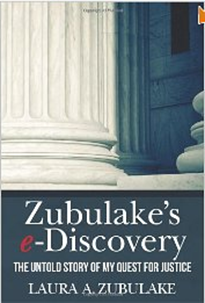
eDiscovery Trends: Interview with Laura Zubulake of Zubulake’s e-Discovery


Last week, we discussed the new book by Laura A. Zubulake, the plaintiff in probably most famous eDiscovery case ever (Zubulake vs. UBS Warburg), entitled Zubulake's e-Discovery: The Untold Story of my Quest for Justice.  I also conducted an interview with Laura last week to get her perspective on the book, including her reasons for writing the book seven years after the case ended and what she expects readers to learn from her story.

The book is the story of the Zubulake case – which resulted in one of the largest jury awards in the US for a single plaintiff in an employment discrimination case – as told by the author, in her words.  As Zubulake notes in the Preface, the book “is written from the plaintiff’s perspective – my perspective. I am a businessperson, not an attorney. The version of events and opinions expressed are portrayed by me from facts and circumstances as I perceived them.”  It’s a “classic David versus Goliath story” describing her multi-year struggle against her former employer – a multi-national financial giant.  The book is available at Amazon and also at CreateSpace.

Our interview with Laura had so much good information in it, we couldn’t fit it all into a single post.  So, today is part 1.  Part 2 will be published in the blog tomorrow!

Why did you decide to write the book at this time, seven years after the case was decided?

Actually, I’ve been working on the book for several years and I think it got to the point where I decided either I publish or I don’t publish.  It’s been a work-in-progress for some time and took me longer than I would have expected or liked, but it finally came together.  I probably started it a couple of years after everything was finalized, so it has taken from that point until now to complete it and get it to the point where it is now that I was happy with the results.

What do you expect that those who are familiar with the Zubulake opinions to get out of the book?

Number one, I think it’s really important to note that it’s from the plaintiff’s perspective.  What I find is that most of what you read about in the industry and hear at eDiscovery and legal conferences discuss topics from a defense standpoint.  Most are either a consultant to a defendant or an attorney representing a defendant and I find that the plaintiff’s voice is rarely heard.  And, I felt that I saw things differently from not only the defendant but also my attorneys from time to time because it was my case, I was taking the risks and I had a lot at stake.  So, I think hearing from the plaintiff not just about going through the motions filed and oral arguments and all that but also about life at home and what it’s like dealing with the day-to-day stresses as a plaintiff in a case that lasts three years.  I wanted people to appreciate the difficulty of it. I’m sure most people would assume it’s difficult, but I’m not sure how much people understand about the isolation and how going through litigation can be a lonely place. I write about that in the book.

Number two, a lot has been written about the Zubulake opinions.  Most of it is accurate, but not all of it.  I thought some of the things that were not accurate should be clarified because they were important.  Like, for instance, the role that the adverse inference instruction apparently played to the jury.  I only learned about its role in the verdict during post trial discussions.  Whenever I mention that observation to people, they find that interesting.  I think there are events throughout the litigation that people might learn that what they read in the press is not necessarily 100% accurate.

Also, I think that eDiscovery is still an issue for a lot of medium sized corporations (and probably large corporations, as well).  I think hearing from someone who went through the process would be valuable to them, especially when you consider that I did so without the aid of legal guidelines because there were very few guidelines at the time as I mentioned and also very little technology available.  I had to do it from a very basic standpoint.  So, when you learn anything, it’s really good to learn it from the foundation, from the basics.  From that, you can apply technology and strategies that have been developed over the years.  So, I’m hoping that everybody who reads it will learn something from my experience.

What do you expect that those who are unfamiliar with, or don’t understand the significance of, the Zubulake opinions to get out of the book?

Well, it’s difficult to write a book. When I wrote my first book several years ago about convertible securities, that was what I did for a living and I knew them very well.  I lived this case, so, clearly, I knew it very well.  The problem you have as a writer is not assuming that the reader knows what you know.  So, I tried to write it as clearly as possible and some who are experts in eDiscovery may not find the book to be technical enough, but that was intentional as my goal was to try to appeal to as broad an audience as possible.  That’s always difficult, but that was my goal.  I hope readers learn about the significance of the opinions, learn about the changes in law, and appreciate the plaintiff's viewpoint.

To the readers, as always, please share any comments you might have or if you’d like to know more about a particular topic!

Disclaimer: The views represented herein are exclusively the views of the author, and do not necessarily represent the views held by CloudNine Discovery. eDiscoveryDaily is made available by CloudNine Discovery solely for educational purposes to provide general information about general eDiscovery principles and not to provide specific legal advice applicable to any particular circumstance. eDiscoveryDaily should not be used as a substitute for competent legal advice from a lawyer you have retained and who has agreed to represent you.

eDiscovery Best Practices: You May Need to Collect from Custodians Who Aren’t There


A little over a week ago, we talked about how critical the first seven to ten days are in the case once litigation hits.  Key activities to get a jump on the case include creating a list of key employees most likely to have documents relevant to the litigation and interviewing those key employees, as well as key department representatives, such as IT for information about retention and destruction policies.  These steps are especially important as they may shed light on custodians you might not think about – the ones who aren’t there.

No, I’m not talking about the Coen brothers’ movie The Man Who Wasn’t There, starring Billy Bob Thornton, I’m talking about custodians who are no longer with the organization.

Let’s face it, when key employees depart an organization, many of those organizations have a policy in place to preserve their data for a period of time to ensure that any data in their possession that might be critical to company operations is still available if needed.  Preserving that data may occur in a number of ways, including:

  • Saving the employee’s hard drive, either by keeping the drive itself or by backing it up to some other media before wiping it for re-use;
  • Keeping any data in their network store (i.e., folder on the network dedicated to the employee’s files) by backing up that folder or even (in some cases) simply leaving it there for access if needed;
  • Storage and/or archival of eMail from the eMail system;
  • Retention of any portable media in the employee’s possession (including DVDs, portable hard drives, PDAs, cell phones, etc.).

As part of the early fact finding, it’s essential to determine the organization’s retention policy (and practices, especially if there’s no formal policy) for retaining data (such as the examples listed above) of departed employees.  You need to find out if the organization keeps that data, where they keep it, in what format, and for how long.

When interviewing key employees, one of the typical questions to ask is “Do you know of any other employees that may have responsive data to this litigation?”  The first several interviews with employees often identify other employees that need to be interviewed, so the interview list will often grow to locate potentially responsive electronically stored information (ESI).  It’s important to broaden that question to include employees that are no longer with the organization to identify any that also may have had responsive data and try to gather as much information about each departed employee as possible, including the department in which they worked, who their immediate supervisor was and how long they worked at the company.  Often, this information may need to be gathered from Human Resources.

Once you’ve determined which departed employees might have had responsive data and whether the organization may still be retaining any of that data, you can work with IT or whoever has possession of that data to preserve and collect it for litigation purposes.  Just because they aren’t there doesn’t mean they’re not important.

So, what do you think?  Does your approach for identifying and collecting from custodians include those who aren’t there?  Please share any comments you might have or if you’d like to know more about a particular topic.

Disclaimer: The views represented herein are exclusively the views of the author, and do not necessarily represent the views held by CloudNine Discovery. eDiscoveryDaily is made available by CloudNine Discovery solely for educational purposes to provide general information about general eDiscovery principles and not to provide specific legal advice applicable to any particular circumstance. eDiscoveryDaily should not be used as a substitute for competent legal advice from a lawyer you have retained and who has agreed to represent you.

eDiscovery Best Practices: When Litigation Hits, The First 7 to 10 Days is Critical

When a case is filed, several activities must be completed within a short period of time (often as soon as the first seven to ten days after filing) to enable you to assess the scope of the case, where the key electronically stored information (ESI) is located and whether to proceed with the case or attempt to settle with opposing counsel.  Here are several of the key early activities that can assist in deciding whether to litigate or settle the case.

Activities:

  • Create List of Key Employees Most Likely to have Documents Relevant to the Litigation: To estimate the scope of the case, it’s important to begin to prepare the list of key employees that may have potentially responsive data.  Information such as name, title, eMail address, phone number, office location and where information for each is stored on the network is important to be able to proceed quickly when issuing hold notices and collecting their data.
  • Issue Litigation Hold Notice and Track Results: The duty to preserve begins when you anticipate litigation; however, if litigation could not be anticipated prior to the filing of the case, it is certainly clear once the case if filed that the duty to preserve has begun.  Hold notices must be issued ASAP to all parties that may have potentially responsive data.  Once the hold is issued, you need to track and follow up to ensure compliance.  Here are a couple of recent posts regarding issuing hold notices and tracking responses.
  • Interview Key Employees: As quickly as possible, interview key employees to identify potential locations of responsive data in their possession as well as other individuals they can identify that may also have responsive data so that those individuals can receive the hold notice and be interviewed.
  • Interview Key Department Representatives: Certain departments, such as IT, Records or Human Resources, may have specific data responsive to the case.  They may also have certain processes in place for regular destruction of “expired” data, so it’s important to interview them to identify potentially responsive sources of data and stop routine destruction of data subject to litigation hold.
  • Inventory Sources and Volume of Potentially Relevant Documents: Potentially responsive data can be located in a variety of sources, including: shared servers, eMail servers, employee workstations, employee home computers, employee mobile devices, portable storage media (including CDs, DVDs and portable hard drives), active paper files, archived paper files and third-party sources (consultants and contractors, including cloud storage providers).  Hopefully, the organization already has created a data map before litigation to identify the location of sources of information to facilitate that process.  It’s important to get a high level sense of the total population to begin to estimate the effort required for discovery.
  • Plan Data Collection Methodology: Determining how each source of data is to be collected also affects the cost of the litigation.  Are you using internal resources, outside counsel or a litigation support vendor?  Will the data be collected via an automated collection system or manually?  Will employees “self-collect” any of their own data?  Answers to these questions will impact the scope and cost of not only the collection effort, but the entire discovery effort.

These activities can result in creating a data map of potentially responsive information and a “probable cost of discovery” spreadsheet (based on initial estimated scope compared to past cases at the same stage) that will help in determining whether to proceed to litigate the case or attempt to settle with the other side.

So, what do you think?  How quickly do you decide whether to litigate or settle?  Please share any comments you might have or if you’d like to know more about a particular topic.

Disclaimer: The views represented herein are exclusively the views of the author, and do not necessarily represent the views held by CloudNine Discovery. eDiscoveryDaily is made available by CloudNine Discovery solely for educational purposes to provide general information about general eDiscovery principles and not to provide specific legal advice applicable to any particular circumstance. eDiscoveryDaily should not be used as a substitute for competent legal advice from a lawyer you have retained and who has agreed to represent you.

eDiscovery Best Practices: Documentation is Key to a Successful Discovery Effort


We like to point out good articles about eDiscovery on this blog to keep our readers aware of trends and best practices.  I recently read an article on InsideCounsel titled E-discovery: Memorializing the e-discovery process, written by Alvin Lindsay, which had some good specific examples of where good documentation is important to prevent sanctions and save litigation costs.

Litigation Holds

The author notes that, since the Zubulake opinions issued by Judge Shira Scheindlin in 2003 and 2004, 1) most jurisdictions have come to expect that parties must issue a litigation hold “as soon as litigation becomes reasonably foreseeable”, and 2) “oral” litigation holds are unlikely to be sufficient since the same Judge Scheindlin noted in Pension Committee that failure to issue a “written” litigation hold constitutes “gross negligence”.  His advice: “make sure the litigation hold is in writing, and includes at minimum the date of issue, the recipients and the scope of preservation”.  IT personnel responsible for deleting “expired” data (outside of retention policies) also need to receive litigation hold documentation; in fact, “it can be a good idea to provide a separate written notice order just for them”.  Re-issuing the hold notices periodically is important because, well, people forget if they’re not reminded.  For previous posts on the subject of litigation holds, click here and here.

Retention Policies and Data Maps

Among the considerations for documentation here are the actual retention and destruction policies, system-wide backup procedures and “actual (as opposed to theoretical) implementation of the firm’s recycle policy”, as well as documentation of discussions with any personnel regarding same.  A data map provides a guide for legal and IT to the location of data throughout the company and important information about that data, such as the business units, processes and technology responsible for maintaining the data, as well as retention periods for that data.  The author notes that many organizations “don’t keep data maps in the ordinary course of business, so outside counsel may have to create one to truly understand their client’s data retention architecture.”  Creating a data map is impossible for outside counsel without involvement and assistance at several levels within the organization, so it’s truly a group effort and best done before litigation strikes.  For previous posts on the subject of data maps, click here and here.

Conferences with Opposing Counsel

The author discusses the importance of documenting the nature and scope of preservation and production and sums up the importance quite effectively by stating: “If opposing parties who are made aware of limitations early on do not object in a timely fashion to what a producing party says it will do, courts will be more likely to invoke the doctrines of waiver and estoppel when those same parties come to complain of supposed production infirmities on the eve of trial.”  So, the benefits of documenting those limitations early on are clear.

Collecting, Culling and Sampling

Chain of custody documentation (as well as a through written explanation of the collection process) is important to demonstrating integrity of the data being collected.  If you collect at a broad level (as many do), then you need to cull through effective searching to identify potentially responsive ESI.  Documenting the approach for searching as well as the searches themselves is key to a defensible searching and culling process (it helps when you use an application, like FirstPass®, powered by Venio FPR™, that keeps a history of all searches performed).  As we’ve noted before, sampling enables effective testing and refinement of searches and aids in the defense of the overall search approach.

Quality Control

And, of course, documenting all materials and mechanisms used to provide quality assurance and control (such as “materials provided to and used to train the document reviewers, as well as the results of QC checks for each reviewer”) make it easier to defend your approach and even “clawback” privileged documents if you can show that your approach was sound.  Mistakes happen, even with the best of approaches.

So, what do you think?  These are some examples of important documentation of the eDiscovery process – can you think of others?  Please share any comments you might have or if you’d like to know more about a particular topic.

Disclaimer: The views represented herein are exclusively the views of the author, and do not necessarily represent the views held by CloudNine Discovery. eDiscoveryDaily is made available by CloudNine Discovery solely for educational purposes to provide general information about general eDiscovery principles and not to provide specific legal advice applicable to any particular circumstance. eDiscoveryDaily should not be used as a substitute for competent legal advice from a lawyer you have retained and who has agreed to represent you.

eDiscovery Case Law: Court Allows Third Party Discovery Because Defendant is an “Unreliable Source”


Repeatedly referring to the defendant’s unreliability and untrustworthiness in discovery and “desire to suppress the truth,” Nebraska Magistrate Judge Cheryl R. Zwart found, in Peter Kiewit Sons’, Inc. v. Wall Street Equity Group, Inc., No. 8:10CV365, (D. Neb. May 18, 2012), that the defendant avoided responding substantively to the plaintiff’s discovery requests through a pattern of destruction and misrepresentation and therefore monetary sanctions and an adverse jury instruction at trial were appropriate. 

In this trademark action, Judge Zwart awarded sanctions of extensive discovery costs against a defendant that destroyed discoverable electronic evidence, failed to search for and locate other electronically stored information (ESI), and made false representations in affidavits and in court regarding its efforts to search for this evidence. In addition, she allowed the plaintiff to conduct discovery by contacting directly the defendant’s current and former clients, despite the court’s acknowledgment that such contact could harm the defendant’s business. Finally, Judge Zwart recommended an adverse jury instruction be given at trial.

Throughout a lengthy and contentious discovery process, the defendant claimed that its failure to produce any electronic documents containing the plaintiff’s mark demonstrated that there simply were no such documents. What the court ultimately discovered, however, was that no documents were produced for very different reasons: (1) the defendant appeared to have a virtually nonexistent records retention policy; (2) the defendant recovered its external hard drives from its landlord just before the landlord received a subpoena for the hard drives, leading the landlord to claim he did not possess the files; (3) to “comply” with discovery requests, the defendant had an employee who is not a computer expert conduct a keyword search consisting of one word (“Kiewit”) of the defendant’s files (from her own workstation) for the name of the plaintiff’s mark and recovered only two nonresponsive documents; and (4) the defendant discarded what it claimed was a non-functioning server the same month that it received notice of the plaintiff’s discovery requests.

The court ordered a forensic examination of the defendants’ computer systems that revealed thousands of documents containing the keyword “Kiewit” on its face as well as in its metadata. It also revealed at least one document that had been previously produced was missing from the electronic files, contributing to the evidence of spoliation. In ruling, the court pointed out that “considering Defendant’s very liberal policy of not keeping documents, consolidating their records in one location, or organizing their files, their efforts to locate relevant electronic files were woefully inadequate.”

As a consequence of the defendants’ “obstreperous” conduct, Judge Zwart found sanctions were appropriate, including monetary awards and an adverse jury instruction. She granted sanctions pursuant to its “authority to sanction the misconduct of parties and their attorneys . . . derived from the Federal Rules of Civil Procedure and the inherent power of the court,” as well as its “power to shape the appropriate remedy including default judgment, striking pleadings, an adverse jury instruction, and an award of attorney’s fees and costs” derived from precedent. Judge Zwart noted, “The most severe sanctions are reserved for those litigants demonstrating ‘blatant disregard of the Court’s orders and discovery rules’ [and] engaging in a pattern of deceit by presenting false and misleading answers and testimony under oath in order to prevent their opponent from fairly presenting its case.’”

Furthermore, Judge Zwart found the defendants’ conduct dictated that the plaintiff should be permitted to conduct third-party discovery. The plaintiff argued that it needed to contact the defendants’ clients in an effort to determine whether and how the defendants used the plaintiff’s trademark, whereas the defendants argued that they would suffer “irreparable harm” should the plaintiff reach out to their current and former clients. Despite courts’ general reluctance to allow direct contact with litigants’ clients in intellectual property cases, Judge Zwart here found that the plaintiff showed the clients’ information was “relevant and necessary”; moreover, because “Defendants are simply not a reliable source of information” and they “continue to attempt to use client confidentiality as a means of preventing Plaintiff from discovering relevant information,” the plaintiff’s contact with the clients would be proper.

So, what do you think?  Did the court’s sanctions go far enough or should they have been even tougher?  Please share any comments you might have or if you’d like to know more about a particular topic.

Case Summary Source: Applied Discovery (free subscription required).  For eDiscovery news and best practices, check out the Applied Discovery Blog here.

Disclaimer: The views represented herein are exclusively the views of the author, and do not necessarily represent the views held by CloudNine Discovery. eDiscoveryDaily is made available by CloudNine Discovery solely for educational purposes to provide general information about general eDiscovery principles and not to provide specific legal advice applicable to any particular circumstance. eDiscoveryDaily should not be used as a substitute for competent legal advice from a lawyer you have retained and who has agreed to represent you.

eDiscovery Trends: Wednesday LTWC 2012 Sessions


As noted yesterday, LegalTech West Coast 2012 (LTWC) is happening this week and eDiscoveryDaily is here to report about the latest eDiscovery trends being discussed at the show.  There’s still time to check out the show if you’re in the Los Angeles area with a number of sessions (both paid and free) available and 69 exhibitors providing information on their products and services, including (shameless plug warning!) my company, CloudNine Discovery, which just announced yesterday release of Version 11 of our linear review application, OnDemand®, and will be exhibiting at booth #216 along with our partners, First Digital Solutions.  Come by and say hi!

Perform a “find” on today’s LTNY conference schedule for “discovery” and you’ll get 21 hits.  More eDiscovery sessions happening!  Here are some of the sessions in the main conference tracks:

10:30 – 12:00 AM:

Information Governance and Information Management

With the volume of electronically stored information (ESI) growing exponentially and the challenges surrounding managing it, protecting it, and developing effective policies are essential. Social media, email, IMs, web pages, mobile devices and the cloud have made a big job even bigger. How much or how little should you collect? How aggressive should you be? How can you be certain your approach and results are defensible?

Speakers are: Richard E. Davis, JD, e-Discovery Solutions Architect & Founder, Litigation Logistics, LLC; Jack Halprin, Head of eDiscovery, Google; Dawson Horn, III, Senior Litigation Counsel, Tyco International and David Yerich, Director, eDiscovery, UHG Legal Department, United Health Group.

The GARP® Principles and eDiscovery

Attendees will hear from experts on the GARP Principles and eDiscovery as well as:

  • Understand the importance of proactive records management through the eight GARP® Principles
  • Revisit the GARP® Principles and learn how their role is magnified by recent case law
  • Learn what to do before eDiscovery: how GARP® precedes and complements the EDRM

Speakers are: Gordon J. Calhoun, Esq., Lewis Brisbois Bisgaard &, Smith LLP; Lorrie DeCoursey, Former Law Firm Administrator and John J. Isaza, Esq., Partner, Rimon P.C.  Moderator: David Baskin, Vice President of Product Management, Recommind.

1:30 – 3:00 PM:

Practical Handbook for Conducting International eDiscovery – Tips and Tricks

This session will present a truly international view on how to conduct global eDiscovery from a practical perspective, including developing proactive global document retention policies and assuring multi-jurisdictional compliance, best practices of global data preservation and collection, successful data migration across jurisdictions, navigating unique cultural and procedural challenges in various global regions, handling multi-lingual data sets as well as strategic positioning of hosting data centers.

Speakers are: Monique Altheim, Esq., CIPP, The Law Office of Monique Altheim; George I. Rudoy, Founder & CEO, Integrated Legal Technology, LLC and David Yerich, Director, eDiscovery, UHG Legal Department, United Health Group.

Litigation Preparedness Through Effective Data Governance

Be prepared. This panel will go through the benefits of data governance in your litigation preparedness and discuss benefits such as:

  • Auto-classification of legacy and newly created content
  • What is email management and is it ready for prime-time?
  • Review the court's findings on the complexities of ESI, including metadata, native formats, back-up tapes, mobile devices, and legacy technology
  • Key questions to ask before outsourcing ESI to the cloud

Speakers are: Lorrie DeCoursey, Former Law Firm Administrator; John J. Isaza, Esq., Partner, Rimon P.C. and Ayelette Robinson, Director – Knowledge Technology, Littler Mendelson.  Moderator: Derek Schueren, GM, Information Access and Governance, Recommind.

3:30 – 5:00 PM:

Managed and Accelerated Review

As costs for review soar and volumes of data multiply at an almost exponential rate, traditional linear review seems to be giving way to new technologies that will enable faster, better, more defensible eDiscovery results. How can you be assured that this new approach will catch everything that needs to be captured? Will human review become obsolete? What do you need to ask when considering this new technology? How should it be incorporated into your overall litigation strategy?

Speakers are: Matthew Miller, Manager, Fraud Investigation & Dispute Services, Ernst & Young; Robert Miller, Founder, Rise Advisory Group, LLC; Former Discovery Counsel, BP; David Sun, Discovery Project Manager, Google.

eDiscovery Circa 2015: Will Aggressive Preservation/Collection and Predictive Coding be Commonplace?

Who's holding back on Predictive Coding, clients or outside counsel? This session will discuss if aggressive preservation/collection of predictive coding will become commonplace as well as:

  • How aggressive should clients be with preservation/collection?
  • How to use effective searching, sampling, and targeting tools and techniques to not over-collect

Speakers are: Gordon J. Calhoun, Esq., Lewis Brisbois Bisgaard &, Smith LLP; Lorrie DeCoursey, Former Law Firm Administrator and Greg Chan, Senior Regional Litigation Technology Manager, Bingham McCutchen LLP.  Moderator: David Baskin, Vice President of Product Management, Recommind.

In addition to these, there are other eDiscovery-related sessions today.  For a complete description for all sessions today, click here.

So, what do you think?  Are you planning to attend LTWC this year?  Please share any comments you might have or if you’d like to know more about a particular topic.

Disclaimer: The views represented herein are exclusively the views of the author, and do not necessarily represent the views held by CloudNine Discovery. eDiscoveryDaily is made available by CloudNine Discovery solely for educational purposes to provide general information about general eDiscovery principles and not to provide specific legal advice applicable to any particular circumstance. eDiscoveryDaily should not be used as a substitute for competent legal advice from a lawyer you have retained and who has agreed to represent you.