

eDiscoveryDaily

It’s 2020! Here’s a Current Survey and a Major Conference To Look Forward To: eDiscovery Trends

Happy New Year!  We’re back and better than ever, ready for not only a new year, but a new decade!  So, what’s on tap for the new year?  Here’s a survey currently underway and a major conference coming up in early February – both very familiar to you if you’re familiar with eDiscovery trends.  ;o)

It’s Winter, so it must be time for another eDiscovery Business Confidence survey from ComplexDiscovery!  Believe it or not, this is the fifth year and the seventeenth quarterly survey, and, since January 2016, more than 1,771 individual responses to the survey have been received from legal, business, and technology professionals across the eDiscovery ecosystem.  It’s a non-scientific quarterly survey designed to provide insight into the business confidence level of individuals working in the eDiscovery ecosystem. The core survey consists of nine multiple-choice questions focused on factors related to the creation, delivery, and consumption of eDiscovery products and services. Additionally, the survey includes three multiple-choice questions focused on the trajectory of key operational business metrics.  Literally takes 1-2 minutes to complete.  You can complete the Winter survey here – hurry, as the survey will close by mid-month.

If you follow our blog, you know that we’ve been covering the survey since the beginning and we will continue to cover it this year as well.  Here’s a link to our coverage of the Fall 2019 survey.

The major conference to look forward to is, of course, Legaltech®, which is part of Legalweek and will be held from February 4 through 6 at the New York Hilton Midtown.  As usual, it will include a slew of educational sessions and a ton of legal technology exhibitors, including (of course) CloudNine (shameless plug warning!).  We will be showcasing some exciting new developments in our Concordance®, LAW, Explore and Review products.  And, we have some exciting brand new products we will also be showcasing.  And, we may have other exciting news to share as well.  More on that coming soon!  And, of course, eDiscovery Daily will be covering the event and will provide a preview later this month and a wrap-up after the conference.

And, at Legaltech, we’re once again excited to be co-sponsoring the annual #DrinkswithDougandMary cocktail reception with Mary Mack, Kaylee Walstad and the rest of the EDRM team!  This is our fourth year and we’re grateful to Marc Zamsky and Compliance Discovery for co-sponsoring as well.  It will once again be at Ruth’s Chris Steak house and will happen Wednesday, February 5 from 4-6pm.  You can register to attend here. Last year, we never closed registration and we “broke” the meeting room upstairs, so we’re taking over even more of the restaurant this year!  Come join us!

So, what do you think?  Are you attending Legaltech this year?  Please share any comments you might have or if you’d like to know more about a particular topic.

Sponsor: This blog is sponsored by CloudNine, which is a data and legal discovery technology company with proven expertise in simplifying and automating the discovery of data for audits, investigations, and litigation. Used by legal and business customers worldwide including more than 50 of the top 250 Am Law firms and many of the world’s leading corporations, CloudNine’s eDiscovery automation software and services help customers gain insight and intelligence on electronic data.

Disclaimer: The views represented herein are exclusively the views of the author, and do not necessarily represent the views held by CloudNine. eDiscovery Daily is made available by CloudNine solely for educational purposes to provide general information about general eDiscovery principles and not to provide specific legal advice applicable to any particular circumstance. eDiscovery Daily should not be used as a substitute for competent legal advice from a lawyer you have retained and who has agreed to represent you.


Court Denies Plaintiff’s Motion for Sanction for Spoliation of Audio Recording: eDiscovery Case Law

In Montoya v. Loya Ins., No. 18-590 SCY/JFR (D.N.M. Oct. 24, 2019), New Mexico Magistrate Judge Steven C. Yarbrough denied the plaintiff’s Motion For Sanctions For Spoliation Of Audio Recording Evidence, after a jury trial in favor of the plaintiff, finding that there was minimal prejudice to the plaintiff and that “there is no dispute over the relevant contents of the telephone conversation” which was recorded.

Case Background

In this case involving a bad faith claim against the plaintiff’s insurance company for its handling of her claim under her uninsured motorist benefits, the defendant took a recorded statement from the plaintiff in the course of its investigation but lost it.  The plaintiff was forced to file suit against the defendant in state court in February 2017 and the jury rendered a verdict in favor of the plaintiff against the defendant in January 2018 in the amount of $23,742.82.  Despite that, the plaintiff sought a finding of liability against the defendant as a sanction for its failure to preserve the recorded statement the defendant took from the plaintiff during its investigation of her claim.

Judge’s Ruling

Considering the plaintiff’s claim, Judge Yarbrough stated: “The Court agrees that the loss of the recording caused Plaintiff some prejudice, as it prevented her from obtaining a full transcript of the conversation rather the parts that Ms. Boneo chose to record in her notes. This prejudice, however, is minimal.”

Continuing, Judge Yarbrough provided three reasons for this, as follows:

“First, Plaintiff herself was part of the conversation. Thus, the loss of the recording did not deny her access to the conversation. Plaintiff therefore retains the ability to testify about conversation despite the loss of the recording…Second, Plaintiff was able to depose the adjustor and thereby obtain the adjuster’s testimony about the conversation. Because Plaintiff has independent personal knowledge of this conversation that she was part of and because Plaintiff obtained the adjuster’s notes and testimony about the conversation, Plaintiff has the means to adequately prepare for trial… Third, and most importantly, there is no dispute over the relevant contents of the telephone conversation. Plaintiff testified in her deposition that she agreed with the substance of Ms. Boneo’s testimony regarding the contents of Plaintiff’s statement.”

As a result, Judge Yarbrough stated: “Any prejudice Plaintiff might suffer from not having a recording of the statement is slight and does not justify the only relief Plaintiff requests: a finding of liability against Defendant. Plaintiff’s Motion For Sanctions For Spoliation Of Audio Recording Evidence (Doc. 75) is therefore DENIED.”

So, what do you think?  Should the judge have penalized the defendant for losing the recording?  Please let us know if any comments you might have or if you’d like to know more about a particular topic.

It’s our last post of the year, so I want to thank all of you for reading our blog all year, attending our webcasts and for all of the support!  Can’t believe we are in the midst of our tenth year and your support has made it possible to keep producing blog posts daily.  In this holiday season, I’m very thankful for your support and also thankful for the love of my wife, Paige, and our kids, Kiley and Carter.  Happy holidays and see you in 2020!

:o)

Case opinion link courtesy of eDiscovery Assistant.

Sponsor: This blog is sponsored by CloudNine, which is a data and legal discovery technology company with proven expertise in simplifying and automating the discovery of data for audits, investigations, and litigation. Used by legal and business customers worldwide including more than 50 of the top 250 Am Law firms and many of the world’s leading corporations, CloudNine’s eDiscovery automation software and services help customers gain insight and intelligence on electronic data.

Disclaimer: The views represented herein are exclusively the views of the author, and do not necessarily represent the views held by CloudNine. eDiscovery Daily is made available by CloudNine solely for educational purposes to provide general information about general eDiscovery principles and not to provide specific legal advice applicable to any particular circumstance. eDiscovery Daily should not be used as a substitute for competent legal advice from a lawyer you have retained and who has agreed to represent you.

Court Enters Parties’ Order for Discovery of ESI: eDiscovery Case Law

It’s a rare, if not unheard of, case law post that discusses an agreement between parties, not a dispute!  Just in time for the holidays!  Actually, early last month, but still…  ;o)

In Shotwell, et al. v. Zillow Group Inc., et al., No. C17-1387-JCC (W.D. Wash. Nov. 7, 2019), Washington District Judge John C. Coughenour entered an order regarding the discovery of electronically stored information (“ESI”), pursuant to the parties’ stipulation and proposed order.

The order included the following sections:

  • General Principles, which notes, along with proportionality guidelines per Fed. R. Civ. P. 26(b)(1), that “An attorney’s zealous representation of a client is not compromised by conducting discovery in a cooperative manner.”
  • ESI Disclosures, which states that the parties will disclose within thirty days after the Fed. R. Civ. P. 26(f) conference (or later if agreed) custodians, non-custodial data sources, third party data sources and inaccessible data.
  • Preservation of ESI, which notes guidelines for the parties regarding preservation and what they don’t have to preserve (absent a showing of good cause by the requesting party, that is).
  • Privilege, Guidelines for privilege logs and handling of inadvertent disclosures of privileged documents.
  • ESI Discovery Procedures, includes definitions and specifications for image load file formats, production of hard copy documents and production of ESI (including things like handling of exceptions, production of metadata, handling of duplicates, handling of parent-child relationships, format of Bates numbers and handling of third-party subpoenas). The parties agreed to produce the ESI in single-page Group IV TIFF image format using at least 300 DPI print setting, except for certain files (Excel files, spreadsheet files, .CSV files, source code, audio, and video) which would be produced natively with a placeholder image.  There was a table of metadata to be produced associated with the discovery specifications, but it was not included in the order.
  • Miscellaneous, to cover things like conflict between the provisions of the agreement and the Stipulated Protective Order (the Protective Order will take precedent) and reiteration of protection of privilege.

It’s nice to cover an agreement between parties for a change and this discovery agreement is a good example of parties cooperating effectively on a plan for discovery.

So, what do you think?  Do you see any issues with this agreement?  I predict somebody will have at least one!  ;o)  Please let us know if any comments you might have or if you’d like to know more about a particular topic.

Case opinion link courtesy of eDiscovery Assistant.

Sponsor: This blog is sponsored by CloudNine, which is a data and legal discovery technology company with proven expertise in simplifying and automating the discovery of data for audits, investigations, and litigation. Used by legal and business customers worldwide including more than 50 of the top 250 Am Law firms and many of the world’s leading corporations, CloudNine’s eDiscovery automation software and services help customers gain insight and intelligence on electronic data.

Disclaimer: The views represented herein are exclusively the views of the author, and do not necessarily represent the views held by CloudNine. eDiscovery Daily is made available by CloudNine solely for educational purposes to provide general information about general eDiscovery principles and not to provide specific legal advice applicable to any particular circumstance. eDiscovery Daily should not be used as a substitute for competent legal advice from a lawyer you have retained and who has agreed to represent you.

Friday the 13th is Unlucky for the City of New Orleans. Almost. Maybe.: Cybersecurity Trends

In Friday’s post about Norton Rose Fulbright’s 2019 Litigation Trends Annual Survey, one of the most notable trends was that 44 percent of corporate respondents identified Cybersecurity/data privacy as the most likely new source of dispute for their business on the horizon, which was more than four times the next likely sources.  Cybersecurity is also a big challenge for municipalities as we saw on Friday.

According to Forbes (New Orleans Declares State Of Emergency Following Cyber Attack, written by Davey Winder), the City of New Orleans suffered a cybersecurity attack last Friday serious enough for Mayor LaToya Cantrell to declare a state of emergency.

The attack started at 5 a.m. CST on Friday, according to the City of New Orleans’ emergency preparedness campaign, NOLA Ready, managed by the Office of Homeland Security and Emergency Preparedness. NOLA Ready tweeted that “suspicious activity was detected on the City’s network,” and as investigations progressed, “activity indicating a cybersecurity incident was detected around 11 a.m.” As a precautionary measure, the NOLA tweet confirmed, the city’s IT department gave the order for all employees to power down computers and disconnect from Wi-Fi. All city servers were also powered down, and employees told to unplug any of their devices.

During a press conference, Mayor Cantrell confirmed that this was a ransomware attack. A declaration of a state of emergency was filed with the Civil District Court in connection with the incident.

NOLA Ready said that emergency communications had not been affected. Although the “Real-Time Crime Center” had been powered down, public safety cameras were still recording, and incident footage would be available if needed. The police and fire departments continued to operate as usual, and the ability to respond to 911 calls was not impacted.

The ransomware attack that has hit New Orleans follows another that targeted the state of Louisiana in November. Louisiana school district computers were also taken offline, and a state of emergency declared, in response to a ransomware attack in July. It isn’t yet known if the two were connected. However, in August, 23 government agencies were taken offline by a cyber-attack on the State of Texas. Which suggests that U.S. municipalities are firmly in the crosshairs of ransomware threat actors.

Gee, you think?  Apparently, any business is in the crosshairs these days, if they have enough money.  After all, why do hackers hack, if not for the money.

So, what do you think?  Does your organization have a plan if it’s hit by a ransomware attack?  Please share any comments you might have or if you’d like to know more about a particular topic.

Sponsor: This blog is sponsored by CloudNine, which is a data and legal discovery technology company with proven expertise in simplifying and automating the discovery of data for audits, investigations, and litigation. Used by legal and business customers worldwide including more than 50 of the top 250 Am Law firms and many of the world’s leading corporations, CloudNine’s eDiscovery automation software and services help customers gain insight and intelligence on electronic data.

Disclaimer: The views represented herein are exclusively the views of the author, and do not necessarily represent the views held by CloudNine. eDiscovery Daily is made available by CloudNine solely for educational purposes to provide general information about general eDiscovery principles and not to provide specific legal advice applicable to any particular circumstance. eDiscovery Daily should not be used as a substitute for competent legal advice from a lawyer you have retained and who has agreed to represent you.

Just in Time for the Holidays! Norton Rose Fulbright’s 2019 Litigation Trends Survey: eDiscovery Trends

No, that’s not Tom O’Connor, it just looks like him… ;o)

Hard to believe it’s the fifteenth edition, but here it is: Norton Rose Fulbright’s 2019 Litigation Trends Annual Survey.  We’ve covered it a few times over the years, but I don’t remember it ever being released this close to the holidays.  Nonetheless, the survey, as always, had some interesting findings.  Let’s take a look.

287 corporate counsel participated in the survey, all respondents were US-based or represent US-based organizations.  The breakdown was as follows: General Counsel 39 percent, Head of Litigation 19 percent, Associate/Deputy/Assistant GC 27 percent, Other 16 percent.

Some notable statistics include:

  • $1.5 million spent on disputes per $1 billion of revenue (median average);
  • 17 percent of respondents expect to increase their team sizes, with only 2 percent predicting a decrease;
  • 66 percent of respondents are using Alternate Fee Agreements (AFAs), but generally for only a minority of spend;
  • 62 percent of respondents now have to balance cross-border discovery with jurisdictional data protection regulations;
  • Greater than 50 percent feel more exposed to cybersecurity and data protection issues, while 11 percent feel less exposed (the second number is the one that surprises me);
  • 35 percent expect volume of disputes to rise moving forward, while only 9 percent expect the volume to decrease (a 26 percent net, which is a rise of 9 percent over 2018 and the third year in a row that the net went up);
  • The most common types of litigation pending against respondent companies over the past 12 months were Labor/Employment 49 percent (up 7 percent from 2018), Contracts 42 percent (up 1 percent), Personal Injury 18 percent (down 1 percent) and IP/Patents 18 percent (up 3 percent);
  • 44 percent of respondents identified Cybersecurity/data privacy as the most likely new source of dispute for their business on the horizon (more than four times the next likely sources: Regulatory and Climate/environment at 10 percent each).

That’s just a sampling of numbers, you can go to the Norton Rose Fulbright site here to download your own copy of the free report.

So, what do you think?  Do any of those numbers surprise you?  Please share any comments you might have or if you’d like to know more about a particular topic.

Sponsor: This blog is sponsored by CloudNine, which is a data and legal discovery technology company with proven expertise in simplifying and automating the discovery of data for audits, investigations, and litigation. Used by legal and business customers worldwide including more than 50 of the top 250 Am Law firms and many of the world’s leading corporations, CloudNine’s eDiscovery automation software and services help customers gain insight and intelligence on electronic data.

Disclaimer: The views represented herein are exclusively the views of the author, and do not necessarily represent the views held by CloudNine. eDiscovery Daily is made available by CloudNine solely for educational purposes to provide general information about general eDiscovery principles and not to provide specific legal advice applicable to any particular circumstance. eDiscovery Daily should not be used as a substitute for competent legal advice from a lawyer you have retained and who has agreed to represent you.

Away CEO Resigns After “Slack Bullying” Revealed in Report from The Verge: eDiscovery Trends

“Yes”, you say, “this is an interesting story, but what does it have to do with eDiscovery?”  And, why is there a picture of Yogi Berra on this story?  Read on and you’ll find out.

After an article (Emotional Baggage, written by Zoe Schiffer) by The Verge last week exposed a story where ex-employees claimed Away, a luggage startup hid a “toxic work culture”, the travel brand announced it hired the Lululemon executive Stuart Haselden as the company’s new CEO to replace current CEO Steph Korey, who is stepping down just four days after the article.

Like many fast-growing startups, Away’s workplace is organized around digital communication. It’s how employees talk, plan projects, and get feedback from co-workers and higher-ups. Away used the popular chat app Slack, which has the motto ‘where work happens.”  Away embraced Slack in more ways than one — its co-founder, Jen Rubio, is engaged to its CEO Stewart Butterfield — but it took things further than most startups. Employees were not allowed to email each other, and direct messages were supposed to be used rarely (never about work, and only for small requests, like asking if someone wanted to eat lunch). Private channels were also to be created sparingly and mainly for work-specific reasons, so making channels to, say, commiserate about a tough workday was not encouraged.

The rules had been implemented in the name of transparency, but employees say they created a culture of intimidation and constant surveillance. Once, when a suitcase was sent out with a customer’s incomplete initials stenciled onto the luggage tag, Korey said the person in charge must have been “brain dead” and threatened to take over the project.  Korey often framed her critiques in terms of Away’s core company values: thoughtful, customer-obsessed, iterative, empowered, accessible, in it together. Empowered employees didn’t schedule time off when things were busy, regardless of how much they’d been working. Customer-obsessed employees did whatever it took to make consumers happy, even if it came at the cost of their own well-being.

An example of that was the Slack message that Korey sent the day before Valentine’s Day in 2018, when she decided she was going to stop the team from taking any more time off. In a series of Slack messages that began at 3AM, she said, “I know this group is hungry for career development opportunities, and in an effort to support you in developing your skills, I am going to help you learn the career skill of accountability. To hold you accountable…no more [paid time off] or [work from home] requests will be considered from the 6 of you…I hope everyone in this group appreciates the thoughtfulness I’ve put into creating this career development opportunity and that you’re all excited to operate consistently with our core values.”  Four days later, when she noticed two managers still had time off on the calendar, she was livid. “If you all choose to utilize your empowerment to leave our customers hanging…you will have convinced me that this group does not embody Away’s core values,” she said.  In both cases, the emphasis was Korey’s.

Throughout, the article talks about how overworked the small customer team was in keeping up with customer emails and how responses from Away management (especially Korey) continued to drive and berate them.

Away indicated that the plan to change its CEO had been in the works for months.  For her part, Korey posted a message on Twitter last Friday (before the CEO announcement) admitting to her “mistakes” and promising that the company “will continue to work to improve.” As for those mistakes, she notes: “At times, I expressed myself in ways that hurt the team. … I was appalled and embarrassed reading [the messages]. … I’m sincerely sorry for what I said and how I said it. It was wrong, plain and simple.”

The follow-up article from The Verge that discussed Korey’s resignation also discussed the use of Slack as part of the story, noting that “executives may begin rethinking the use of Slack. The kind of type-first, think-later style of communication that it inspires is categorically different than email, the technology that preceded it in companies like Away.”

So, what does this article have to do with eDiscovery?  It illustrates how communications in organizations are changing these days.  While the communication policies at Away are an extreme example, they certainly illustrate how communication is about much more than email these days – communications with colleagues via text and other messaging apps like Skype and Slack are routine in organizations these days as those messages are often the quickest way to get a response versus wading through a sea of emails.  When it comes to emails and urgent communications, as Yogi Berra once said about a popular restaurant in New York, “nobody goes there anymore, it’s too crowded.”  And, all of that data is discoverable.

So, what do you think?  Does your organization use Slack or another messaging app for internal communications?  Please share any comments you might have or if you’d like to know more about a particular topic.  It’s never over ’til it’s over.  ;o)

Sponsor: This blog is sponsored by CloudNine, which is a data and legal discovery technology company with proven expertise in simplifying and automating the discovery of data for audits, investigations, and litigation. Used by legal and business customers worldwide including more than 50 of the top 250 Am Law firms and many of the world’s leading corporations, CloudNine’s eDiscovery automation software and services help customers gain insight and intelligence on electronic data.

Disclaimer: The views represented herein are exclusively the views of the author, and do not necessarily represent the views held by CloudNine. eDiscovery Daily is made available by CloudNine solely for educational purposes to provide general information about general eDiscovery principles and not to provide specific legal advice applicable to any particular circumstance. eDiscovery Daily should not be used as a substitute for competent legal advice from a lawyer you have retained and who has agreed to represent you.

Today’s Webcast Will Help You Learn about Important eDiscovery Developments for 2019: eDiscovery Webcasts

2019 was another busy year from an eDiscovery, cybersecurity and data privacy standpoint.  So busy, we couldn’t fit it all into a single webcast!  Nonetheless, what do you need to know about those important 2019 events?  Today’s webcast will discuss what you need to know about important 2019 events and how they impact your eDiscovery, data privacy and cybersecurity efforts.

Today at noon CST (1:00pm EST, 10:00am PST), CloudNine will conduct the webcast 2019 eDiscovery Year in Review.  In this one-hour webcast that’s CLE-approved in selected states, we will discuss key events and trends in 2019, what those events and trends mean to your discovery practices and provide our predictions for 2020. Key topics include:

  • How Much Data is Being Transmitted Every Minute on the Internet in 2019
  • What a Lawyer’s Notification Duty When a Data Breach Occurs
  • General Data Protection Regulation (GDPR) and Data Privacy Fines
  • Biometric Security and Data Privacy Litigation
  • Cell Phone Passwords and the Fifth Amendment
  • How Organizations Are Doing on Compliance with the California Consumer Privacy Act (CCPA)
  • Social Media and Judges Accepting “Friend” Requests from Litigants
  • How #metoo and Investigations are Impacting eDiscovery within Organizations
  • Whether Emojis Are the Next eDiscovery Challenge
  • The Challenge to Obtain Significant Spoliation Sanctions under the New Rule 37(e)
  • Whether Lawyers Are “Failing” at Cybersecurity?
  • Outside Hackers vs. Internal Employees As Cybersecurity Threat
  • Sanctions Resulting from Inadvertent Disclosure of Privileged Information

As always, I’ll be presenting the webcast, along with Tom O’Connor.  To register for it, click here – it’s not too late! Even if you can’t make it, go ahead and register to get a link to the slides and to the recording of the webcast (if you want to check it out later).  If you want to learn how key events and trends in 2019 can affect your eDiscovery practice in 2020, this webcast is for you!

So, what do you think?  Do you have FOMO (fear of missing out) on important info for 2019?  Please share any comments you might have or if you’d like to know more about a particular topic.

Sponsor: This blog is sponsored by CloudNine, which is a data and legal discovery technology company with proven expertise in simplifying and automating the discovery of data for audits, investigations, and litigation. Used by legal and business customers worldwide including more than 50 of the top 250 Am Law firms and many of the world’s leading corporations, CloudNine’s eDiscovery automation software and services help customers gain insight and intelligence on electronic data.

Disclaimer: The views represented herein are exclusively the views of the author, and do not necessarily represent the views held by CloudNine. eDiscovery Daily is made available by CloudNine solely for educational purposes to provide general information about general eDiscovery principles and not to provide specific legal advice applicable to any particular circumstance. eDiscovery Daily should not be used as a substitute for competent legal advice from a lawyer you have retained and who has agreed to represent you.
This is What WON’T Be On Our 2019 eDiscovery Year in Review Webcast Tomorrow: eDiscovery Trends

Tomorrow, CloudNine will conduct the webcast 2019 eDiscovery Year in Review.  As 2019 has been a busy year, we have a lot of topics planned for tomorrow – everything from key case law decisions to important data privacy trends to whether lawyers are “failing” at cybersecurity and it will be a challenge to get through them all.  But, we still couldn’t cover everything – there was simply too much that happened this year to cover it all.  So, here are some notable events and trends that we covered on eDiscovery Daily this year that we won’t have time to discuss tomorrow.  Enjoy!

To Preserve Sanction Potential, Plaintiff Fights To NOT Have Claim Against Them Dismissed: Yes, you read that right. In DR Distrib., LLC v. 21 Century Smoking, Inc., Illinois District Judge Iain D. Johnston denied the defendants’ Motion for Leave to Amend their counterclaim to remove their own defamation counterclaim (Count VIII) against the plaintiffs – a move to which the plaintiffs objected, because it could eliminate their chance to pursue sanctions against the defendants for ESI spoliation.

Discovery Can’t Be Stayed While Motion to Dismiss is Considered, Court Says: In Udeen v. Subaru of America, Inc., New Jersey Magistrate Judge Joel Schneider denied the defendants’ request that all discovery be stayed until their Motion to Dismiss is decided, but, with the proviso that only limited and focused discovery on core issues would be permitted.

Firm IT Director Predicts “Carnage” in Legal Tech Consolidation: Not since Clubber Lang predicted “pain” in Rocky III has the state of legal tech consolidation been stated quite this way. Is that good news or bad news for consumers of legal tech software and services?

Is eDiscovery “Too Practical” to Offer as Part of Law School Curriculums?: We’ve certainly noted before how slow law schools are to provide eDiscovery education. But, are they slow to push for it because eDiscovery is “too practical”? At least one law school dean suggests that might be the case.

Another Case Where Intent to Deprive is Put in the Hands of the Jury: In Woods v. Scissons, Arizona Chief District Judge G. Murray Snow granted in part and denied in part the plaintiff’s motion for sanctions for spoliation of video footage of an arrest incident involving the plaintiff and the defendant (a police officer with the Prescott Police Department), ruling that non-party City of Prescott violated a duty to preserve evidence of the alleged incident, but that the question of intent should be submitted to the jury to determine appropriate sanctions.

Mary Mack and Kaylee Walstad acquire the EDRM from Duke Law: In a rare two-post day for us at eDiscovery Daily, we broke the news that Mary Mack and Kaylee Walstad, the former executive director and former vice president of client engagement, respectively, of The Association of Certified E-Discovery Specialists (ACEDS) announced that they have acquired the Electronic Discovery Reference Model (EDRM) from the Bolch Judicial Institute at Duke Law School.  Before that, ACEDS announced its new leadership as well.

Why Process in eDiscovery? Isn’t it “Review Ready”?: I’ve been asked a variation of this question for years. But, perhaps the best answer to this question lies in Craig Ball’s new primer – Processing in E-Discovery.

Despite Email from Defendants Instructing to Destroy Evidence, Court Declines Sanctions: In United States et al. v. Supervalu, Inc. et al., Illinois District Judge Richard H. Mills, despite an email produced by the defendants with instructions to their pharmacies to destroy evidence, denied the relators’ motion for sanctions, stating: “Upon reviewing the record, the Court is unable to conclude that Defendants acted in bad faith. If the evidence at trial shows otherwise and bad faith on the part of the Defendants is established, the Court can revisit the issue and consider one or both of the sanctions requested by the Relators or another appropriate sanction.”  {OK, we might mention this one}

Court Infers Bad Faith for Plaintiffs Use of Ephemeral Messaging App: In Herzig v. Arkansas Foundation for Medical Care, Inc., Arkansas District Judge P.K. Holmes, III indicated his belief that the use and “necessity of manually configuring [the messaging app] Signal to delete text communications” on the part of the plaintiffs was “intentional and done in bad faith”. However, Judge Holmes declined to consider appropriate sanctions, ruling that “in light of the [defendant’s] motion for summary judgment, Herzig and Martin’s case can and will be dismissed on the merits.”

Despite Email from Defendants Instructing to Destroy Evidence, Court Declines Sanctions: In United States et al. v. Supervalu, Inc. et al., Illinois District Judge Richard H. Mills, despite an email produced by the defendants with instructions to their pharmacies to destroy evidence, denied the relators’ motion for sanctions, stating: “Upon reviewing the record, the Court is unable to conclude that Defendants acted in bad faith. If the evidence at trial shows otherwise and bad faith on the part of the Defendants is established, the Court can revisit the issue and consider one or both of the sanctions requested by the Relators or another appropriate sanction.”  {OK, we might mention this one}

If this is what didn’t make the cut, tune in tomorrow (noon CST, 1:00pm EST, 10:00am PST) to see what did!

So, what do you think?  What do you think was most notable about eDiscovery in 2019?  Please share any comments you might have or if you’d like to know more about a particular topic.

Sponsor: This blog is sponsored by CloudNine, which is a data and legal discovery technology company with proven expertise in simplifying and automating the discovery of data for audits, investigations, and litigation. Used by legal and business customers worldwide including more than 50 of the top 250 Am Law firms and many of the world’s leading corporations, CloudNine’s eDiscovery automation software and services help customers gain insight and intelligence on electronic data.

Disclaimer: The views represented herein are exclusively the views of the author, and do not necessarily represent the views held by CloudNine. eDiscovery Daily is made available by CloudNine solely for educational purposes to provide general information about general eDiscovery principles and not to provide specific legal advice applicable to any particular circumstance. eDiscovery Daily should not be used as a substitute for competent legal advice from a lawyer you have retained and who has agreed to represent you.
Court Infers Bad Faith for Plaintiffs Use of Ephemeral Messaging App: eDiscovery Case Law

We’re catching up on notable cases from earlier in the year.  Here’s one that’s notable regarding the use of ephemeral messaging and spoliation sanctions.

In Herzig v. Arkansas Foundation for Medical Care, Inc., No. 2:18-CV-02101 (W.D. Ark. July 3, 2019), Arkansas District Judge P.K. Holmes, III indicated his belief that the use and “necessity of manually configuring [the messaging app] Signal to delete text communications” on the part of the plaintiffs was “intentional and done in bad faith”.  However, Judge Holmes declined to consider appropriate sanctions, ruling that “in light of the [defendant’s] motion for summary judgment, Herzig and Martin’s case can and will be dismissed on the merits.”

Case Background

In this case where the plaintiffs alleged unlawful termination due to age discrimination, the parties conferred and agreed that the defendant might request data from the plaintiffs’ mobile phones and that the parties had taken reasonable measures to preserve potentially discoverable data from alteration or destruction.  In July 2018, the defendant served requests for production on the plaintiffs and, in September 2018, Plaintiffs Brian Herzig and Neal Martin produced screenshots of parts of text message conversations from Martin’s mobile phone, including communications between Herzig and Martin, but nothing more recent than August 20, 2018, even after a motion to compel.

After the August production, Martin installed the application Signal (which allows users to send and receive encrypted text messages accessible only to sender and recipient, and to change settings to automatically delete these messages after a short period of time) on his phone.  Herzig had done so while working at the defendant.  Herzig and Martin set the application to delete their communications and, as a result, disclosed no additional text messages to the defendant, which was unaware of their continued communication using Signal until Herzig disclosed it in his deposition near the end of the discovery period.  The defendant filed a motion for dismissal or adverse inference on the basis of spoliation.

Judge’s Ruling

In assessing the defendant’s motion, Judge Holmes stated that “Herzig and Martin had numerous responsive communications with one another and with other AFMC employees prior to responding to the requests for production on August 22, 2018 and producing only some of those responsive communications on September 4, 2018. They remained reluctant to produce additional communications, doing so only after AFMC’s motion to compel. Thereafter, Herzig and Martin did not disclose that they had switched to using a communication application designed to disguise and destroy communications until discovery was nearly complete. Based on the content of Herzig and Martin’s earlier communications, which was responsive to the requests for production, and their reluctance to produce those communications, the Court infers that the content of their later communications using Signal were responsive to AFMC’s requests for production. Based on Herzig and Martin’s familiarity with information technology, their reluctance to produce responsive communications, the initial misleading response from Martin that he had no responsive communications, their knowledge that they must retain and produce discoverable evidence, and the necessity of manually configuring Signal to delete text communications, the Court believes that the decision to withhold and destroy those likely-responsive communications was intentional and done in bad faith.”

However, Judge Holmes also stated: “This intentional, bad-faith spoliation of evidence was an abuse of the judicial process and warrants a sanction. The Court need not consider whether dismissal, an adverse inference, or some lesser sanction is the appropriate one, however, because in light of the motion for summary judgment, Herzig and Martin’s case can and will be dismissed on the merits.”  As a result, the requested sanctions were denied as moot.

So, what do you think?  Should use of an ephemeral messaging app when a duty to preserve attaches lead to significant sanctions?  Please let us know if any comments you might have or if you’d like to know more about a particular topic.

Case opinion link courtesy of eDiscovery Assistant.

Sponsor: This blog is sponsored by CloudNine, which is a data and legal discovery technology company with proven expertise in simplifying and automating the discovery of data for audits, investigations, and litigation. Used by legal and business customers worldwide including more than 50 of the top 250 Am Law firms and many of the world’s leading corporations, CloudNine’s eDiscovery automation software and services help customers gain insight and intelligence on electronic data.

Disclaimer: The views represented herein are exclusively the views of the author, and do not necessarily represent the views held by CloudNine. eDiscovery Daily is made available by CloudNine solely for educational purposes to provide general information about general eDiscovery principles and not to provide specific legal advice applicable to any particular circumstance. eDiscovery Daily should not be used as a substitute for competent legal advice from a lawyer you have retained and who has agreed to represent you.

eDiscovery Markets Are Growing and Legal Tech Investments Are “Skyrocketing”. So, Who’s Buying?: eDiscovery Trends

No, I don’t mean who’s buying the drinks.  Though the growth of the markets and the growth in legal tech investment is certainly worth celebrating (especially for those who’ve seen their investments pay off).  ;o)  But what I’m asking is: who’s buying the technology?

First, the investment part.  As discussed earlier this week in Legaltech News® (As Legal Tech Investments Skyrocket, Startups Combat Tech Adoption Perceptions, written by Victoria Hudgins), it’s been a record-setting year for investments in legal tech, with the industry reaching the $1.2 billion threshold this year for the first time, according to Bob Ambrogi’s excellent LawSites blog.  And, that was as of the middle of September!

Hudgins has some excellent quotes from several C-Suite execs from legal tech companies that have received funding from investors and part of the tone of the article is the challenge associated with convincing investors that tech-averse lawyers will really buy the software.  As an example, Litify chief revenue officer Terry Dohrmann, whose law firm management software company raised $2.5 million in 2018 and $50 million last June, noted that there are differences in pitching legal tech to investors.

“The short answer is yes, there is a difference,” Dohrmann said. “A lot of that is driven by the universal acceptance that law firms are a little behind in adoption of technology.”

So, it’s the law firms that are fueling this growth in the market?  Maybe partially, but I’m not so sure they are the major factor.

As we’ve covered many times before, Rob Robinson on his terrific Complex Discovery site tracks the eDiscovery specific mergers, acquisitions and investments here (he’s got them all the way back to 2001).  By my count, we’ve had 44 such transactions so far this year (that we know of), with a total estimated amount (at least where amounts are available) of over $560 million, just for eDiscovery company investments.  And, that doesn’t include two investments of over $2.5 billion which have been announced, but not closed.  So, that $1.2 billion threshold could be shattered before year’s end.  Crikey!

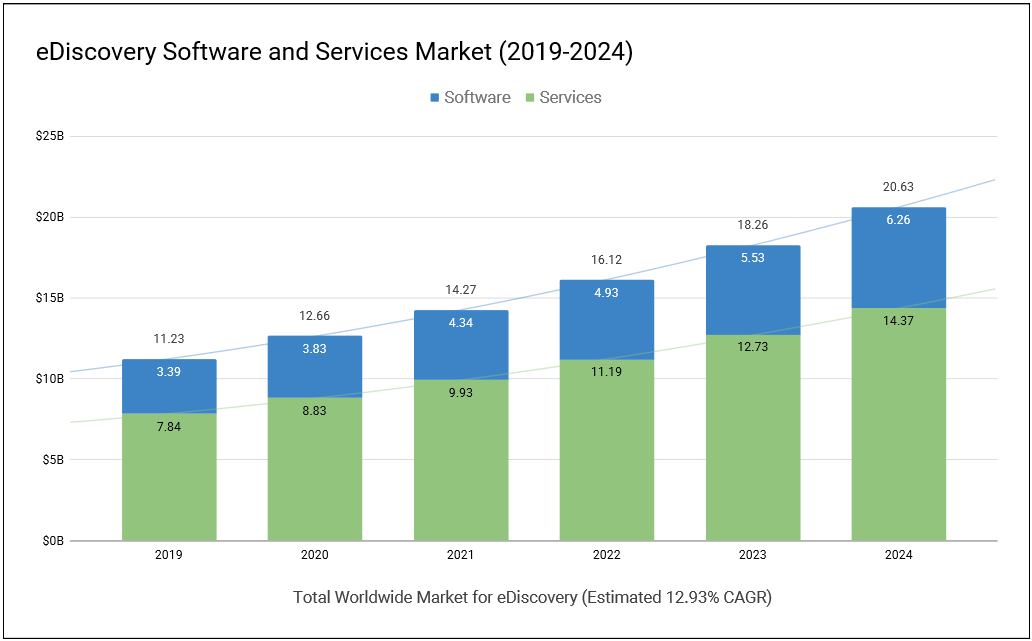
Also, as we covered just last week, Rob presented his worldwide eDiscovery services and software overview for 2019 to 2024 on Complex Discovery last month and his annual “mashup” of industry estimates shows the eDiscovery Software and Services market is expected to grow an estimated 12.93% Compound Annual Growth Rate (CAGR) per year from 2019 to 2024 from $11.23 billion to $20.63 billion per year.  Here’s the combined eDiscovery markets for 2019 to 2024, represented graphically:

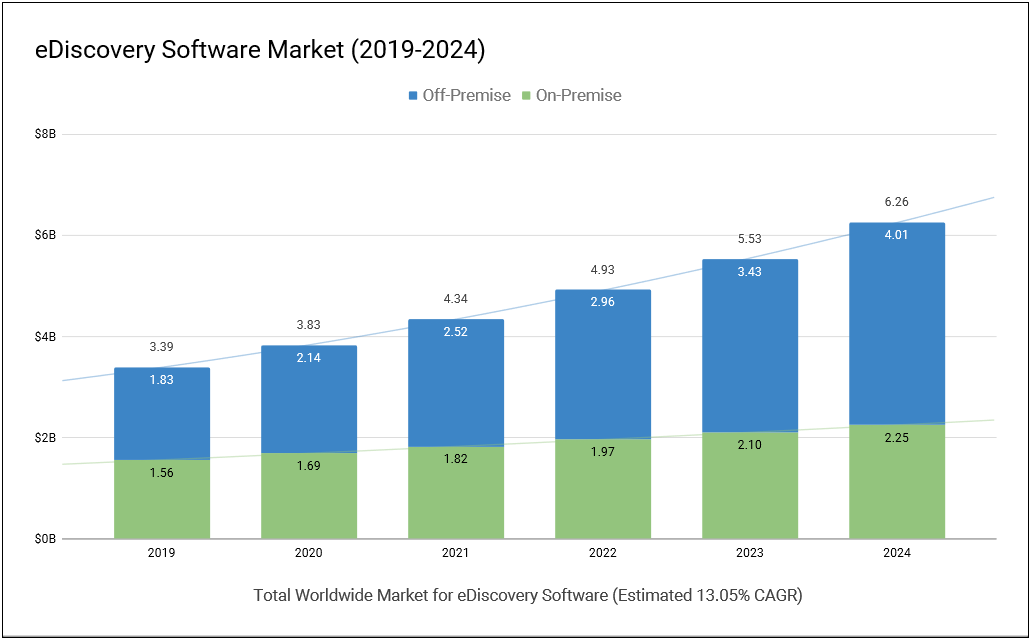
Of that, the eDiscovery Software market is expected to grow at an even larger estimated 13.05% CAGR per year from $3.39 billion in 2019 to $6.26 billion in 2024, growing about 85% in five years.  Here’s the eDiscovery software market for 2019 to 2024:

Which leaves the eDiscovery Services market, which is expected to grow at an estimated 12.88% CAGR per year from 2019 to 2024 from $7.84 billion to $14.37 billion per year.  Here’s the eDiscovery services market for 2019 to 2024:

Charts courtesy of Complex Discovery.

So, who’s buying?  Seems a lot of the technology is being purchased by the service providers, who are (in turn) using it to provide services to corporations, law firms and government entities, who are buying those services.  Obviously, corporations, law firms and government entities are buying some of the technology as well and law firms providing some of the eDiscovery services.  But, it seems like it’s the service providers who have the biggest impact on the growth of the market.  Do you agree?

So, what do you think?  Will the growth of the market and the “skyrocketing” investment in legal tech continue?  Please share any comments you might have or if you’d like to know more about a particular topic.

Sponsor: This blog is sponsored by CloudNine, which is a data and legal discovery technology company with proven expertise in simplifying and automating the discovery of data for audits, investigations, and litigation. Used by legal and business customers worldwide including more than 50 of the top 250 Am Law firms and many of the world’s leading corporations, CloudNine’s eDiscovery automation software and services help customers gain insight and intelligence on electronic data.

Disclaimer: The views represented herein are exclusively the views of the author, and do not necessarily represent the views held by CloudNine. eDiscovery Daily is made available by CloudNine solely for educational purposes to provide general information about general eDiscovery principles and not to provide specific legal advice applicable to any particular circumstance. eDiscovery Daily should not be used as a substitute for competent legal advice from a lawyer you have retained and who has agreed to represent you.