
Our Insights on eDiscovery

Read on to learn more about the latest trends and insights in the world of digital discovery.
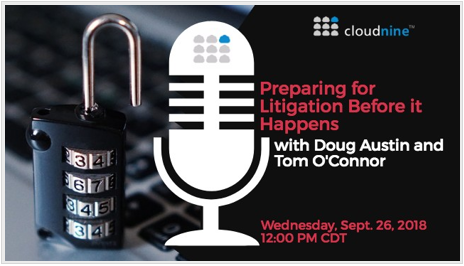
Today is the Day to Learn How to Prepare for Litigation Before it Happens: eDiscovery Webcasts
Today is the Day to Learn How to Prepare for Litigation Before it Happens: eDiscovery Webcasts 464 266 CloudNine

Information Governance (IG) has always been part of the eDiscovery landscape and it has always been important for reducing the population of potentially responsive electronically stored information (ESI) that might be subject to litigation by helping organizations adopt best practices for keeping their information “house in order”. But how can you leverage IG best practices to prepare for litigation before it happens? Find out in our webcast today!

read more
Get a “Clue” Regarding Your eDiscovery Process (October 31, 2018)
Get a “Clue” Regarding Your eDiscovery Process (October 31, 2018) 150 150 CloudNine

This CLE-approved webcast will discuss the various participants in the eDiscovery process, what motivates each of them, and best practices on how to avoid becoming the next high-profile eDiscovery disaster.

read more
Eight is Great! eDiscovery Daily is Eight Years Old!
Eight is Great! eDiscovery Daily is Eight Years Old! 338 329 CloudNine

As a loving husband, it’s a bad thing to forget an anniversary. Thankfully, I forgot the other one. Holy $#*%@! I can’t believe I missed the anniversary for the blog! It snuck up on me. Anyway, believe it or not, it has been eight years ago last Thursday since we launched the eDiscovery Daily blog!

read more
In No Small Ruling, Court Takes Defendant to Task for Discovery Violations: eDiscovery Case Law
In No Small Ruling, Court Takes Defendant to Task for Discovery Violations: eDiscovery Case Law 479 270 CloudNine

In Small v. Univ. Med. Ctr., Nevada Magistrate Judge Peggy A. Leen, in a lengthy ruling so large it included a table of contents, accepted and adopted in part and overruled in part the Special Master’s Report and Recommendation and Final Findings of Fact and Conclusions of Law. Judge Leen sanctioned the defendant with an adverse inference instruction to the jury instead of the default judgment sanction recommended by the special master.

read more
Plaintiffs Granted Discovery Extension Due to Defendant’s TAR Review Glitch: eDiscovery Case Law
Plaintiffs Granted Discovery Extension Due to Defendant’s TAR Review Glitch: eDiscovery Case Law 479 270 CloudNine

In the case In Re Domestic Airline Travel Antitrust Litigation, District of Columbia District Judge Colleen Kollar-Kotelly granted the Plaintiffs’ Motion for an Extension of Fact Discovery Deadlines (over the defendants’ objections) for six months, finding that defendant “United’s production of core documents that varied greatly from the control set in terms of the applicable standards for recall and precision and included a much larger number of non-responsive documents that was anticipated” (United’s core production of 3.5 million documents contained only 600,000 documents that were responsive).

read more
Survey Says! Predictive Coding Technologies and Protocols Survey Results: eDiscovery Trends
Survey Says! Predictive Coding Technologies and Protocols Survey Results: eDiscovery Trends 391 236 CloudNine

Last week, I discussed the predictive coding survey that Rob Robinson was conducting on his Complex Discovery site (along with the overview of key predictive coding related terms. The results are in and here are some of the findings.

read more
In California, IoT Device Cybersecurity Foresight is Also 2020, Apparently: Cybersecurity Trends
In California, IoT Device Cybersecurity Foresight is Also 2020, Apparently: Cybersecurity Trends 291 326 CloudNine

As I noted a couple of months ago, 2018 is certainly on its way to becoming the year of data privacy rights for the individual and, back then, California passed a new data privacy law which will give consumers several rights regarding their personal data (though the California AG doesn’t seem thrilled about it). Now, California is once again poised to take the lead on important new technology policy.

read more
Despite Carpenter, This Defendant’s Cell Site Location Information is Ruled Admissible: eDiscovery Case Law
Despite Carpenter, This Defendant’s Cell Site Location Information is Ruled Admissible: eDiscovery Case Law 479 270 CloudNine

In United States v. Pleasant, Pennsylvania District Judge Gerald Austin McHugh ruled that the defendant’s motion to suppress historical cell-site location information associated with his cellular telephone lacked merit, despite the Supreme Court’s recent decision in Carpenter v. United States, because the agents proceeded “by means of a court order issued under a federal statute that had repeatedly withstood Fourth Amendment scrutiny…in good faith under then existing law”.

read more
University of Florida Brings eDiscovery Teachings to a Chinese University: eDiscovery Best Practices
University of Florida Brings eDiscovery Teachings to a Chinese University: eDiscovery Best Practices 474 145 CloudNine

Needless to say, eDiscovery is becoming more global than ever and we’ve certainly seen a lot of instances where non-U.S. legal practitioners have to not only better understand U.S. discovery obligations, but also understand the methodologies and technologies associated with managing eDiscovery. One U.S. university recently spent some time bringing some of those teachings to a university in Nanjing, China.

read more
Houston, We Have an Adverse Inference Finding: eDiscovery Case Law
Houston, We Have an Adverse Inference Finding: eDiscovery Case Law 479 270 CloudNine

In Hernandez, et al. v. City of Houston, Texas District Judge Kenneth M. Hoyt, finding that the defendant “intentionally destroyed” evidence by wiping the hard drives of several custodians no longer employed by the City, determined “that entering an adverse inference finding is appropriate” against the defendant.

read more