
Information Governance

Laura Zubulake, Author of “Zubulake’s e-Discovery” – eDiscovery Trends

This is the fourth of the 2014 LegalTech New York (LTNY) Thought Leader Interview series.  eDiscoveryDaily interviewed several thought leaders after LTNY this year (don’t get us started) and generally asked each of them the following questions:

  1. What significant eDiscovery trends did you see at LTNY this year and what do you see for 2014?
  2. With new amendments to discovery provisions of the Federal Rules of Civil Procedure now in the comment phase, do you see those being approved this year and what do you see as the impact of those Rules changes?
  3. It seems despite numerous resources in the industry, most attorneys still don’t know a lot about eDiscovery?  Do you agree with that and, if so, what do you think can be done to improve the situation?

Today’s thought leader is Laura Zubulake.  Laura worked on Wall Street for 20 years in institutional equity departments and, in 1991, authored the book The Complete Guide to Convertible Securities Worldwide. She was the plaintiff in the Zubulake vs. UBS Warburg case, which resulted in several landmark opinions related to eDiscovery and counsel’s obligations for the preservation of electronically stored information. The December 2006 amendments to the Federal Rules of Civil Procedure were influenced, in part, by the Zubulake case. In 2012, Laura published a book titled Zubulake’s e-Discovery: The Untold Story of my Quest for Justice, previously discussed on this blog here and she speaks professionally about eDiscovery topics and her experiences related to the case.

What significant eDiscovery trends did you see at LTNY this year and what do you see for 2014?

As far as what I saw last week, there was an increase in focus on Information Governance over last year’s conference. There was also a continued interest in eDiscovery.  What I found particularly interesting is that some of the larger vendors put less emphasis on Information Governance than they did last year and more on eDiscovery this year. When I went to the vendor booths and talked to them about actual business, I got the sense that several have taken a step back from Information Governance and refocused their efforts on eDiscovery. I’m not saying this is the case with all of them, but several of them.  I was not able to find out a reason why, but I surmised from my conversations that monetizing, or creating a business around Information Governance has been difficult for some vendors. It seems they find it easier to generate business with eDiscovery.  This intrigued me.

I’m looking at it more from a business standpoint than a legal or a conference agenda standpoint. In other words, how are they actually making money in this industry? It’s still predominantly in eDiscovery, not Information Governance. I think part of that has to do with the state of the economy, which is not great and it’s difficult trying to get clients to buy certain services at this time. Information Governance is probably a tougher sell than certain technologies you have on the eDiscovery side.  This creates a real business opportunity.  Over time I think the focus will shift towards Information Governance.  Corporations will realize that eDiscovery is a subsector of Information Governance and that Information Governance is a more efficient and effective investment.

Other things that I did see at the show: clearly there was an emphasis on big data, which was expected. When I looked at the tracks, the topics included Risk and Compliance, eDiscovery, Information Governance and technology in general. This seemed to be a continuation of those topics from last year’s show – again except for Information Governance, where I did see an increased focus.

I was surprised that I didn’t see more attention in areas like healthcare, which I would have expected — given what’s going on in the country and given the planned to shift from ICD-9 to ICD-10. Although now I guess there’s a little bit of a debate about that. But, I would have thought that there would have been more emphasis on healthcare.  

As for a prediction for next year and the coming years, I think that healthcare is going to become a major focus – for Information Governance in particular.   To continue on this, it would be interesting to see other detailed sector analysis.  That is, how Information Governance (particularly in light of industry regulations) could affect the finance, utilities, and energy sectors.

I also think you’re going to see – and people have different names for this – more emphasis on applying algorithms to Information Governance and not just for eDiscovery. People use the term “predictive coding” to refer to applying algorithms to eDiscovery efforts and with Information Governance, some people call it “auto-classification.”  Essentially, it’s taking a macro view and using algorithms to help companies organize and manage their data, from the top down. So, I think you’ll start seeing more discussion on not just predictive coding for EDD, but also algorithms for Information Governance efforts.

I would say the “Internet of things” (I guess everybody has their own way to describe that) is going to become more of a focus as well. For example, Google recently purchased Nest. If you think of the implications of that, Google is going to have access to data within your home. So, I think as the “Internet of things” expands, that’s going to become more of a focus for Information Governance, eDiscovery and Risk and Compliance type issues.

Cyber security will be another trend, obviously. Security and privacy issues with regard to healthcare and the security of data at every level, whether it’s your home or business, will become increasingly important.

With new amendments to discovery provisions of the Federal Rules of Civil Procedure now in the comment phase, do you see those being approved this year and what do you see as the impact of those Rules changes?

I contributed comments to the website. In fact, I sent my book to Senator Coons, who is in charge of the committee and I have been in contact with other individuals involved in the discussion.  I think it’s important for the decision makers to appreciate what it’s like for an individual to go through litigation. While no one wants to be in that situation, it can happen to anyone.  I’m not so sure the amendments will be approved this year — maybe by the end of this year or next year.  My personal concern is that most of what I’ve read about the debate has been dominated by the defense side.  I’m not sure that the plaintiff side has been thoroughly represented. That was the concern that I voiced when I added my comments to the website.  While I understand the business and cost implications of eDiscovery, I believe the plaintiff ‘s side needs to be properly represented in the talks. With regard to the nature of the proposals, restricting the number of depositions, having certain restrictions on time, etc., I think it’s going to make it more difficult for an individual to stand up for their rights, to actually take a stand.  

It seems despite numerous resources in the industry, most attorneys still don’t know a lot about eDiscovery? Do you agree with that and, if so, what do you think can be done to improve the situation?

Generally, I agree. Based on what I’ve read, there appears to be a significant segment of the legal community that is not well informed. What do I think can be done to improve the situation? Obviously, continue to educate.   Unfortunately, I think that there are many people that won’t take the time to learn new things until they’ve been thrown into a situation and forced to learn. That’s sad, because eDiscovery has been around for so long now. It should really be part of the conversation. Law schools need to include it in their curriculum somehow so that all law students become familiar with it at some level. Also, perhaps requiring continuing education for lawyers solely dedicated to eDiscovery where they sit in classes instead of just attending a conference. When you have to take an exam and answer questions, that’s when you’re forced to learn something.

Thanks, Laura, for participating in the interview!

And to the readers, as always, please share any comments you might have or if you’d like to know more about a particular topic!

Disclaimer: The views represented herein are exclusively the views of the author, and do not necessarily represent the views held by CloudNine Discovery. eDiscoveryDaily is made available by CloudNine Discovery solely for educational purposes to provide general information about general eDiscovery principles and not to provide specific legal advice applicable to any particular circumstance. eDiscoveryDaily should not be used as a substitute for competent legal advice from a lawyer you have retained and who has agreed to represent you.

James D. Zinn, Managing Director of Huron Consulting Group – eDiscovery Trends

This is the third of the 2014 LegalTech New York (LTNY) Thought Leader Interview series.  eDiscoveryDaily interviewed several thought leaders after LTNY this year (don’t get us started) and generally asked each of them the following questions:

  1. What significant eDiscovery trends did you see at LTNY this year and what do you see for 2014?
  2. With new amendments to discovery provisions of the Federal Rules of Civil Procedure now in the comment phase, do you see those being approved this year and what do you see as the impact of those Rules changes?
  3. It seems despite numerous resources in the industry, most attorneys still don’t know a lot about eDiscovery?  Do you agree with that and, if so, what do you think can be done to improve the situation?
  4. What are you working on that you’d like our readers to know about?

Today’s thought leader is James D. Zinn. James is Managing Director of Huron Consulting Group.  James leads the technology team at Huron Legal, which includes the data collection, processing, hosting, production, and forensic analysis services along with infrastructure, support, and software development. James has extensive experience managing the strategic and tactical use of technology within investigative and litigation consulting matters.

What significant eDiscovery trends did you see at LTNY this year and what do you see for 2014?

The Legal Tech conference was another good experience for us as a company.  It was an overall good conference for us with good traffic at our booth, great meetings throughout the week and good business opportunities coming from the show.  So, overall our impressions were positive and we felt good about the experience all around.  In fact, I would say that it was one of the best LegalTech experiences ever from our perspective.

As I look around the conference in terms of trends, the biggest trend that I noted was an increase in the discussion about Information Governance.  The whole concept of Information Management and Information Governance has become a popular topic.  There were lots of exhibitors using Information Governance or related language when talking about their products.  There were also several sessions and panel discussions about it, as well.  So, that stood out to me as the biggest trend I saw at the show over the previous year. I think that observation is reflective of an overall trend toward a greater focus on Information Governance and the impact it has on a number of things, including discovery costs and workflow.

The other trend that I see for 2014 is more stratification among the service providers.  Part of the reason for that is continued industry consolidation.  I think there is a growing differentiation between service providers, which we feel from our own experience, as well.  On one hand, a number of providers are continuing to mature and develop their full service offerings while on the other hand; there are new entrants into the market focusing on the application of technology as a differentiator from legacy service providers.

A related trend is greater acceptance of cloud-based solutions.  I think a number of providers are focusing on leveraging cloud-based infrastructures and technologies in their solutions.  I’m sensing an increased acceptance within the marketplace for cloud-based solutions.

With new amendments to discovery provisions of the Federal Rules of Civil Procedure now in the comment phase, do you see those being approved this year and what do you see as the impact of those Rules changes?

I don’t have any particular source of information that would lead me to do anything more than speculate on the timing of their approval, but I do see them being accepted this year.  While the amendments have generated a fair amount of discussion, I think they represent a positive trend and will be approved and enacted.  I think the impact on the up front preparation and speed of litigation has been talked about extensively and will be a natural evolution for those who are already well prepared in that area. They will cause even more pain than the last amendments for those who are not as organized.  The impact on the early calendar of litigation may come as a shock to the litigants who aren’t as organized as they need to be.  I also think the introduction of proportionality via the amendments is a good thing and will bring some reasonableness to the burden of discovery that many of our clients face.

It seems despite numerous resources in the industry, most attorneys still don’t know a lot about eDiscovery?  Do you agree with that and, if so, what do you think can be done to improve the situation?

That’s an interesting question because I wonder how much my experience personally and our experience as an organization is influenced by attorneys who are self-selecting.  In other words, do we see a representative sample of attorneys in the marketplace?  I would argue that we’ve seen an increase in the sophistication of our clients, both our clients at law firms and those at corporate legal departments.  To generalize them as a group, they are definitely more educated and more knowledgeable around eDiscovery issues than they were a few years ago.  But, I don’t know if that’s because of the nature of the types of clients we tend to attract are those that have recurring needs for discovery services and have been dealing with it for a number of years.

I do think that, as an industry, there are a lot of resources available to educate, so for those who do not avail themselves of those resources, it may be a reflection of their lack of a regular need for those services.  It’s easy to say that there could always be more education provided, but I think that you’re correct in the assessment that there are a number of good resources already.

What are you working on that you’d like our readers to know about?

We pride ourselves on being close to our clients and their needs and so we are continuing the development of our full-service offerings.  Our focus continues to be around holistic solutions to our clients’ problems, discovery being one of them, Information Governance certainly being another, compliance being a third, and so on.  So, in each of these areas, our focus is on how we can provide a complete solution to our clients.  By “complete”, I’m referring to everything from strategy and organizational assistance to help with the implementation of technologies or procedures and then on to the actual provision of services.  Huron is continuing within eDiscovery and beyond eDiscovery within the legal industry to focus on providing relevant, holistic solutions.

Thanks, James, for participating in the interview!

And to the readers, as always, please share any comments you might have or if you’d like to know more about a particular topic!

Disclaimer: The views represented herein are exclusively the views of the author, and do not necessarily represent the views held by CloudNine Discovery. eDiscoveryDaily is made available by CloudNine Discovery solely for educational purposes to provide general information about general eDiscovery principles and not to provide specific legal advice applicable to any particular circumstance. eDiscoveryDaily should not be used as a substitute for competent legal advice from a lawyer you have retained and who has agreed to represent you.

Tom Gelbmann of Gelbmann & Associates, LLC – eDiscovery Trends

This is the second of the 2014 LegalTech New York (LTNY) Thought Leader Interview series.  eDiscoveryDaily interviewed several thought leaders after LTNY this year (don’t get us started) and generally asked each of them the following questions:

  1. What significant eDiscovery trends did you see at LTNY this year and what do you see for 2014?
  2. It seems despite numerous resources in the industry, most attorneys still don’t know a lot about eDiscovery?  Do you agree with that and, if so, what do you think can be done to improve the situation?
  3. What are you working on that you’d like our readers to know about?

Today’s thought leader is Tom Gelbmann. Tom is Principal of Gelbmann & Associates, LLC.  Since 1993, Gelbmann & Associates, LLC, is a consulting practice serving the legal services industry. Tom has an extensive record of working with law firms, corporate counsel and legal services providers as a consultant, advisor, project manager, and has also held the CIO position at two major law firms.  Tom has also been co-author of the leading survey on the electronic discovery market, The Socha-Gelbmann Electronic Discovery Survey; in 2011 he and George Socha converted the Survey into Apersee, an online system for selecting eDiscovery providers and their offerings.  In 2005, he and George Socha launched the Electronic Discovery Reference Model project to establish standards within the eDiscovery industry – today, the EDRM model has become a standard in the industry for the eDiscovery life cycle.

What significant eDiscovery trends did you see at LTNY this year and what do you see for 2014?

While I didn’t attend the show this year (for the first time in many years), I have been monitoring communications about the show and what took place and have talked with a number of attendees, so I do have some perspectives about it.  Not surprisingly, a major theme this year was the surge in attention to Information Governance.  Information Governance is becoming the area that is grabbing attention within organizations, and rightly so.  We’ve been saying for quite some time in “EDRM-land” that if you can get your electronic house in order, eDiscovery challenges are mitigated and costs can be considerably reduced.

One of the results that you’re starting to see is the appearance of tools to help with that whole Information Governance process of: What do you have?  Who has it?  Where is it?  How do you curate it?  How do you identify what you no longer need to hold onto and effectively get rid of it?  And, when litigation does occur, how do you effectively hone in on the ESI that you need for that particular matter?

Another trend that I’m seeing in general is really two somewhat related trends: Metrics and Project Management.  Metrics has been something that has been slow to catch on for a long time, but I think organizations are now catching on to the fact that if you don’t measure it, you can’t manage it.  The light is coming on for people who are realizing that “yeah, I’d better start tracking these things”.  Metrics have really started to become more mainstream within the industry.  Associated with that is Project Management.  In eDiscovery, you have to have a well-defined, repeatable process to manage the projects effectively.  The more disciplined you are, the better your outcomes will be.  So, metrics and project management are really “coming of age”.

We’re also seeing more and more activity with mobile devices.  You’ve got smart phones, iPads and other tablets, BYOD, etc.  And, that’s really where more and more ESI will be.  I think mobile platforms are starting to take over as far as the means of communication and, in many cases, that’s where the story is.  And, what eDiscovery is all about is finding out the story.  Not that email is going to dry up any time soon, but you’re starting to see that the growth is in mobile and social media.

It seems despite numerous resources in the industry, most attorneys still don’t know a lot about eDiscovery?  Do you agree with that and, if so, what do you think can be done to improve the situation?

I agree.  From what I’m seeing, it may have gotten a little bit better, but not a whole lot.  For change to come, the impetus has to come from clients.  Clients need to be more demanding and validate their outside counsel attorney’s claims of “I know all about eDiscovery” when maybe all they did was attend a CLE.  There has to be proof of their knowledge, but I’m not sure how clients will go about obtaining that proof.  But, they’re the ones paying the bill, so the impetus will have to come from them.  I don’t think it will come from a bar association.

What are you working on that you’d like our readers to know about?

I’m very enthused about EDRM this year from a couple of aspects.  One, we’re very excited that we’re moving towards a non-profit model for EDRM.  There’s been a lot of work so far and there’s still a lot of work to do, but I think we’re on track to complete that this year.  I think that’s really going to serve EDRM well for the longer term.  What I mean by that is that it’s been the “George and Tom show” and we realize that it can’t be if it’s going to continue and flourish for the long term.  There’s a lot of energy and a lot of good minds behind this initiative and I’m looking forward to that.

As far as projects are concerned, the Data Set group has been busy further developing the Privacy & Security Risk Reduction Model.  There are some new frameworks coming out and a few other things that we will hopefully be able to announce fairly soon.  The projects are continuing to create and update helpful tools and frameworks which, to some extent, address the education question you asked me earlier.  Information Governance is one of those project teams that is working on some interesting items.  Also, we started in October with a monthly update, so we’re doing a better job of letting people know about all of the accomplishments of EDRM.  In retrospect, we should have been doing that a lot earlier.  You don’t realize on a day-to-day basis what we’re accomplishing, but when we put together a monthly update, we realize that we did accomplish a lot.  Our 2013 end of year update shows that there were several things we accomplished in 2013 that were valuable to the industry.  So, the future is bright for EDRM from a variety of perspectives.

With regard to Apersee, we’re still working to prove to providers that there is value in maintaining their profiles about their products and services.  We understand that it takes effort to do so and we’re still trying to demonstrate the value to them.  The more providers put into it, the more valuable it becomes to consumers.  The Apersee Special Requests are a bright spot. When we distribute Apersee special requests from the consumer, looking for a specific complex, time-sensitive service, we get dozens of responses from providers within minutes to a couple of hours.  Generally, the consumer tells us within a day or less “Stop, we’ve got enough responses, this is great.”  So, the effectiveness of the Apersee special request tells us that there is a need to be fulfilled.  We’ve been told by consumers that it’s very valuable service, so we’re excited about that.

Thanks, Tom, for participating in the interview!

And to the readers, as always, please share any comments you might have or if you’d like to know more about a particular topic!

Disclaimer: The views represented herein are exclusively the views of the author, and do not necessarily represent the views held by CloudNine Discovery. eDiscoveryDaily is made available by CloudNine Discovery solely for educational purposes to provide general information about general eDiscovery principles and not to provide specific legal advice applicable to any particular circumstance. eDiscoveryDaily should not be used as a substitute for competent legal advice from a lawyer you have retained and who has agreed to represent you.

EDRM Updates Privacy & Security Risk Reduction Model – eDiscovery Best Practices

The Electronic Discovery Reference Model (EDRM) continues to pile up the accomplishments. In addition to announcing a transition to nonprofit status by May 2014, since the May annual meeting, several EDRM projects (Metrics, Jobs, Data Set and the new Native Files project) have already announced new deliverables and/or requested feedback and EDRM also published new Collection Standards for collecting electronically stored information (ESI).  Now, EDRM is making updates to earlier accomplishments from just five months ago.

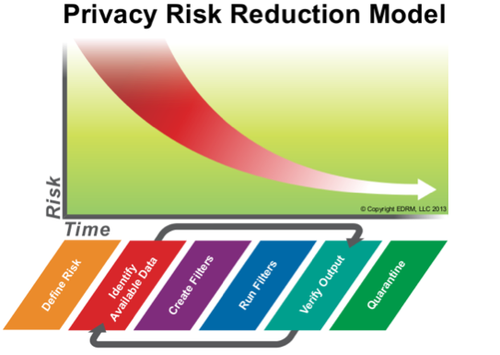
As they announced last week, EDRM announced the reintroduction and refinement of its Privacy & Security Risk Reduction Model (PSRRM). Initially introduced last September by EDRM’s Data Set group (and covered on this blog here), the model provides a process for reducing the volume of private, protected and risky data by using a series of steps applied in sequence as part of the information management, identification, preservation and collection phases of the Electronic Discovery Reference Model.

The PSRRM model is used prior to producing or exporting data containing risky information such as privileged or proprietary information. The middle steps are cyclical and are repeated until the amount of private material is reduced to a desirable amount. The private data is finally quarantined in the final step before the remaining information is produced.

Recent high profile data breaches at Target and Neiman Marcus are prime examples to illustrate that high risk data can cause significant trouble and exposure for organizations today.  As their press release notes, EDRM has revised the PSRRM to include industry feedback and real-world experiences using the model in data remediation and eDiscovery projects to help companies address this exposure in an organized and systematic manner.

The current resource page for the PSRRM model is located here.

So, what do you think?  How do you handle security of your organization’s sensitive data?  Please share any comments you might have or if you’d like to know more about a particular topic.

Disclaimer: The views represented herein are exclusively the views of the author, and do not necessarily represent the views held by CloudNine Discovery. eDiscoveryDaily is made available by CloudNine Discovery solely for educational purposes to provide general information about general eDiscovery principles and not to provide specific legal advice applicable to any particular circumstance. eDiscoveryDaily should not be used as a substitute for competent legal advice from a lawyer you have retained and who has agreed to represent you.
Effective Information Governance Takes Initiative – eDiscovery Best Practices

Despite the fact that I missed LegalTech New York (LTNY) last week because of travel difficulties, eDiscoveryDaily is still conducting our fourth annual LTNY thought leader interview series again this year.  I owe a BIG thank you to the thought leaders who were gracious enough to reschedule with me this week and early next week.  We will publish the schedule for posting the interviews early next week.  Stay tuned!

One of the best side-benefits I get from conducting thought leader interviews for the blog is that I get to learn about new programs in the industry that promote best practices.  I learned about one such new program in my thought leader interview with Jason R. Baron, Of Counsel with Drinker Biddle & Reath LLP and former long-time Director of Litigation for the U.S. National Archives and Records Administration (NARA).  Through my interview with Jason, I learned that the Information Governance Initiative (IGI), a cross-disciplinary consortium and think tank focused on advancing information governance, launched last week.

As announced on their expansive launch press release, the IGI will publish research, benchmarking surveys, and guidance for practitioners on its website. The research will be freely available, and the group will also be providing an online community designed to foster discussion and networking among practitioners.

The IGI was founded by Barclay T. Blair, who is the group’s executive director and Bennett B. Borden, who is the organization’s chair, with Jason R. Baron as co-chair. Jay Brudz is general counsel.

As Jason stated on the press release, “I see the IGI’s mission as sounding a call to arms that current information practices are unsustainable in our increasingly big data world, and that IG solutions exist that better leverage new technology and smart practices. Unless corporations and government agencies take more concerted actions, information overload and mismanagement may pose a serious threat to the economy and even to the justice system itself.”

The IGI identifies several leading providers as supporters and is also partnering with several organizations to bring IG stakeholders from different disciplines together to work on the information governance problem, including The CFO Alliance and ARMA International.

Best of all, it’s free to join and receive updates from the IGI and to gain access to their publications when they are available.  Click here to join.

Based on the thought leader interviews that I’ve conducted so far, Information Governance was the most talked about trend at this year’s LTNY.  It will be interesting to see what impact the IGI has on providing best practices and guidance for managing information.

So, what do you think?  Are you interested in the IGI? Will you join?  Please share any comments you might have or if you’d like to know more about a particular topic.

Disclaimer: The views represented herein are exclusively the views of the author, and do not necessarily represent the views held by CloudNine Discovery. eDiscoveryDaily is made available by CloudNine Discovery solely for educational purposes to provide general information about general eDiscovery principles and not to provide specific legal advice applicable to any particular circumstance. eDiscoveryDaily should not be used as a substitute for competent legal advice from a lawyer you have retained and who has agreed to represent you.

Six eDiscovery Predictions for 2014, Part One – eDiscovery Trends

It’s that time of year, where people make predictions for the coming year for all sorts of things, including electronic discovery trends for the coming year.  Though I have to say, I’ve seen fewer predictions this year than in past years.  Nonetheless, I feel compelled to offer some of my own predictions.  If they turn out right, you heard it here first!

Prediction 1: Predictive coding technologies will become more integrated into the discovery process, for more than just review.

Two or three years ago, predictive coding (a.k.a., technology assisted review or computer assisted review) was a promising technology that had yet to be officially accepted in the courts.  Then, in 2012, cases such as Da Silva Moore v. Publicis Groupe & MSL Group, Global Aerospace Inc., et al, v. Landow Aviation, L.P. dba Dulles Jet Center, et al and In re Actos (Pioglitazone) Products Liability Litigation, predictive coding was approved (and there was at least two other cases where it was contemplated).  So, it’s beginning to be used, though most attorneys still don’t fully understand how it works or understand that it’s not a “turn-key” software solution, it includes a managed process that uses the software.

It’s not going out on a limb to say that this year predictive coding technologies will be more widely used; however, I think those technologies will branch out beyond review to other phases of the eDiscovery life cycle, including Information Governance.  Predictive coding is not new technology, it’s basically artificial intelligence applied to the review process, so it’s logical that same technology can be applied to other areas of the discovery life cycle as well.

Prediction 2: The proposed amendments will be adopted, but it will be a struggle.

Changes to Federal Rules for eDiscovery have been drafted and have been approved for public comment.  However, several people have raised concerns about some of the new rules.  Judge Shira Scheindlin has criticized proposed Rule 37(e), intended to create a uniform national standard regarding the level of culpability required to justify severe sanctions for spoliation, for creating “perverse incentives” and encouraging “sloppy behavior.”

U.S. Sen. Christopher Coons (D-Del.), who chairs the Subcommittee on Bankruptcy and the Courts, predicted that some proposed restrictions – such as reducing the number of depositions, interrogatories and requests for admission for each case – “would do nothing about the high-stakes, highly complex or highly contentious cases in which discovery costs are a problem.”  Senator Coons and Sherrilyn Ifill, president of the NAACP Legal Defense and Educational Fund Inc., also expressed concerns that those limits would likely restrict plaintiffs in smaller cases in which discovery costs are not a problem.

Needless to say, not everybody is a fan of all of the new proposed rules, especially Rule 37(e).  But, the proposed rules have gotten this far and there are a number of lobbyists pushing for adoption.  So, I think they’ll be adopted, but not without some controversy and struggle.

Prediction 3: The eDiscovery industry will continue to consolidate and many remaining providers will need to continue to reinvent themselves.

Every year, I see several predictions that more eDiscovery vendors will fail and/or there will be more consolidation in the industry.  And, every year there is consolidation.  Here’s the latest updated list of mergers, acquisitions and investments since 2001, courtesy of Rob Robinson.  But, every year there also new players in the market, so the number of providers never seems to change dramatically.  Last year, by my count, there were 225 exhibitors at Legal Tech New York (LTNY), with many, if not most of them in the eDiscovery space.  This year, the partial list stands at 212.  Not a tremendous drop off, if any.

Nonetheless, there will be more pressure on eDiscovery providers than ever before to provide services at reasonable prices, yet turn a profit.  I’ve seen bold predictions, like this one from Albert Barsocchini at NightOwl Discovery in which he predicted the possible end of eDiscovery processing fees.  I’m not sure that I agree that they’re going away entirely, but I do see further commoditization of several eDiscovery services.  The providers that offer truly unique software offerings and/or expert services to complement any commodity-based services that they offer will be the ones best equipped to meet market demands, profitably.

On Monday, I predict I’ll have three more predictions to cover.  Hey, at least that’s one prediction that should come true!

So, what do you think?  Do you have any eDiscovery predictions for 2014?  Please share any comments you might have or if you’d like to know more about a particular topic.

Disclaimer: The views represented herein are exclusively the views of the author, and do not necessarily represent the views held by CloudNine Discovery. eDiscoveryDaily is made available by CloudNine Discovery solely for educational purposes to provide general information about general eDiscovery principles and not to provide specific legal advice applicable to any particular circumstance. eDiscoveryDaily should not be used as a substitute for competent legal advice from a lawyer you have retained and who has agreed to represent you.

For Successful Discovery, Think Backwards – eDiscovery Best Practices

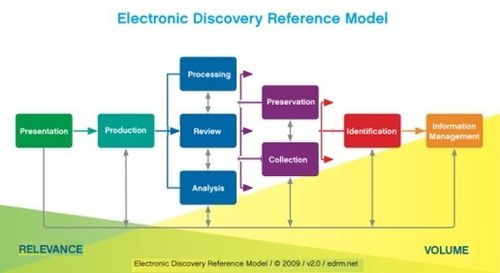
The Electronic Discovery Reference Model (EDRM) has become the standard model for the workflow of the process for handling electronically stored information (ESI) in discovery.  But, to succeed in discovery, regardless whether you’re the producing party or the receiving party, it might be helpful to think about the EDRM model backwards.

Why think backwards?

You can’t have a successful outcome without envisioning the successful outcome that you want to achieve.  The end of the discovery process includes the production and presentation stages, so it’s important to determine what you want to get out of those stages.  Let’s look at them.

Presentation

As a receiving party, it’s important to think about what types of evidence you need to support your case when presenting at depositions and at trial – this is the type of information that needs to be included in your production requests at the beginning of the case.

Production

The format of the ESI produced is important to both sides in the case.  For the receiving party, it’s important to get as much useful information included in the production as possible.  This includes metadata and searchable text for the produced documents, typically with an index or load file to facilitate loading into a review application.  The most useful form of production is native format files with all metadata preserved as used in the normal course of business.

For the producing party, it’s important to save costs, so it’s important to agree to a production format that minimizes production costs.  Converting files to an image based format (such as TIFF) adds costs, so producing in native format can be cost effective for the producing party as well.  It’s also important to determine how to handle issues such as privilege logs and redaction of privileged or confidential information.

Addressing production format issues up front will maximize cost savings and enable each party to get what they want out of the production of ESI.

Processing-Review-Analysis

It also pays to determine early in the process about decisions that affect processing, review and analysis.  How should exception files be handled?  What do you do about files that are infected with malware?  These are examples of issues that need to be decided up front to determine how processing will be handled.

As for review, the review tool being used may impact production specs in terms of how files are viewed and production of load files that are compatible with the review tool, among other considerations.  As for analysis, surely you test search terms to determine their effectiveness before you agree on those terms with opposing counsel, right?

Preservation-Collection-Identification

Long before you have to conduct preservation and collection for a case, you need to establish procedures for implementing and monitoring litigation holds, as well as prepare a data map to identify where corporate information is stored for identification, preservation and collection purposes.

As you can see, at the beginning of a case (and even before), it’s important to think backwards within the EDRM model to ensure a successful discovery process.  Decisions made at the beginning of the case affect the success of those latter stages, so don’t forget to think backwards!

So, what do you think?  What do you do at the beginning of a case to ensure success at the end?   Please share any comments you might have or if you’d like to know more about a particular topic.

P.S. — Notice anything different about the EDRM graphic?

Disclaimer: The views represented herein are exclusively the views of the author, and do not necessarily represent the views held by CloudNine Discovery. eDiscoveryDaily is made available by CloudNine Discovery solely for educational purposes to provide general information about general eDiscovery principles and not to provide specific legal advice applicable to any particular circumstance. eDiscoveryDaily should not be used as a substitute for competent legal advice from a lawyer you have retained and who has agreed to represent you.

A Model for Reducing Private Data – eDiscovery Best Practices

Since the Electronic Discovery Reference Model (EDRM) annual meeting just four short months ago in May, several EDRM projects (Metrics, Jobs, Data Set and the new Native Files project) have already announced new deliverables and/or requested feedback.  Now, the Data Set project has announced another new deliverable – a new Privacy Risk Reduction Model.

Announced in yesterday’s press release, the new model “is a process for reducing the volume of private, protected and risky data by using a series of steps applied in sequence as part of the information management, identification, preservation and collection phases” of the EDRM.  It “is used prior to producing or exporting data containing risky information such as privileged or proprietary information.”

The model uses a series of six steps applied in sequence with the middle four steps being performed as an iterative process until the amount of private information is reduced to a desirable level.  Here are the steps as described on the EDRM site:

  • Define Risk: Risk is initially identified by an organization by stakeholders who can quantify the specific risks a particular class or type of data may pose. For example, risky data may include personally identifiable information (PII) such as credit card numbers, attorney-client privileged communications or trade secrets.
  • Identify Available Data: Locations and types of risky data should be identified. Possible locations may include email repositories, backups, email and data archives, file shares, individual workstations and laptops, and portable storage devices. The quantity and type should also be specified.
  • Create Filters: Search methods and filters are created to ‘catch’ risky data. They may include keyword, data range, file type, subject line etc.
  • Run Filters: The filters are executed and the results evaluated for accuracy.
  • Verify Output: The data identified or captured by the filters is compared against the anticipated output. If the filters did not catch all the expected risky data, additional filters can be created or existing filters can be refined and the process run again. Additionally, the output from the filters may identify additional risky data or data sources in which case this new data should be subjected the risk reduction process.
  • Quarantine: After an acceptable amount of risky data has been identified through the process, it should be quarantined from the original data sets. This may be done through migration of non-risky data, or through extraction or deletion of the risky data from the original data set.

No EDRM model would be complete without a handy graphic to illustrate the process so, as you can see above, this model includes one that illustrates the steps as well as the risk-time continuum (not to be confused with the space-time continuum, relatively speaking)… 😉

Looks like a sound process, it will be interesting to see it in use.  Hopefully, it will enable the Data Set team to avoid some of the “controversy” experienced during the process of removing private data from the Enron data set.  Kudos to the Data Set team, including project co-leaders Michael Lappin, director of archiving strategy at Nuix, and Eric Robi, president of Elluma Discovery!

So, what do you think?  What do you think of the process?   Please share any comments you might have or if you’d like to know more about a particular topic.

Disclaimer: The views represented herein are exclusively the views of the author, and do not necessarily represent the views held by CloudNine Discovery. eDiscoveryDaily is made available by CloudNine Discovery solely for educational purposes to provide general information about general eDiscovery principles and not to provide specific legal advice applicable to any particular circumstance. eDiscoveryDaily should not be used as a substitute for competent legal advice from a lawyer you have retained and who has agreed to represent you.

eDiscovery Daily is Three Years Old!

We’ve always been free, now we are three!

It’s hard to believe that it has been three years ago today since we launched the eDiscoveryDaily blog.  We’re past the “terrible twos” and heading towards pre-school.  Before you know it, we’ll be ready to take our driver’s test!

We have seen traffic on our site (from our first three months of existence to our most recent three months) grow an amazing 575%!  Our subscriber base has grown over 50% in the last year alone!  Back in June, we hit over 200,000 visits on the site and now we have over 236,000!

We continue to appreciate the interest you’ve shown in the topics and will do our best to continue to provide interesting and useful posts about eDiscovery trends, best practices and case law.  That’s what this blog is all about.  And, in each post, we like to ask for you to “please share any comments you might have or if you’d like to know more about a particular topic”, so we encourage you to do so to make this blog even more useful.

We also want to thank the blogs and publications that have linked to our posts and raised our public awareness, including Pinhawk, Ride the Lightning, Litigation Support Guru, Complex Discovery, Bryan College, The Electronic Discovery Reading Room, Litigation Support Today, Alltop, ABA Journal, Litigation Support Blog.com, Litigation Support Technology & News, InfoGovernance Engagement Area, EDD Blog Online, eDiscovery Journal, Learn About E-Discovery, e-Discovery Team ® and any other publication that has picked up at least one of our posts for reference (sorry if I missed any!).  We really appreciate it!

As many of you know by now, we like to take a look back every six months at some of the important stories and topics during that time.  So, here are some posts over the last six months you may have missed.  Enjoy!

Rodney Dangerfield might put it this way – “I Tell Ya, Information Governance Gets No Respect

Is it Time to Ditch the Per Hour Model for Document Review?  Here’s some food for thought.

Is it Possible for a File to be Modified Before it is Created?  Maybe, but here are some mechanisms for avoiding that scenario (here, here, here, here, here and here).  Best of all, they’re free.

Did you know changes to the Federal eDiscovery Rules are coming?  Here’s some more information.

Count Minnesota and Kansas among the states that are also making changes to support eDiscovery.

By the way, since the Electronic Discovery Reference Model (EDRM) annual meeting back in May, several EDRM projects (Metrics, Jobs, Data Set and the new Native Files project) have already announced new deliverables and/or requested feedback.

When it comes to electronically stored information (ESI), ensuring proper chain of custody tracking is an important part of handling that ESI through the eDiscovery process.

Do you self-collect?  Don’t Forget to Check for Image Only Files!

The Files are Already Electronic, How Hard Can They Be to Load?  A sound process makes it easier.

When you remove a virus from your collection, does it violate your discovery agreement?

Do you think that you’ve read everything there is to read on Technology Assisted Review?  If you missed anything, it’s probably here.

Consider using a “SWOT” analysis or Decision Tree for better eDiscovery planning.

If you’re an eDiscovery professional, here is what you need to know about litigation.

BTW, eDiscovery Daily has had 242 posts related to eDiscovery Case Law since the blog began!  Forty-four of them have been in the last six months.

Our battle cry for next September?  “Four more years!”  🙂

Disclaimer: The views represented herein are exclusively the views of the author, and do not necessarily represent the views held by CloudNine Discovery. eDiscoveryDaily is made available by CloudNine Discovery solely for educational purposes to provide general information about general eDiscovery principles and not to provide specific legal advice applicable to any particular circumstance. eDiscoveryDaily should not be used as a substitute for competent legal advice from a lawyer you have retained and who has agreed to represent you.

200,000 Visits on eDiscovery Daily! – eDiscovery Milestones

While we may be “just a bit behind” Google in popularity (900 million visits per month), we’re proud to announce that yesterday eDiscoveryDaily reached the 200,000 visit milestone!  It took us a little over 21 months to reach 100,000 visits and just over 11 months to get to 200,000 (don’t tell my boss, he’ll expect 300,000 in 5 1/2 months).  When we reach key milestones, we like to take a look back at some of the recent stories we’ve covered, so here are some recent eDiscovery items of interest.

EDRM Data Set “Controversy”: Including last Friday, we have covered the discussion related to the presence of personally-identifiable information (PII) data (including social security numbers, credit card numbers, dates of birth, home addresses and phone numbers) within the Electronic Discovery Reference Model (EDRM) Enron Data Set and the “controversy” regarding the effort to clean it up (additional posts here and here).

Minnesota Implements Changes to eDiscovery Rules: States continue to be busy with changes to eDiscovery rules. One such state is Minnesota, which has amending its rules to emphasize proportionality, collaboration, and informality in the discovery process.

Changes to Federal eDiscovery Rules Could Be Coming Within a Year: Another major set of amendments to the discovery provisions of the Federal Rules of Civil Procedure is getting closer and could be adopted within the year.  The United States Courts’ Advisory Committee on Civil Rules voted in April to send a slate of proposed amendments up the rulemaking chain, to its Standing Committee on Rules of Practice and Procedure, with a recommendation that the proposals be approved for publication and public comment later this year.

I Tell Ya, Information Governance Gets No Respect: A new report from 451 Research has indicated that “although lawyers are bullish about the prospects of information governance to reduce litigation risks, executives, and staff of small and midsize businesses, are bearish and ‘may not be placing a high priority’ on the legal and regulatory needs for litigation or government investigation.”

Is it Time to Ditch the Per Hour Model for Document Review?: Some of the recent stories involving alleged overbilling by law firms for legal work – much of it for document review – begs the question whether it’s time to ditch the per hour model for document review in place of a per document rate for review?

Fulbright’s Litigation Trends Survey Shows Increased Litigation, Mobile Device Collection: According to Fulbright’s 9th Annual Litigation Trends Survey released last month, companies in the United States and United Kingdom continue to deal with, and spend more on litigation.  From an eDiscovery standpoint, the survey showed an increase in requirements to preserve and collect data from employee mobile devices, a high reliance on self-preservation to fulfill preservation obligations and a decent percentage of organizations using technology assisted review.

We also covered Craig Ball’s Eight Tips to Quash the Cost of E-Discovery (here and here) and interviewed Adam Losey, the editor of IT-Lex.org (here and here).

Jane Gennarelli has continued her terrific series on Litigation 101 for eDiscovery Tech Professionals – 32 posts so far, here is the latest.

We’ve also had 15 posts about case law, just in the last 2 months (and 214 overall!).  Here is a link to our case law posts.

On behalf of everyone at CloudNine Discovery who has worked on the blog over the last 32+ months, thanks to all of you who read the blog every day!  In addition, thanks to the other publications that have picked up and either linked to or republished our posts!  We really appreciate the support!  Now, on to 300,000!

And, as always, please share any comments you might have or if you’d like to know more about a particular topic.

Disclaimer: The views represented herein are exclusively the views of the author, and do not necessarily represent the views held by CloudNine Discovery. eDiscoveryDaily is made available by CloudNine Discovery solely for educational purposes to provide general information about general eDiscovery principles and not to provide specific legal advice applicable to any particular circumstance. eDiscoveryDaily should not be used as a substitute for competent legal advice from a lawyer you have retained and who has agreed to represent you.